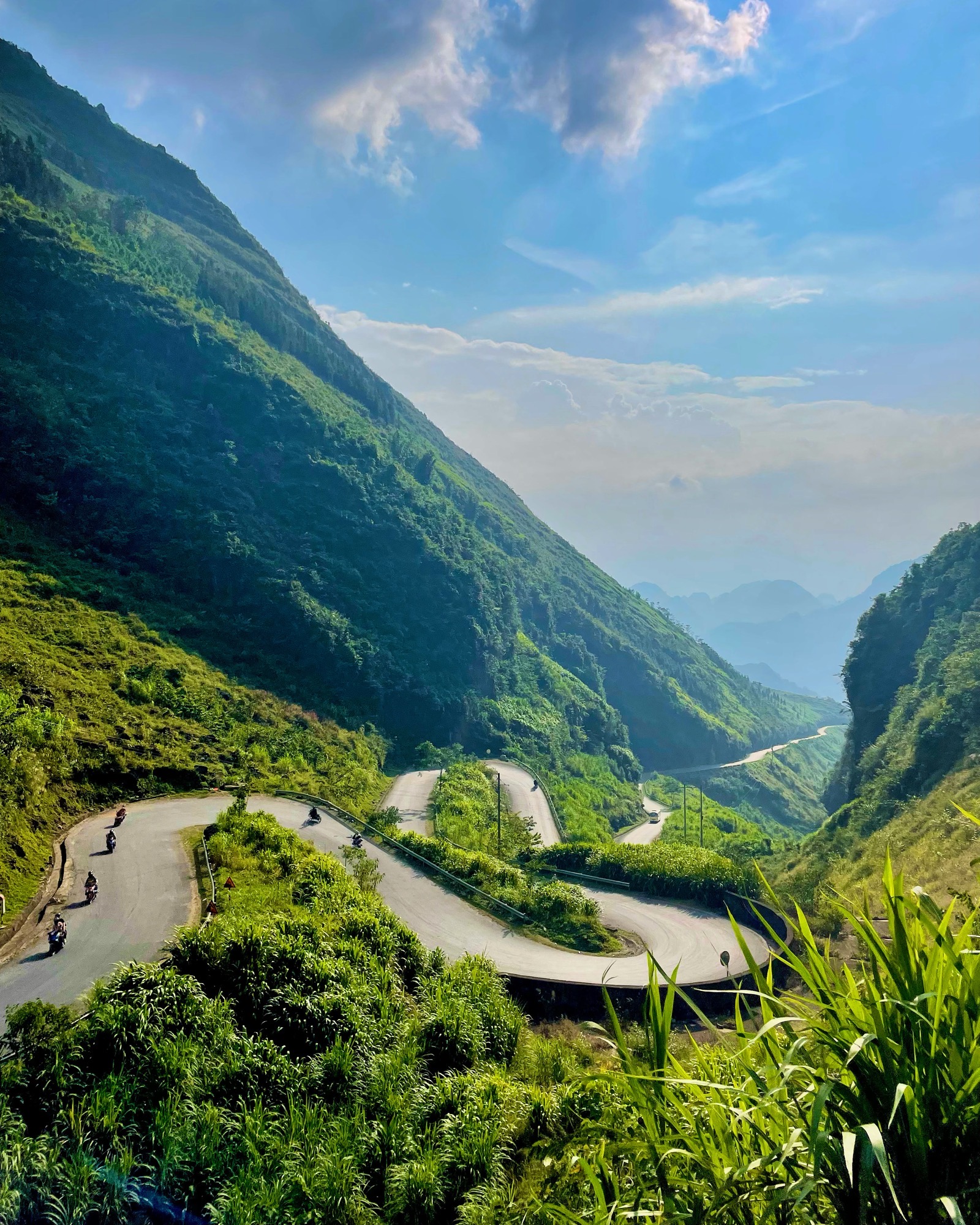
We rented a Honda XR 150 from a man who checked Lucas's riding posture before handing over the key. No paperwork, no deposit, just a look that said: if you drop it, you pay. Fair enough. The bike had 38,000 kilometres on it and a horn that worked better than the brakes, which is exactly the right ratio for northern Vietnam.
The first pass out of Hà Giang city sets the terms. The road narrows to a single lane cut into limestone, the drop is unmarked, and the trucks — always trucks — take the turns wide. The landscape is karst plateau: grey rock, green valleys, terraced hillsides that the Hmong have been farming on gradients that would make a European surveyor refuse the contract. We stopped at a point where the road bent around a cliff face and the Nho Quế river appeared three hundred metres below, the colour of jade, and perfectly still.
You are not looking at scenery. You are looking at what someone risked to build a connection between two valleys that had none.
Đồng Văn sits at the centre of the loop, a town built in stone and altitude. The old market quarter dates from the early 1900s — grey walls, tiled roofs, courtyards that face inward. On a Sunday, the market fills with Hmong, Tày, and Dao families who have walked for hours to trade. Nobody sells souvenirs. The goods are livestock, fabric, tobacco, and rice wine served in plastic bottles. A woman sold us two ears of grilled corn for 10,000 đồng and refused to make change for 20,000. We ate both standing up.
The Mã Pí Lèng pass is the reason people ride the loop and the reason some people stop. The road was built by hand in the early 1960s by youth volunteers, thousands of them, working with chisels and dynamite along a cliff face that drops a thousand metres to the river below. A plaque at the top records the names of those who died during construction. We parked the bike and sat there for twenty minutes without speaking. Not because the view demanded silence — it is spectacular, obviously — but because the effort behind the road reframes the view. You are not looking at scenery. You are looking at what someone risked to build a connection between two valleys that had none.
Below the pass, Mèo Vạc is quieter and less visited. The guesthouse had concrete walls, a fan, and a balcony facing a valley so deep that the morning fog took until 10 AM to burn off. The woman who ran it cooked us phở for breakfast with herbs from a garden behind the kitchen, and when Lucas asked what was in it she listed fourteen ingredients, including a root she kept in a jar by the stove. She told us the Hmong name but said there was no word for it in Vietnamese. People just pointed.
The return leg follows a different valley — less dramatic, more agricultural. Buffalo in the road. Children walking to school along the verge in groups of three or four, uniforms pressed, backpacks too large for their frames. A mechanic in Yên Minh tightened our chain, charged nothing, and asked where we were from. When Marie said France, he said he had a cousin in Bordeaux, which may or may not have been true but was said with complete conviction.
We returned the bike with 700 new kilometres on it. The owner checked the tyres, the mirrors, the underside. Then he nodded — the same single dip of the chin — and that was the inspection complete. Four days, no GPS, no guide, no plan beyond the next town.