The taxi driver studied the hand-drawn map for forty seconds without speaking. Then he nodded — a single, precise dip of the chin — shifted into gear, and navigated for twenty minutes through streets without signs, past houses without numbers, to a wooden gate that had no sign. This is how you arrive at a ryokan that has never needed a website.
The building was three hundred years old and smelled of hinoki cypress and the particular stillness of wood that has been polished by hands rather than machines. Our shoes were removed at the entrance, placed in a cubby by a woman whose bow lasted exactly the right length of time — long enough to mean it, short enough to avoid theatre. The tatami room was bare except for a low table, a scroll painting of a crane, and a window that framed a garden so precisely composed it looked like a photograph of itself.
Fuji stood clear in a sky the colour of weak tea, its snowcap catching the first light. We watched until the clouds came back. It was enough.
Dinner was kaiseki: fourteen courses served over two hours, each one a season. A clear broth with a single chrysanthemum petal. Grilled sweetfish from the river we could hear through the shoji screen. A persimmon carved into the shape of a maple leaf — because it was October and in Japan even fruit observes the calendar. The chef appeared once, at the end, and bowed without waiting for compliments. We tried to say something. He was already gone.
Kyoto outside the ryokan operated on a different register. The Fushimi Inari shrine at five in the morning, before the crowds: ten thousand vermillion torii gates climbing a mountain, forming a tunnel of red and silence that compresses your sense of time until you forget whether you have been walking for twenty minutes or two hours. We reached the summit and a woman was sweeping the steps with a bamboo broom. She had started at four.
In Gion, the geisha district, we saw a maiko — an apprentice geisha — crossing from one teahouse to another at twilight, her white face catching the light from a paper lantern. She moved with a speed that contradicted her costume, wooden geta clicking on stone, and disappeared through a doorway before we could do more than register the fact. Gion remains a working neighbourhood. The work happens to be the preservation of an art form that is over three centuries old.
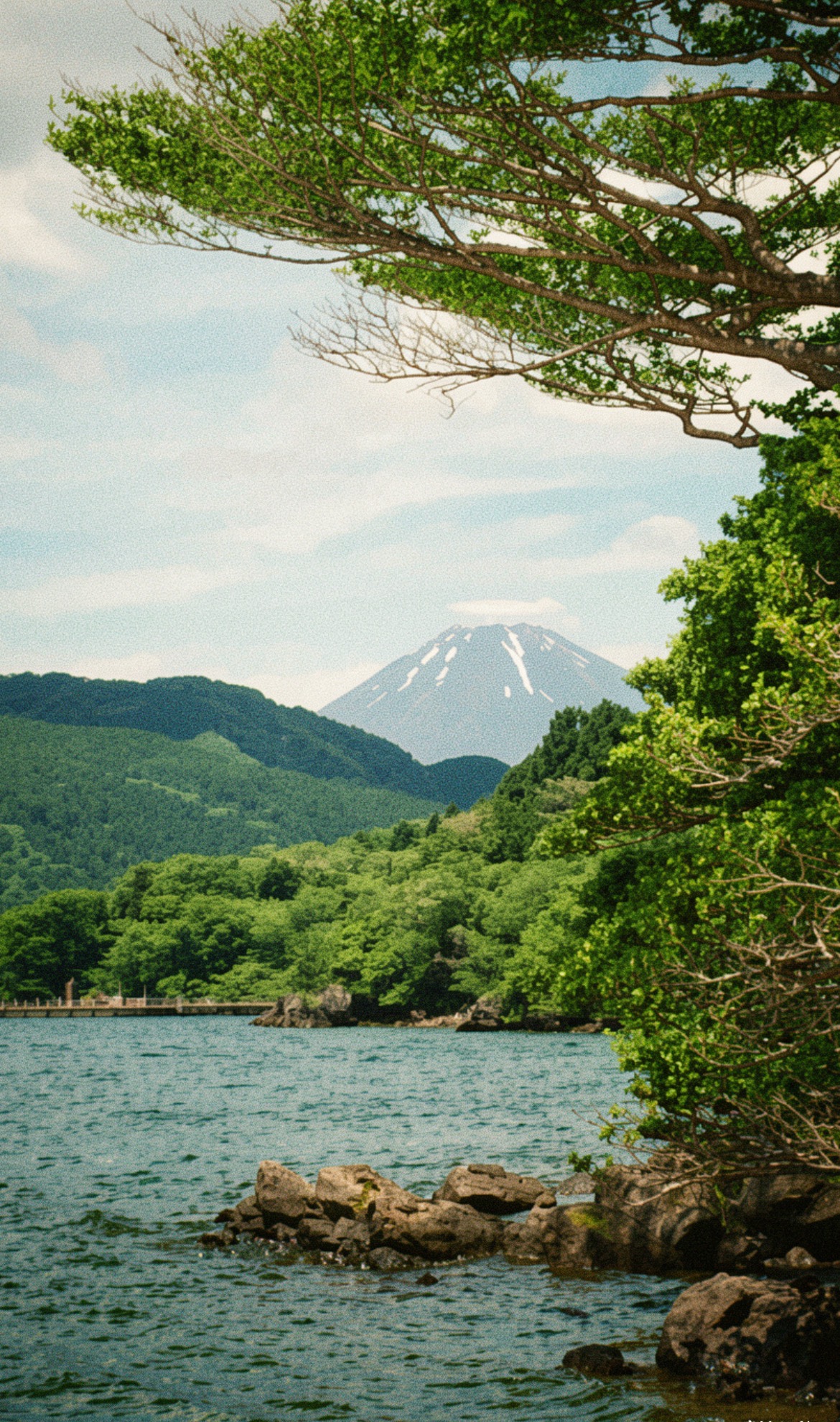
We took the shinkansen east to Mishima, where the platform empties and the mountains begin. From there we transferred to the Fujikyu line, a local train that climbed slowly through cedar forests and into a silence that deepened with every station until we reached Kawaguchiko, on the northern shore of the Fuji Five Lakes. When we stepped out, the air was cold, clear, and tasted of altitude. And there it was — Fuji, so perfectly symmetrical it looked like a drawing someone had pinned to the sky. The lake reflected it whole, upside down, and for a few seconds neither version seemed more real than the other.
We spent two days at Kawaguchiko. Walked the northern shore in the early morning when mist sat on the water and the mountain appeared and disappeared like something deciding whether to stay. Rented bicycles and rode to Ōishi Park, where the last of the autumn cosmos were still in bloom against the volcanic cone. Ate hōtō — thick flat noodles in a miso broth heavy with pumpkin — at a restaurant where the window framed Fuji so precisely it felt staged, except that every window in this town frames Fuji, because the mountain is the reason the town exists.
What surprised us was the patience. Fuji reveals itself on its own schedule. Clouds gather by mid-morning, wrap the summit, and the mountain vanishes for hours. Locals barely glance up. They have learned what visitors struggle to accept: that the view is not guaranteed, and the waiting is part of the experience. On our second morning, we woke at five and walked to the lakeshore. Fuji stood clear in a sky the colour of weak tea, its snowcap catching the first light. We watched until the clouds came back, which took forty minutes. It was enough.
The shinkansen took us to Tokyo in under two hours. Tokyo is the opposite of Kyoto in almost every measurable way — louder, taller, faster — and yet the same principles apply. The ramen shop in Shinjuku had nine seats and one rule: eat in silence. The tsukemen was perfect. The chef watched each bowl leave the counter the way someone watches a taxi pull away with their luggage.
We spent our last morning at Meiji Shrine, a Shinto sanctuary buried in a forest in the centre of the city. The gravel path was raked. The torii gate was made from a 1,500-year-old cypress. A wedding procession passed us — the bride in white, a Shinto priest leading, the guests walking in formation — and the forest closed behind the procession and the only sound left was the river.