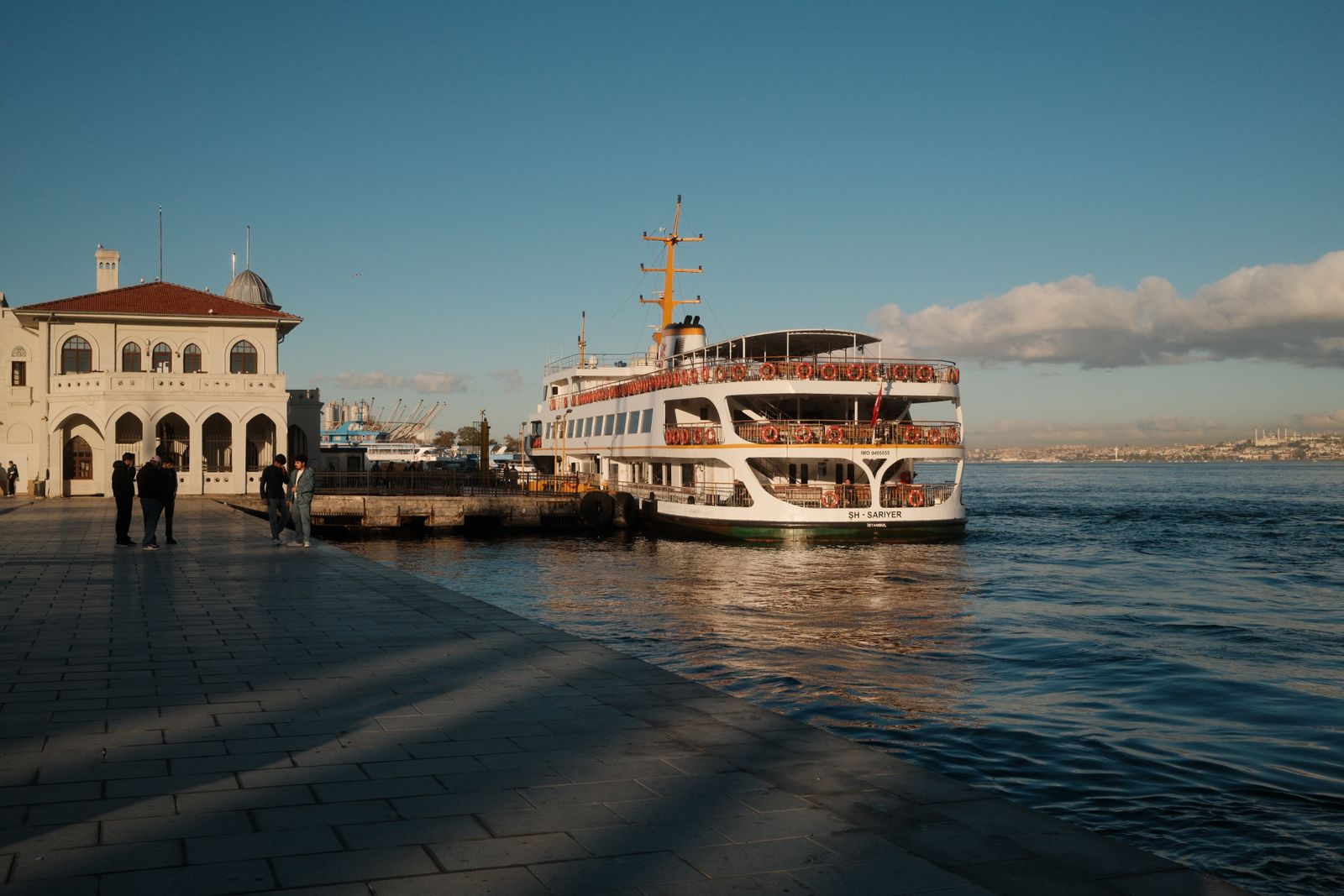
Istanbul is the only city on Earth that straddles two continents, and the crossing costs the price of a ferry ticket — less than two euros to go from Europe to Asia and back, as many times as you like, in an afternoon. We did it twice, once for the Bosphorus view of the Hagia Sophia and the Blue Mosque from the water, and once simply because we could, drinking çay from a tulip-shaped glass on the open deck both times. The ferry was full of commuters who treated the continental divide the way Londoners treat the Thames — an inconvenience between home and the office, not a geographical event. Seagulls followed the wake. A fisherman on the Galata Bridge below cast his line without looking up as we passed beneath him.
The Hagia Sophia has been a Byzantine cathedral, an Ottoman mosque, a secular museum, and, since 2020, a mosque again — a building that has changed its own purpose four times in fifteen hundred years without ever losing the argument for its own importance. Its dome, nearly a thousand years older than the one in Florence that supposedly inspired the Renaissance, still holds Christian mosaics beside Islamic calligraphy roundels, the two traditions coexisting under a curtain that's drawn or opened depending on the hour of prayer. We stood in the nave for twenty minutes, necks craned, trying to understand how sixth-century engineers held that much stone in the air without steel reinforcement. The answer, as near as we could tell, involves pendentives, divine ambition, and a refusal to accept the word impossible from a structural perspective.
Istanbul is the only city we know where you can eat a mackerel sandwich by the water and see two continents while you chew.
The food alone would justify the trip. We ate a breakfast of menemen — eggs scrambled with tomatoes and peppers in a copper pan — at a lokanta in Karaköy where the cook worked three pans simultaneously and never once looked hurried. For lunch, a balık ekmek, a grilled mackerel sandwich, from a stall by the Eminönü waterfront where the queue moved quickly, the way it does when everyone already knows the price. The simit sellers appeared at every corner, their circular bread coated in sesame seeds, sold from carts that seem not to have changed design since the Ottoman period. Turkish food does not try to be clever. It picks three good ingredients and treats them seriously. That is enough.
The Grand Bazaar, sixty-one covered streets and four thousand shops, is the ancestor every modern shopping mall owes a debt to and has never repaid with equivalent craft. We watched a coppersmith in a stall his family had run for four generations, hammering a bowl by hand at a speed that made the finished product look, absurdly, easy. Two streets over, a carpet seller poured us tea and talked for forty minutes about Anatolian weaving traditions before mentioning, almost as an afterthought, that he also sold carpets.
Cappadocia, an hour's flight from Istanbul, is a landscape that looks digitally rendered until you're standing in it — fairy chimneys, cone-shaped rock formations carved by volcanic ash and millennia of erosion, riddled with cave dwellings and underground cities that sheltered entire populations from invasion, some of them eight storeys deep. We descended into Derinkuyu, the deepest of the underground cities, through passages so narrow we turned sideways, past ventilation shafts and stone doors designed to roll shut from the inside. Eight floors below the surface, in a chapel carved from solid rock, the air was cool and still, and it was easy to understand why entire communities chose to live here for months rather than face what waited above. We stayed in a cave hotel carved into the same soft tuff rock, and woke at 5 AM to a hundred hot air balloons rising simultaneously over the valley, a sight so improbable that our first instinct, both mornings, was to check whether it was really happening.
Turkey holds Byzantium and the Ottoman Empire, Europe and Asia, and a geology that predates all of it, in a single country that refuses to simplify itself into one identity for the sake of a traveller's convenience. We left with more questions than answers, which is probably the point.