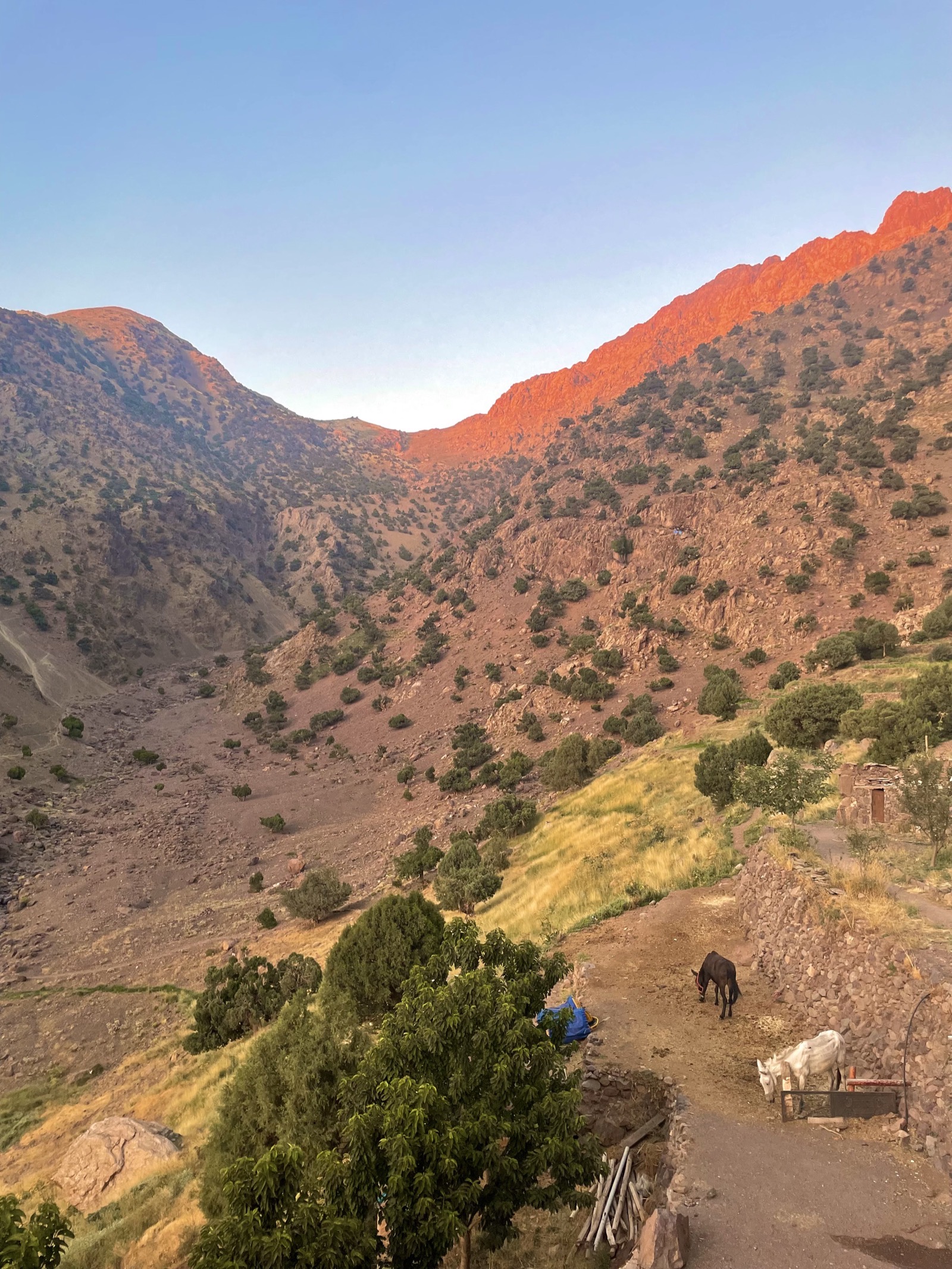
Jebel Toubkal is the highest peak in North Africa and the most democratic of the Atlas summits — you don't need ropes or crampons in summer, only legs and a tolerance for scree that stretches above you like a staircase designed by someone who hated knees. At 4,167 metres, it is not Himalayan altitude. But it is enough to change the conversation between your lungs and your ambition. The mountain sits sixty kilometres south of Marrakech, close enough that you can leave the medina at breakfast and be above the treeline by lunch. The proximity is the trick — it invites people who wouldn't ordinarily call themselves mountaineers, and then it teaches them what the word means.
We started from Imlil, a Berber village at 1,740 metres where the mule drivers drink mint tea in the square and assess your pack weight with a glance that is simultaneously an offer and a judgement. We carried our own. This was, we learned by hour three, a decision born of pride rather than wisdom. The mules passed us at every switchback, carrying twice the load at twice the speed, the drivers singing. The trail from Imlil follows the Mizane Valley through walnut groves and terraced fields where irrigation channels cut by hand centuries ago still feed the plots below. The villages along the way — Aroumd, Sidi Chamarouch — are stone and mud, built into the hillside with a compactness that wastes nothing, the flat roofs doubling as drying racks for walnuts and saffron.
At 4,167 metres, it is not Himalayan altitude. But it is enough to change the conversation between your lungs and your ambition.
The Toubkal Refuge sits at 3,207 metres in a cirque of rust-coloured rock. The bunks are narrow. The dinner is tagine — lamb, potatoes, preserved lemon, cooked over a gas ring in a kitchen the size of a cupboard, and somehow better than any tagine we'd eaten at altitude had a right to be. The warden, a man from the valley who spent seven months of each year at the refuge, kept a logbook of summits and weather that read like a novel in shorthand. The stars, when you step outside at midnight, are the Atlas stars — so dense above the High Atlas that the Milky Way casts a shadow. We stood there in down jackets and sandals, watching Orion hang above the summit like a signpost.
Summit day is four hours of scree, switchbacks, and the slow discovery that 4,000 metres is not 3,000 metres with a number change. The air subtracts. Each step is a negotiation. The scree is the worst part — loose, ankle-deep, sliding back half a step for every step forward, terrain that turned a four-hour climb into a five-hour argument with gravity. But the summit, when it arrives, is a flat platform of rocks with a triangulation pillar and a view that stretches from the Sahara to the Anti-Atlas, from Marrakech's haze to the snow on M'Goun. We sat there for forty minutes. Nobody spoke. There was nothing to add.
The descent to Imlil took three hours, and the knees that had been cooperative on the way up staged a quiet revolt on the way down. By the time we reached the village, the hammam was open, the mint tea was waiting, and our legs had developed a tremor that would last two days. The hammam was a stone room with a wood-fired boiler and water so hot it turned the air opaque. We sat on the tile floor and let the heat do what ibuprofen couldn't. A Berber woman at the guesthouse asked where we'd been. We pointed up. She nodded. She'd lived beneath that mountain her entire life and had never climbed it. Why would she? She already knew what was up there. The view.