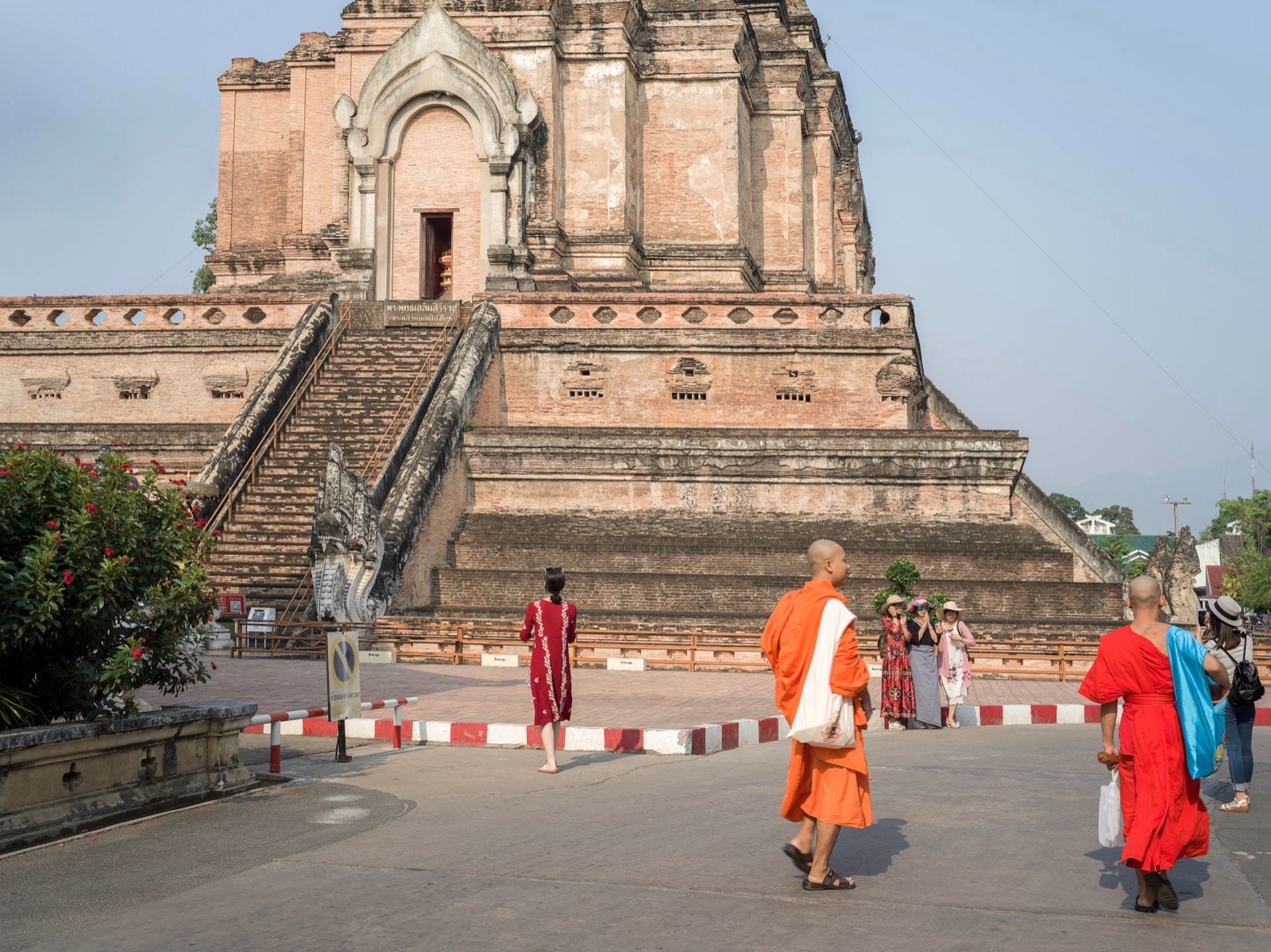
Chiang Mai's old city is a square drawn by 14th-century engineers and still, remarkably, respected by 21st-century traffic. Inside the moat, motorbikes slow down. Something about the geometry insists on it. We stayed inside the walls, in a teak house behind Wat Phra Singh, and woke each morning to the sound of monks receiving alms — rice, not money, offered in a transaction that predates every app now trying to digitise generosity. The alms round begins before six. Orange robes move single file along streets still wet from the night, and the kneeling donors — mostly women, mostly elderly — place sticky rice into each bowl without eye contact, the exchange conducted in a silence that feels negotiated over centuries.
The food here has a different logic than Bangkok's. Northern Thai cuisine, Lanna cuisine, leans on fermentation, bitterness, and herbs that don't travel south. At a shophouse with six plastic stools and no sign, a woman served us khao soi — egg noodles in a coconut curry broth, crispy noodles on top, a squeeze of lime insisted upon rather than offered — and Lucas said it made every khao soi he'd eaten in Europe seem like a rumour of the real thing. We went back the next day and the day after. The broth had been simmering since before dawn each time, the woman stirring it slowly, eyes half-closed, one hand on the ladle and the other holding her phone. At the Sunday walking market on Ratchadamnoen Road, we ate sai ua — northern sausage, pork pounded with lemongrass and galangal — from a grill tended by a man who spoke to no one but watched every customer's first bite with a focus that was its own form of conversation.
Thailand contains both arguments comfortably.
We drove north to Chiang Rai on the White Temple pilgrimage everyone makes, and it's worth making — Wat Rong Khun is genuinely startling, a Buddhist temple built entirely in white and mirrored glass by an artist still alive and still adding to it. The bridge leading to the entrance is flanked by hundreds of plaster hands reaching up from below, a vision of hell that the artist, Chalermchai Kositpipat, insists is not religious but personal. But the detour we didn't expect to love was Baan Dam, the Black House: a compound of dark teak structures filled with animal bones and skins, built by a different artist as a deliberate rebuttal to the White Temple's purity. One building houses a table made from a single buffalo hide stretched over teak. Another holds crocodile skulls in rows, labelled by species, the largest one longer than my arm. Thailand contains both arguments comfortably.
In the hills above Chiang Rai, a hill-tribe cooperative runs a coffee farm at 1,200 metres where Akha farmers, once pushed toward opium cultivation by geography and poverty, now grow arabica that competes internationally. The road up was red clay and switchbacks. In the rearview mirror, the valley dropped away. We drank a cup on the terrace, roasted that morning, and the farmer who served it — a woman named Amae — talked about the shift not as a redemption story but as a business decision that happened to also be a good one. Her daughter was studying agronomy in Chiang Mai. The farm's elevation and the mist that rolled through each morning produced a natural slow-drying process that gave the beans a sweetness you couldn't engineer at lower ground.
Northern Thailand doesn't advertise itself with a beach. It doesn't need to. It has mountains, mist, a cuisine that rewards a slower fork, and a way of feeding people that makes you wonder why you ever ate khao soi anywhere else. On our last morning, we walked the old city walls at dawn — the moat reflecting the temples, a dog asleep on the stone rampart — and Marie said she could live here. She was not joking.