At Cairo the Nile is infrastructure — wide, brown, crossed by bridges that tremble with traffic. At Luxor it becomes a sentence: deliberate, unhurried, leading somewhere. We arrived by train from Cairo, a journey of nine hours through a delta that compressed all of Egyptian agriculture into a green strip between two deserts, and the conductor woke us at Luxor by tapping the compartment door with a precision that suggested he had been waking travellers at this exact station for decades.
The Valley of the Kings is on the west bank of the Nile, the side where the sun sets, which is why the ancient Egyptians buried their dead there. The logic is impeccable: life rises in the east, sets in the west, and the tombs follow the metaphor into the hillside. We descended into the tomb of Ramesses VI, a corridor of painted walls so vivid they looked wet, the ceiling covered in astronomical charts that described the passage of the sun through the underworld with a detail that modern astronomers still consult. The air was hot and close and smelled of limestone and time.
They have been watching the sunrise for 3,200 years. They looked patient.
The Karnak Temple complex is not one temple but thirty, built over two thousand years by pharaohs who each added a court, a pylon, or an obelisk in the ancient Egyptian equivalent of a building competition. The Hypostyle Hall — 134 columns, each twenty metres tall, carved with hieroglyphs from floor to ceiling — creates a forest of stone that reduces the human figure to a footnote. We spent two hours there and used up an entire notebook. The scale is beyond description but not beyond experience: you feel it in your neck, tilted back, and in the dust that falls from the carvings when the wind moves through.
Islamic Cairo is the antidote to the pharaonic. The Khan el-Khalili souk is copper, spice, and salesmanship, but turn two corners past the tourist corridor and you are in a medieval street where a man is shaping brass with the same tools his grandfather used. The Al-Azhar Mosque, a thousand years old, smells of rosewater and warm stone, and the courtyard is the quietest place in a city of twenty million people. A student was reading the Quran in a corner, cross-legged on a carpet, and the sound carried across the marble and filled the dome without an echo.
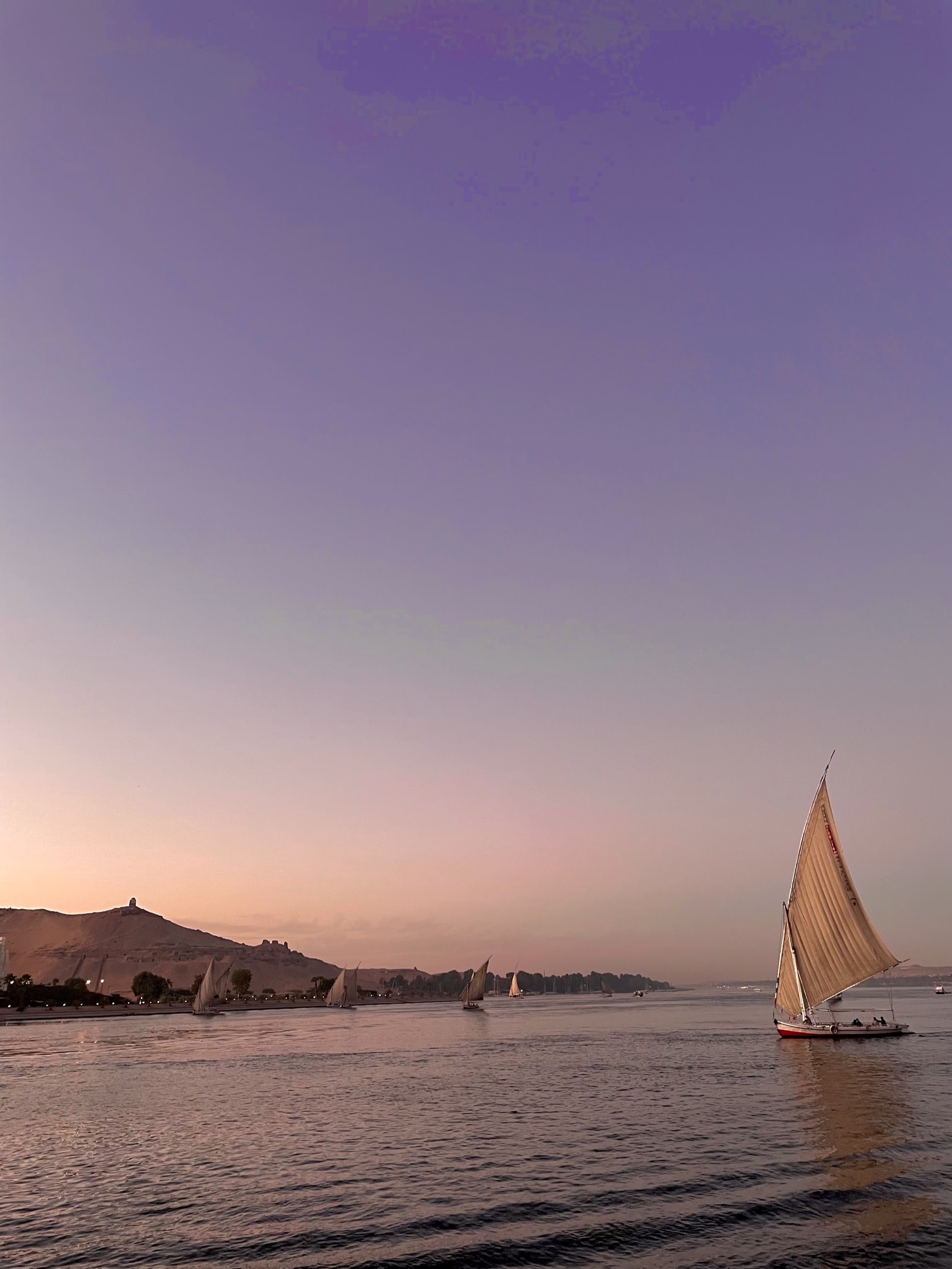
The train south follows the Nile and so does the temperature. At Aswan the river narrows and the sandstone turns pink and the feluccas move with a silence that feels chosen rather than accidental. We sailed to Elephantine Island at sunset and watched the light do something to the water that no photograph has ever captured and none ever will. The Nubian villages on the west bank are painted in blues and yellows that seem improbable against the desert until you realise they are the only colours strong enough to hold their own against the sand.
Abu Simbel at dawn is worth the 3 AM alarm, the three-hour drive through absolute desert, and the military checkpoint where a soldier examined our permits for three full minutes, turning each page twice. The four colossi of Ramesses II face east. They have been watching the sunrise for 3,200 years. The interior of the temple narrows to a sanctuary where, twice a year, the sun penetrates sixty-five metres of stone to illuminate the faces of four seated gods. The engineering required to achieve this alignment predates the telescope by three millennia. We stood in the sanctuary and waited, but it was not the right day. The sun stopped short by two metres. We would have to come back.
We left Egypt from Aswan, by plane, and the desert from above was a tan surface crossed by a single green line — the Nile, still doing what it has done for five million years, bringing water to a country that exists because of it and for no other reason. Nine days south, and every one of them had made us feel simultaneously older and smaller. Three thousand years of civilisation on display, and you walk through it knowing your own century will leave nothing half as good.