Zanzibar's Stone Town smells of clove, diesel, and salt. The doors are carved from teak and studded with brass — there are over five hundred of them catalogued, each one different, each one a record of the family behind it: Arab motifs for the oldest houses, Indian carved lotuses for the merchant families, plain heavy wood for the Swahili traders who were here before anyone else arrived. Behind every door, a courtyard you weren't expecting. Stone Town teaches you to stop reading facades and start walking through them.
The island is the entry point to a coast that has been trading with Oman, India, and Persia for a millennium. You feel this in the food — a biryani that owes nothing to Britain, a pilau spiced with cardamom from the plantation down the road, a coconut bean soup served in a clay bowl on a bench outside a house whose walls are coral. The Forodhani night market bears no resemblance to a European market; it's a negotiation conducted in smoke and fluorescent light over skewers of octopus and Zanzibar pizza — a thin crepe folded around egg, minced meat, and whatever the cook decides. We went three evenings in a row and ordered differently each time. The last evening, the cook chose for us and was right.
The summit is not beautiful in any conventional sense — it's lunar, cold, and the light is the thinnest you've ever seen.
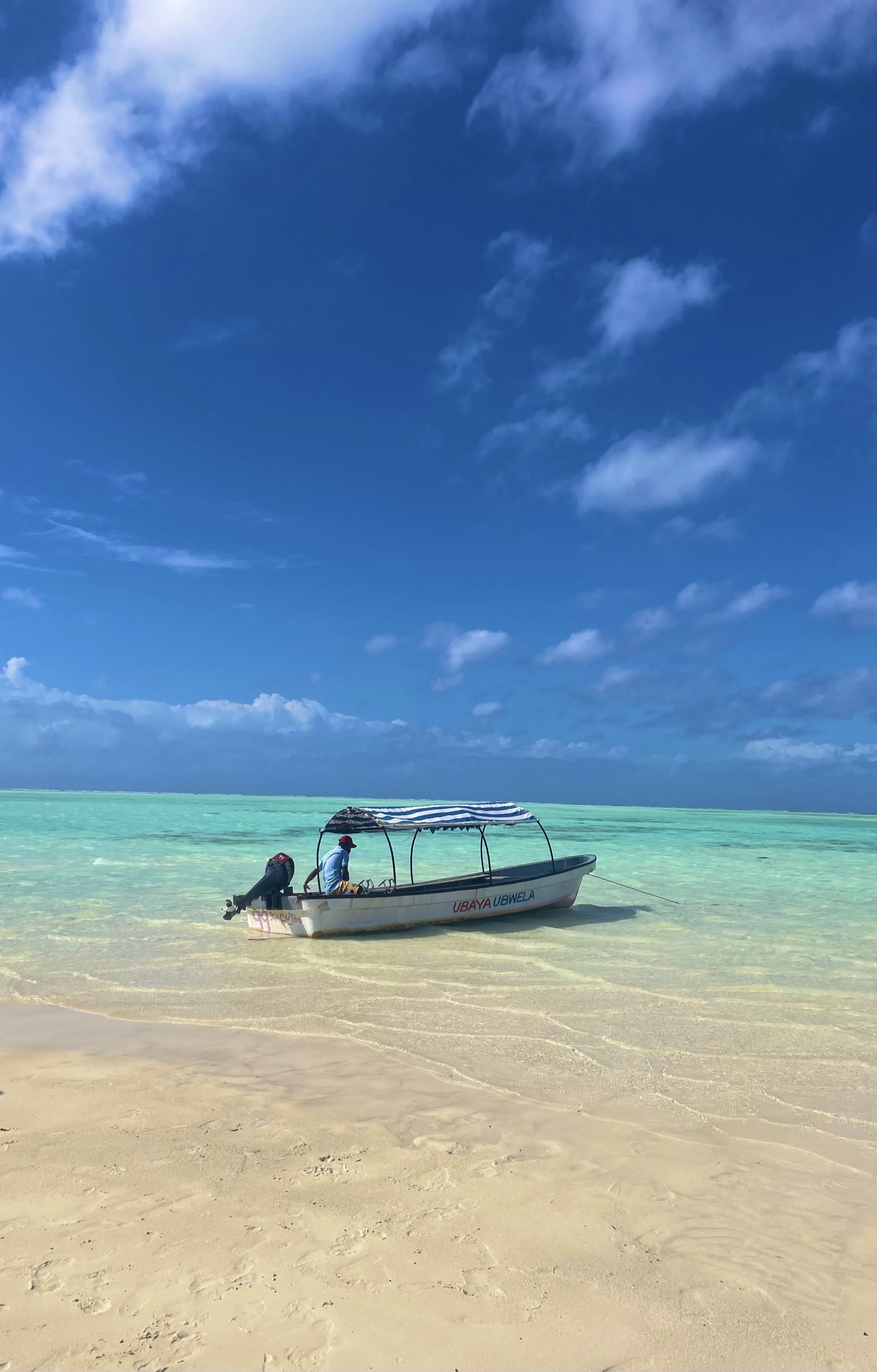
We took a dhow to Chumbe Island, a marine reserve with seven bungalows and a reef that looked like an aquarium that had never seen a human hand. The crossing took forty minutes on water so clear the seabed scrolled beneath us like a slow film. The snorkelling was so good it made us angry at every reef we'd seen before. There's a coral called brain coral for obvious reasons, and off Chumbe it grows the size of a washing machine. Parrotfish moved through the reef in groups, unhurried, a calm that only exists in water where no one has dragged a net. The bungalows run on rainwater and solar; there is no hot shower, no air conditioning, and no reason to want either.
We spent a morning at a spice farm outside Stone Town — not the tourist version with a guide reciting Latin names, but a working plantation where a man named Hamisi picked us a nutmeg, cracked it open, and explained the economics: the whole fruit sells for less than the jar of ground spice costs in a London supermarket. Clove trees lined the path, their buds drying on tarps in the sun, and the air was so heavy with scent that you could taste it. Vanilla orchids climbed the trunks of coconut palms. Hamisi's daughter, who was studying agriculture in Dar es Salaam, joined us for lunch and talked about yield models with the same ease her father talked about rainfall.
Kilimanjaro was a different conversation. Five days of walking through climate zones that compress what normally takes five thousand kilometres of latitude into five thousand metres of altitude. Rainforest. Moorland. Alpine desert. Glacier. The porters carried our packs and their own, singing on the ascent in a Chagga dialect we couldn't follow but whose rhythm set the pace better than any metronome. The summit at Uhuru Peak at dawn is not beautiful in any conventional sense — it's lunar, cold, and the light is the thinnest you've ever seen. But you are standing on the roof of a continent, and that fact is its own aesthetic.
Tanzania holds these two experiences — the coast and the summit — close enough that you can do both in a single trip and far enough apart that they feel like different countries. Zanzibar hums. Kilimanjaro is silent above the tree line. One feeds you clove-scented tea on a rooftop; the other hands you a thermos of instant coffee at four in the morning and asks you to keep walking. We did both in ten days and still feel like we visited two different countries.