Grindelwald smells like cut grass and diesel from the Jungfrau railway. The Eiger shows up behind the village like it has nowhere else to be. We arrived from Bern on a 9:32 InterCity, changed once at Interlaken Ost, and stepped out at 11:14 — two minutes ahead of what I had mapped, which the man at the ticket counter corrected to exactly on time. The 11:14 was the scheduled arrival. Swiss Rail does not run early. That would be a different kind of disorder.
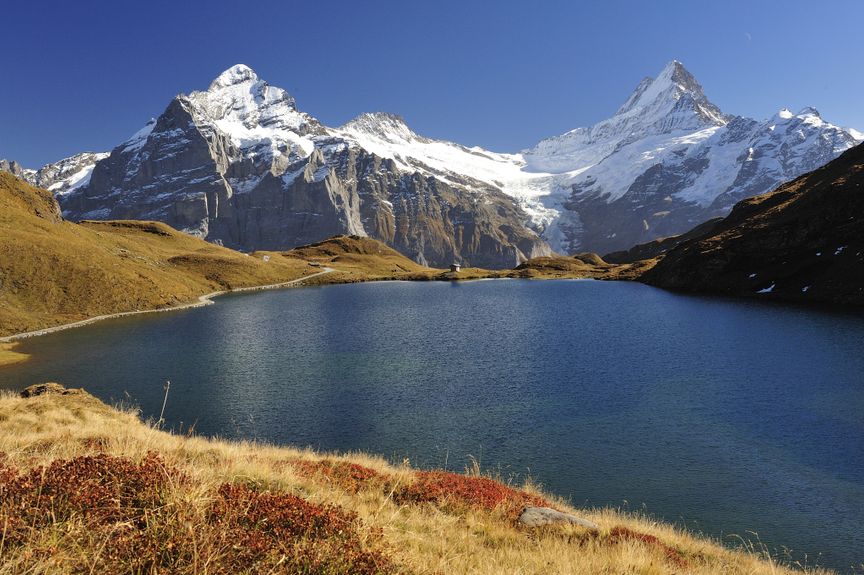
The hike from First to Bachalpsee is marked as two hours return. It took us two hours and forty because we stopped at the Berghaus where they sell Rivella and Nussgipfel for 4.50 CHF each and the terrace faces the Schreckhorn. The lake, when we reached it, was so flat that a French couple stood at the edge arguing quietly about whether the reflection or the actual summit was sharper. We did not settle the question. The water was five degrees and Lucas went in anyway.
She said I was tasting white flowers. She said wrong, you are tasting altitude.
Zermatt bans cars. Electric taxis hum through the main street at walking speed, carrying luggage to hotels that charge 480 CHF for a room with a Matterhorn view and 320 for one without. We paid the 320 and walked two minutes to a bench where the view was free. The Matterhorn at sunset turns from grey to gold to pink in about twelve minutes. We timed it. A Japanese photographer next to us had been timing it for three days and said Tuesday was the best so far. It was Wednesday.
The Valais is where Switzerland turns southern. The vineyards above Sion climb terraces so steep that everything is done by hand — no tractor fits. In Fully, a vigneronne named Madeleine poured us a Petite Arvine and asked what we tasted. I said white flowers. She said wrong, altitude. Each terrace sits at a different height above the Rhône, and each one produces a different wine. By the third glass — an Humagne Rouge, 28 CHF the bottle — the theory felt less like poetry and more like geology. Almost none of this wine leaves Switzerland. The Swiss drink it themselves and do not feel guilty about it.
In Gruyères, a man at the fromagerie spent eleven minutes explaining the difference between a twelve-month and an eighteen-month Gruyère. He made us taste both. Then he made us taste them again, this time with the eighteen-month on the left. He was right, the order mattered. The fondue that evening — at a restaurant called Le Chalet, where the copper pot looked older than the building — cost 29 CHF per person and came with enough bread to feed four. We were two. We finished it.
The last Matterhorn Gotthard Bahn from Zermatt left at 18:02. The valley darkened behind us. The woman across the aisle was knitting a sock. The conductor stamped our tickets without looking up. We arrived in Visp at 19:23, which is exactly what the display at Zermatt had said, and nobody on the platform seemed to find this remarkable. We were beginning to understand why.