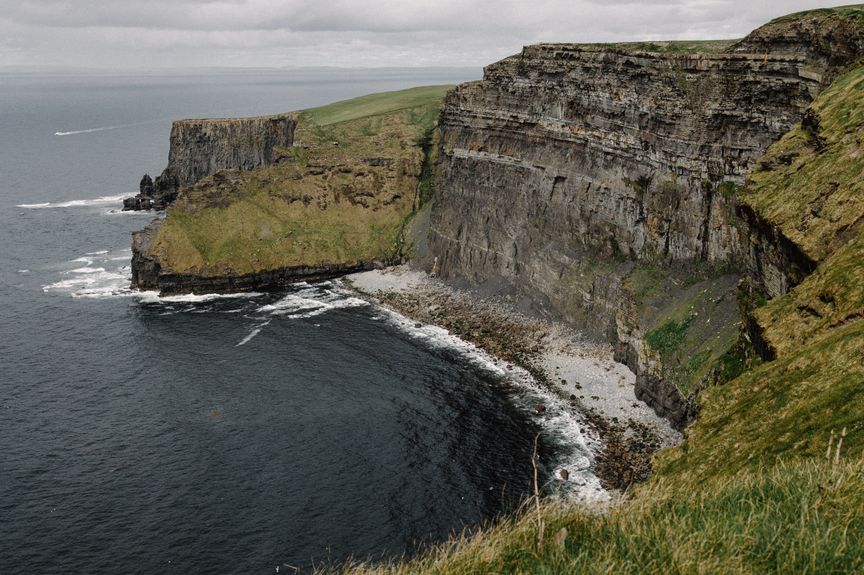
The Cliffs of Moher drop two hundred metres into the Atlantic straight down into the Atlantic, two hundred metres of limestone and nothing after that for five thousand years and has decided it is not going to blink. The wind arrives horizontally. The grass leans inland. The tourists lean into the wind and the wind wins. We drove from Galway along the coast road, where the Burren — a karst landscape of cracked limestone that looks like the surface of a planet where nothing grows — gives way, without warning, to the cliffs, and the Atlantic below is the colour of pewter and twice as heavy.
Galway runs on its own clock — buskers on Shop Street at noon, oyster bars by the Spanish Arch at four, and pubs that fill from six and empty around the time you stop checking. The shop fronts are painted in colours that suggest a municipal agreement to remain cheerful regardless of weather. The buskers on Shop Street play with a talent that other cities would put on a stage but that Galway, characteristically, puts on the pavement. We ate oysters at a bar by the Spanish Arch where the shells were opened with a speed that suggested the oysters had agreed to cooperate, and the stout — poured slowly, tipped at an angle, left to settle, and topped with a dome of cream that the barman shaped like a signature — was the best we have ever had, though we say this about every Guinness we have in Ireland.
The wind arrives horizontally. The grass leans inland. The tourists lean into the wind and the wind wins.
The Connemara, west of Galway, is where Ireland runs out of hedgerows and becomes the thing the postcards promise: bog, mountain, stone wall, sheep, and a sky that changes mood every ten minutes like a weather forecast written by a dramatist. We drove Sky Road, a loop above Clifden that the guidebooks call scenic and that we would call cinematic if cinema had this many shades of grey. The Atlantic was visible from every point, and the islands — Inishbofin, Inishturk — sat low in the water, grey-green and barely there.
In the Aran Islands, reached by a ferry that pitched and rolled in a way that made the passengers rethink lunch, the stone walls outnumber the inhabitants and the landscape is so spare it looks like a drawing someone started but had the wisdom to leave unfinished. Inis Mór is seven miles long and the fort of Dún Aengus sits at its western edge on a cliff that drops vertically to the sea. The builders, three thousand years ago, did not include a railing. The Irish have not added one since. This tells you something about the Irish relationship with risk, or possibly about their relationship with railings.
Dublin, on the last two days, was the counterpoint — Georgian terraces, the Liffey, and a literary heritage so dense that you cannot walk a block without stepping on a plaque. The Long Room at Trinity College — two hundred thousand books in an oak barrel vault that stretches sixty-five metres — is what every library in the world is trying to be and none of them quite manage. The Book of Kells, in the case below, is twelve hundred years old and illuminated with a patience that the modern world has neither the time nor the gold leaf to replicate.
On the flight out of Shannon, clearing the coast, the Aran Islands were visible for a moment through a break in the cloud — three grey shapes in a grey sea, the stone walls just visible from altitude, running in lines that made no sense from above but that someone, three thousand years ago, thought were important enough to build. The cloud closed over them. The Atlantic continued.