Singapore runs on food the way other cities run on coffee. At six in the morning, the hawker centres are already loud — the clang of woks on gas, the scrape of metal spatulas against flat-tops, a woman folding roti prata at a speed that suggested she had been doing this since before the MRT existed. By seven, the tables are full. Office workers in pressed shirts sit beside construction workers in high-vis vests, eating the same plate of char kway teow from the same stall that has occupied the same three metres of counter since 1978. There is no irony in this. There is no branding. There is only the food, and the understanding that it matters.
We arrived in January, the month when Singapore's humidity reaches the point where the air itself becomes a texture. Changi Airport deposited us into a country that felt less like a country and more like a proof of concept — what happens when you engineer a city-state around efficiency, greenery, and the absolute insistence that street food is a national treasure. The taxi driver asked where we were staying. When we said Tiong Bahru, he nodded the way people nod when you have made the correct choice without needing to be told.
Singapore runs on food the way other cities run on coffee. There is no irony in this. There is no branding. There is only the food, and the understanding that it matters.
Tiong Bahru is Singapore's oldest public housing estate, built in the 1930s in an Art Deco style that the tropics have since softened into something both elegant and slightly faded. The balconies are curved. The staircases spiral. The neighbourhood has gentrified, as neighbourhoods do, but it has done so with a restraint that most cities fail to achieve — the new coffee shops occupy the ground floors of the same walk-up blocks, and the older residents still hang their laundry from bamboo poles above the street, indifferent to the flat whites being served below.
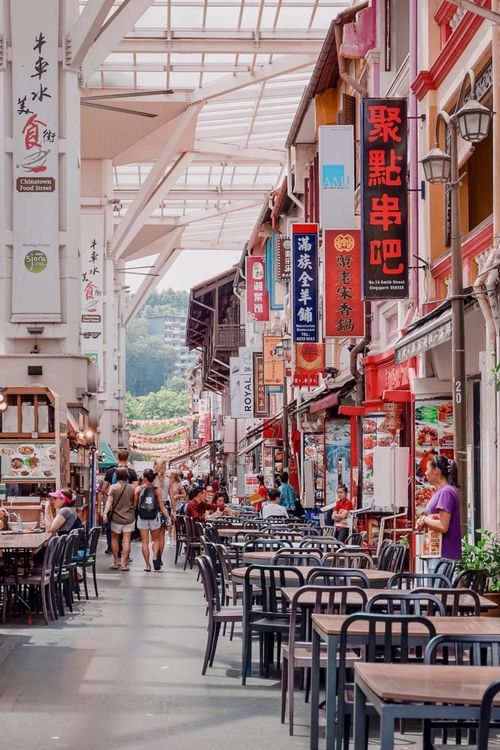
Chinatown at dusk is where Singapore stops pretending to be orderly. The streets narrow, the signage multiplies, the temples compete with the shophouses for attention, and the smell of five-spice powder and charcoal smoke settles over everything like a second atmosphere. We ate at a hawker centre on Smith Street where a man had been grilling satay for forty years. He threaded the skewers with a speed that suggested muscle memory had long since replaced thought. The peanut sauce was made that morning. It would not survive until tomorrow. This was understood to be the point.
The botanical gardens — a UNESCO site that earns its designation — are where Singapore reveals its other obsession: the choreography of nature. Every tree is accounted for. Every orchid has a file. The national flower, the Vanda Miss Joaquim, grows in a section of the garden that feels more like a cathedral than a greenhouse, the light filtered through canopies that have been growing since the colonial period decided that order was a form of beauty. We spent an entire morning there and left feeling slightly undisciplined, and slightly more aware of how we were standing.
At Maxwell Food Centre, we waited thirty minutes for Tian Tian chicken rice. The rice is cooked in chicken fat and pandan leaf. The chicken is poached at a temperature that the stall owner adjusts by instinct, not by thermometer. The chilli sauce is the colour of a sunset and has the complexity of a sauce that has been refined over three generations of family argument. We ate it standing up because the tables were full, and it was worth every minute of the wait and every degree of the heat.
On the last evening, we sat at Lau Pa Sat while the satay smoke drifted across the tables and the office towers of Raffles Place lit up behind the cast-iron arches of the market. A man at the next table was eating char kway teow in complete silence, bent over the plate, not looking up once. His colleague was on the phone, switching between Mandarin and English mid-sentence. The chilli sauce between them had been refilled twice. Nobody was in a hurry. The air conditioning was off because we were outside, and the heat was the kind that settles on your skin and stays, and the food was good enough that it did not matter.