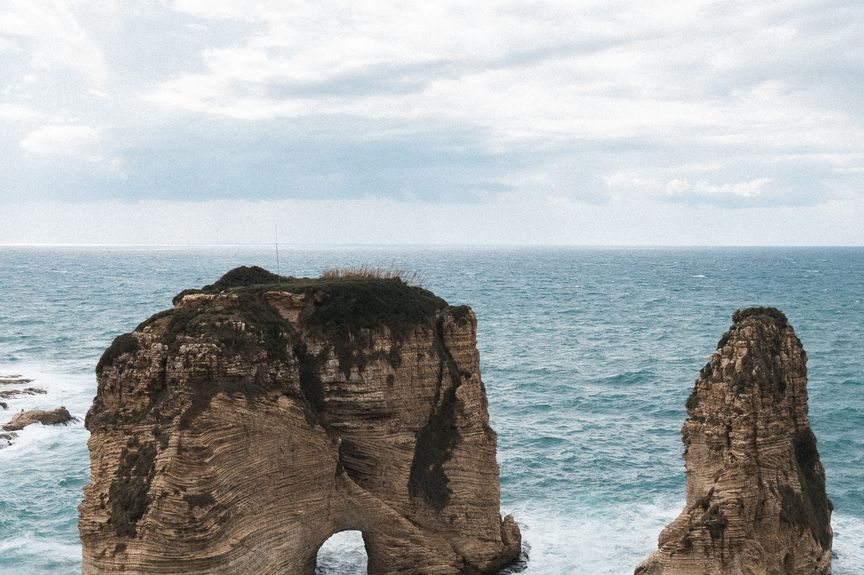
We landed in Beirut at midnight and the city was still eating. The taxi crossed a skyline built in layers — Ottoman stone under French ironwork under concrete under cranes — and the driver had Fairuz turned up loud enough to settle any question about whether the song was optional. It was not. At every red light, the car next to us had the same station on.
Gemmayzeh and Mar Mikhael slope down toward the port in a tangle of scarred facades and new paint. Some buildings carry shrapnel marks from 2020. Others wear older damage that nobody explains unless you ask. But the bars are open late, the galleries keep strange hours, and by five in the morning the bakeries are pulling manoushe off the oven — flatbread folded around za’atar and olive oil, eaten standing on a pavement that smells of jasmine and diesel. We went back every morning. The queue never got shorter.
A mezze in a village restaurant in the Chouf arrived in seventeen dishes we hadn’t ordered, and all of them were correct.
Byblos — Jbeil in Arabic — sits forty minutes north and claims to be one of the oldest continuously inhabited cities on earth. The Phoenician port is an excavation where Crusader walls rest on Roman columns that rest on Bronze Age foundations, and the fishing harbour below still hauls in its catch as though nothing since the cedar trade has been worth adjusting for. A fisherman mending a net told us his family had been here since before the Ottomans. He said it the way you’d say you had milk in the fridge — a fact, not a boast.
The Chouf Mountains, southeast of Beirut, are where Lebanon turns vertical and quiet. The cedar reserve holds some of the last old-growth cedars in the country — the tree on the flag, the one that shows up in every origin story from Solomon’s temple to the Phoenician shipyards. We walked for two hours among trunks that were growing before most European borders were drawn, their roots deep in the limestone with no apparent intention of letting go.
In Baalbek, in the Bekaa Valley, the Roman temples are built at a scale that makes you recalibrate what the word ‘temple’ means. The Temple of Jupiter was the largest religious structure in the empire, and the six columns still standing — twenty-two metres of stacked stone drums, each drum cut and hauled from a quarry kilometres away — are visible from the edge of the valley. They rise above the town like something the empire started and the centuries never bothered to take down.
Lebanese food needs no pitch from us, but eating it here is different. A mezze in a village restaurant in the Chouf arrived in seventeen dishes we hadn’t ordered — tabbouleh that was more parsley than bulgur, hummus with a surface like wet silk, arak cold and cloudy, tasting of anise and long afternoons. The owner joined us for coffee and talked about the village, the cedars, the wars, the rebuilding, then the next war and the next rebuilding, all in the same even voice, the way someone might list the seasons.
On the last night, back in Beirut, we sat on a rooftop in Gemmayzeh with a bottle of arak and watched the city go about the business of being alive. A mosque called. A car honked. Somewhere below, a bakery was already heating the oven for the morning’s first manoushe. The Mediterranean was out there in the dark, flat and old and carrying the smell of thyme up from the coast road.