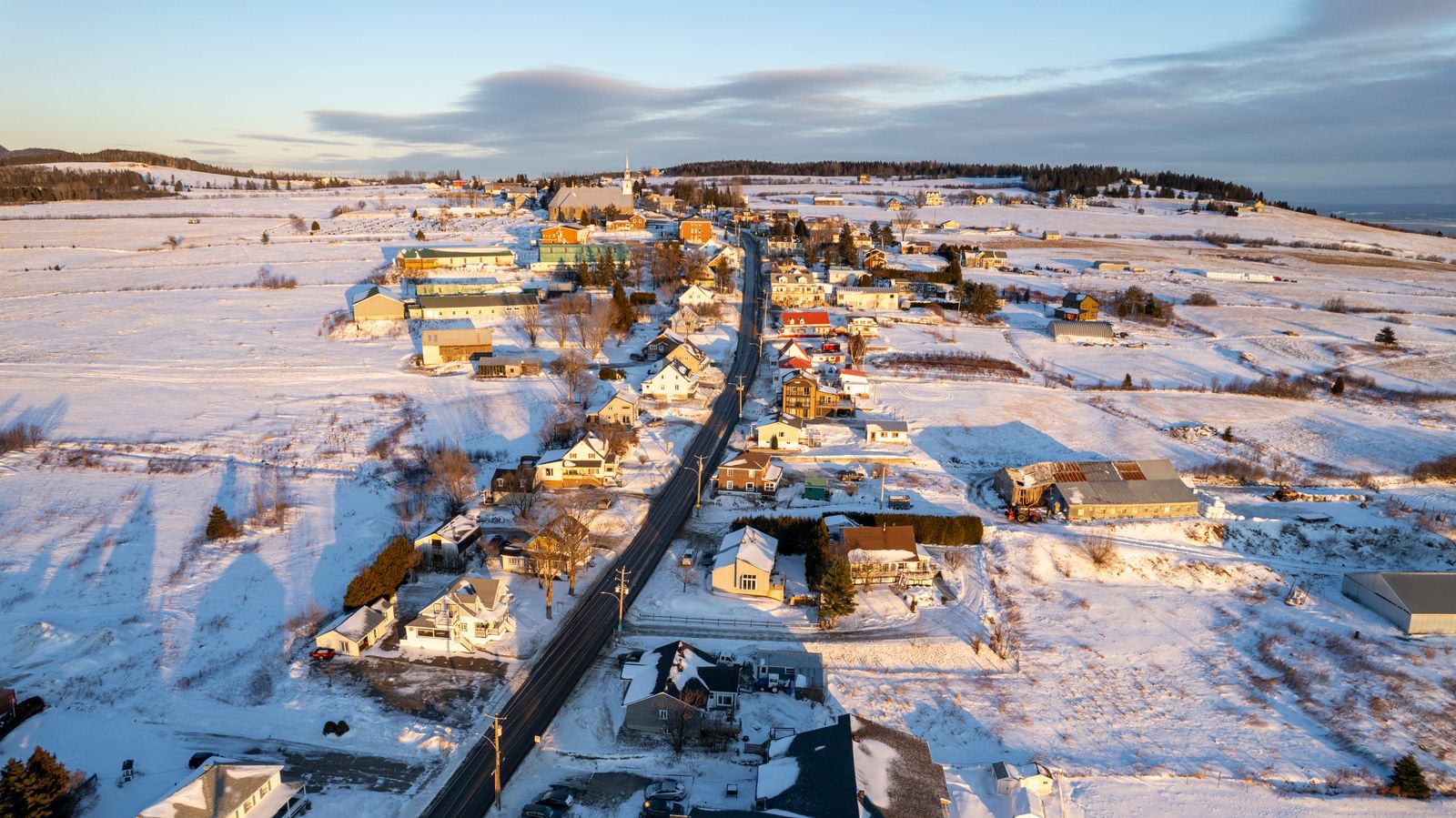
Québec City in early March is a study in the relationship between stone and cold. The walls of the Vieux-Québec hold the temperature of the season in a way that glass and steel cannot — you feel the winter stored in the limestone when you press your hand to the facade of a building on Rue du Petit-Champlain. The cobblestones were glazed with ice and we walked in the careful, deliberate way that winter teaches everyone who stays long enough to learn. The Château Frontenac loomed above the lower town the way it has since 1893, enormous and copper-roofed and completely certain of itself. A toboggan slide had been built on the Terrasse Dufferin, and children in snowsuits descended it screaming with a joy that the cold could not diminish.
The European echo in Vieux-Québec is real but inexact — the proportions of the streets recall Normandy or Brittany, the steep roofs are designed for snow loads that French architecture never had to calculate, and the language on the shopfronts is a French that has evolved in isolation, preserving idioms that Paris discarded a century ago. We ate tourtière at a restaurant near Place Royale, the meat pie arriving in a cast-iron dish with the crust bronzed and the filling fragrant with clove and savory — a dish that belongs to the cold months the way ratatouille belongs to the warm ones. The waitress called us 'mes amours' without irony, a Québécois habit that startled us each time with its unearned tenderness. The wine list was modest and almost entirely from France, which made sense, given that you could nearly see France from here.
Forty litres of sap yield one litre of syrup, which is either a lesson in patience or in value, depending on your disposition.
In the Laurentians, an hour north of Montréal, the sugar shacks open in late March when the nights still freeze and the days warm enough to start the sap running. We visited a cabane à sucre that had been operated by the same family for four generations — a wooden building in a maple forest where the evaporator filled the room with a steam so sweet it felt nutritional. The process is simple and ancient: tap the tree, collect the sap, boil it down. Forty litres of sap yield one litre of syrup, which is either a lesson in patience or in value, depending on your disposition. We ate tire sur la neige — hot syrup poured on snow and rolled onto a popsicle stick — standing outside in our coats while the sugar crystallized in the cold air. Cold air, hot sugar, snow. We ate three.
Montréal operates at a different frequency. The city is bilingual in the way that only cities formed by argument can be — the French and English coexist not through harmony but through a negotiation so long-standing it has become a kind of music. We walked the Plateau Mont-Royal on a Sunday morning, past the row houses with their external staircases — wrought iron spirals that are beautiful and terrifying in ice — and the bagel shops that have been arguing about who came first since the 1950s. At St-Viateur, we bought a dozen sesame bagels still hot from the wood-fired oven, smaller and denser and sweeter than their New York cousins, and ate them on a bench in Parc Jeanne-Mance while squirrels conducted reconnaissance from a respectful distance.
The winter light in Québec is a subject that painters understand better than photographers. It arrives low and sharp, casting long shadows even at noon, turning the snow surfaces into fields of blue and gold that shift as the clouds move. We drove through the Laurentian hills on a morning when the temperature had dropped to minus twenty and the birch trees stood white against a sky so pale it was nearly colourless. The road followed a frozen river, and at one point we stopped to watch a man ice-fishing alone on the surface, his shelter a plywood box, his patience visible from a distance as the particular stillness of someone who has decided that waiting is the activity. The car thermometer read minus twenty-two. We did not get out.
We left Québec on a morning when the St. Lawrence was partially frozen, the ice forming geometric patterns along the shore while the current ran dark and fast in the centre channel. A ferry crossed to Lévis trailing a wake that closed behind it like a seam. The cold had a finality to it that was not hostile but instructive — this is what the season means, it said, when you do not dilute it with central heating and short visits. The scarves were pulled to our eyes and the cold had reached the temperature where you stop converting to Celsius and simply accept it. The river below carried its ice toward the sea, and the ferry to Lévis was already a small shape in the channel, trailing a wake that closed behind it and froze.