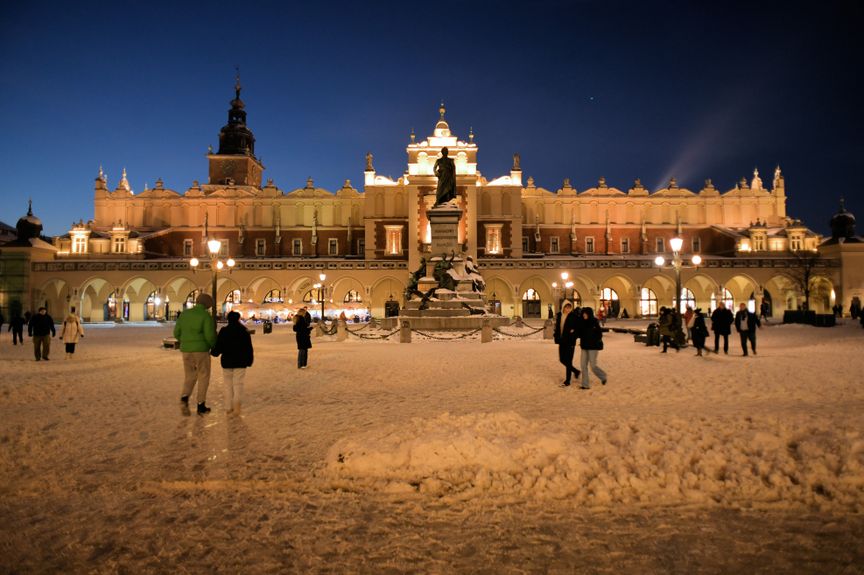
Kraków’s main square — the Rynek Główny, the largest medieval square in Europe — is a masterclass in how a city can hold beauty and weight in the same hand. The Cloth Hall runs down the centre like a Renaissance market that never closed. St Mary’s Basilica rises at one end, its twin towers mismatched in a way that the city has decided is not a flaw but a signature. The trumpet call from the taller tower stops mid-phrase, as it has every hour for seven centuries, in memory of a watchman killed by a Mongol arrow. The note that is not played says more than the notes that are.
We stayed in Kazimierz, the Jewish quarter, which is now the part of Kraków where the cafés are in old prayer halls and the bookshops sell Yiddish poetry beside Polish noir. The neighbourhood is beautiful and the beauty is complicated, because the streets that are now lined with restaurants were, within living memory, emptied of everyone who lived on them. A synagogue on Szeroka Street has been restored. The square outside is quiet. The contrast between what the square is and what the square was is the thing you carry home.
The note that is not played says more than the notes that are.
Wawel Castle sits on a hill above the Vistula and has been every kind of power — royal, religious, military, and now touristic — that Poland has cycled through in a thousand years. The Sigismund Chapel, a Renaissance jewel in gold dome and white marble, is considered the finest example of Italian architecture north of the Alps, which makes sense when you learn that the architect was Florentine and the patron was a king who understood that beauty is a form of sovereignty.
The Wieliczka Salt Mine, fifteen kilometres south of the city, is what happens when miners spend seven hundred years underground and decide to turn the workplace into a cathedral. The Chapel of St Kinga — carved entirely from salt, including the chandeliers, the altar, and a copy of Da Vinci’s Last Supper rendered in salt relief — is a hundred metres below the surface and holds nine hundred people. The acoustics are extraordinary. The air tastes of salt. The whole experience is so improbable that it circles back to feeling inevitable.
The Tatra Mountains, two hours south of Kraków, are where Poland becomes vertical. Zakopane, the mountain town at their base, is wooden architecture and smoked cheese and hikers who take their trails seriously enough to mark them with paint and maintain them with the diligence of people who have been climbing these mountains since before borders settled. We hiked to Morskie Oko, the Eye of the Sea — a glacial lake surrounded by granite walls so steep the water is always in shadow by three o’clock — and ate oscypek, the smoked sheep’s cheese grilled over charcoal by a woman who made it that morning from milk she carried down from a high pasture.
Polish food is the cuisine of a country that has survived everything and decided the appropriate response is to eat well. The pierogi — stuffed with potato and cheese, with sauerkraut and mushroom, with meat, with seasonal fruit — are the national argument that simplicity, done perfectly, is harder than it looks. The żurek — a sour rye soup with sausage and egg, served in a bread bowl in a cellar restaurant in the old town — was the meal that explains why the Poles survived everything: because nobody here has ever let a good recipe die, no matter what else was going on.
On the last evening, in a milk bar on Nowy Świat, the woman behind the counter ladled an extra scoop of pierogi onto our plates and waved away the zloty we tried to add. The price was written in chalk on a board that looked older than the menu. Outside, the trumpet call from St Mary’s reached the end of its interrupted phrase and stopped — mid-note, as it has stopped every hour for seven hundred years — and nobody at the neighbouring tables looked up.