The road from Tribhuvan airport crosses the Bagmati on a bridge that smells of woodsmoke in the evening and something sharper by morning. Kathmandu at night is a city of horn blasts and headlight halos, the traffic following rules that exist but are not written down. Dwarika’s Hotel, in Battisputali, sits behind a wall thick enough to cancel the city. The building is itself a rescue operation: its founder spent thirty years buying carved Newari window frames from palaces being demolished across the valley, then built a hotel around them. Six centuries of woodwork line the corridors, each piece catalogued by dynasty and neighbourhood. The courtyard is stone, water, silence. We slept nine hours, the deepest since leaving home.
Durbar Square before seven belongs to the people who live around it. A painter on a bamboo scaffold was retouching a wooden strut that has been structural since the fifteenth century, working with a brush no wider than his thumb. The 2015 earthquake left scaffolding on half the temples — nine years later, it looks permanent, and the pigeons have adopted it. A woman was selling oranges from a basket, counting change without looking up. The square carries its damage openly: cracked lintels, tilted pagodas, one temple reduced to a roped-off foundation. What strikes you is not the destruction but the calm around it. The city has decided that repair is a form of continuity, not urgency.
At some point it was no longer a walk around a monument. It was just the right way to end twelve days in Nepal.
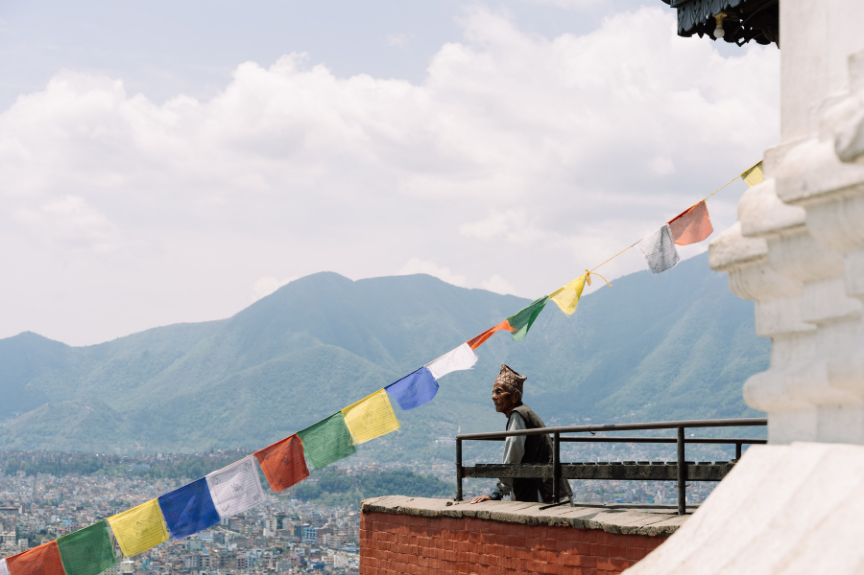
Behind Thamel — the trekking-gear quarter, identical shop after identical shop — the streets narrow until your shoulders brush both walls. Asan is Kathmandu’s oldest market district, and the air shifts abruptly to turmeric, kerosene, raw meat, cotton dye. We climbed Swayambhunath at dawn, three hundred and sixty-five steps through forest and rhesus macaques, to a stupa platform where the entire valley opened below. Kitchen smoke was rising from every neighbourhood at once, and the prayer flags overhead snapped in a cold wind carrying juniper. At that altitude, with that view, the city looked less like a capital than like a settlement that had grown too large to notice.
Patan is ten minutes across the river and operates at a lower volume. No hawkers in the square, no rickshaw horns — stone, brick, carved wood, and a quiet that feels less peaceful than deliberate. In a workshop at street level, a man was casting a bronze Tara by lost-wax, the same method commissioned by Malla kings in the fourteenth century. We watched the pour: four seconds of molten bronze into a clay mould that had taken three weeks to carve. He said the finished piece was months away and showed no sign of impatience. Around the corner, a woman was serving steamed momos from a window — pork, with a tomato achaar that cleared the head in one breath. We ordered sixteen.
The bus to Pokhara takes seven hours and breaks down at least once — ours stopped near Mugling for a tyre. Tourist Pokhara is paragliding offices and lakeside bars and backpackers comparing altitude sickness. We gave it two hours, then drove twenty minutes east to Begnas Lake, where there is nothing to do and no reason to leave. A still lake, a wooden boat, a fisherman casting a net with a wrist motion so practised it looked involuntary. The Annapurna range filled the sky to the north — not as a backdrop but as a wall, close enough to pick out individual crevasses at seven thousand metres. We ate dal bhat at a farmhouse where the rice came from the slope behind the kitchen, the lentils from the field below, the greens from the irrigation ditch. It was the best meal of the trip, and the simplest.
On the last evening we walked the kora at Boudhanath — three laps around the great stupa, moving with the pilgrims, the butter lamps, the low continuous sound of Om mani padme hum that comes from everywhere and nowhere. The stupa’s painted eyes look out in four directions with an expression that could be serenity or simply patience. Night fell. The lamps held. We did four laps, then five, then stopped counting. At some point it was no longer a walk around a monument. It was just the right way to end twelve days in a country where every altitude has its own weather, its own gods, its own way of making you slow down.