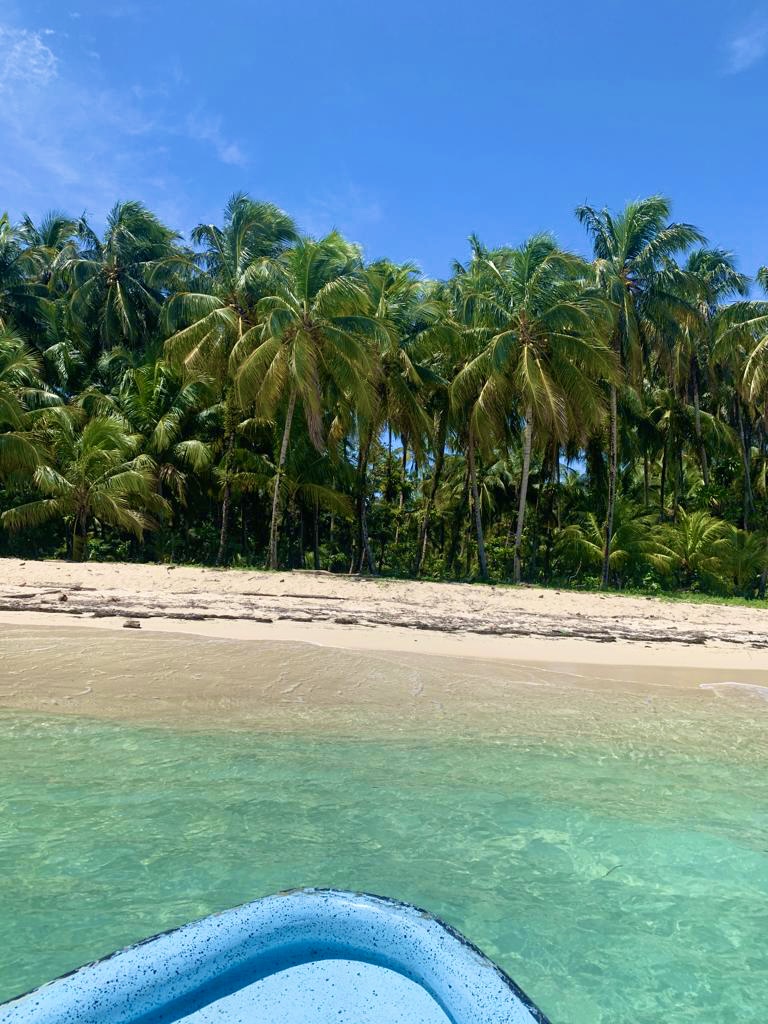
The water taxi from Almirante to Bocas Town takes forty minutes if the sea is calm, twenty if the driver is late for something, and the entire ride is over water the colour of mouthwash — a turquoise so saturated it looks artificial until you put your hand in and find it warm. The mainland disappears behind you. The archipelago appears ahead as a scatter of green hills in flat water, and the first thing you notice is the quiet. Not silence — the birds are too active for that — but the quiet of a place where the combustion engine has not entirely won.
Bocas Town sits on Isla Colón, the largest of the nine islands, and it has the improvised beauty of a Caribbean settlement that was never designed. Clapboard houses on stilts, painted in colours that salt air has softened to pastels, line a waterfront where fishing boats, dive boats, and the occasional catamaran share the same dock without apparent system. We checked into a guesthouse above a surf shop, the wooden floor warm from the sun and the ceiling fan turning at a speed that suggested ambition rather than competence.
Some cities are defined by movement through them, and the people who live there hold still while the world passes.
The food in Bocas is Caribbean by way of everywhere. At a palapa on the water — four tables, a zinc roof, a cook named Gloria — we ate fried red snapper with patacones and a coconut rice that had been simmering since morning. The fish had been swimming three hours earlier. Gloria served it with a lime and a look that indicated the correct response was to eat, not to photograph. We ate. The meal cost seven dollars and was worth every restaurant we had overpaid in Panama City.
Starfish Beach on the western side of the island is named literally: the shallows are filled with orange starfish scattered across white sand in water warm enough to stand in for hours. We snorkelled off Cayo Zapatilla, a national marine park where the reef drops off a wall into blue so deep it becomes navy and then black, and the coral was alive in a way that made every aquarium we had seen look like a diorama. A hawksbill turtle passed below us with the unhurried glide of something that has been navigating these waters for sixty million years and does not intend to speed up for tourists.
On the second day we took a boat to Bahía de los Delfines, where bottlenose dolphins live year-round in a bay enclosed by mangroves. The boat driver cut the engine and we drifted. Three dolphins surfaced, breathed, and disappeared. They did this six times, each time closer. They were not performing. They were commuting. The bay smelled of salt and warm vegetation and the particular sweetness of a tropical coast where the forest reaches the water.
The rain arrived in the afternoon, as it does every day in Bocas, sudden and vertical, turning the streets into streams and the gutters into rivers for precisely forty minutes before the sun came back and the puddles steamed dry in twenty minutes. We sat under a tin roof at a waterfront bar, drinking a Balboa and watching the rain hit the harbour in a pattern that looked choreographed, and a local at the next table said: give it a week and you stop running from the rain. Give it two and you start waiting for it.
On our last evening the sunset turned the water pink and then gold and then a colour somewhere between copper and rust, and the fishing boats headed out for the night run, their lights appearing one by one on the darkening water, until the whole bay was dotted with light. Bocas del Toro is the end of a road that starts in Panama City and crosses a continental divide, and at the end of it the road simply stops and the water begins and the Caribbean takes over the way it has been doing since long before anyone thought to build a road out here.