The Osa Peninsula is loud. The forest operates at a volume that suburban silence has not prepared you for — cicadas layering over frogs layering over something moving through the leaf litter that you will not identify. We arrived at Puerto Jimenez by small plane, the kind where the pilot counts passengers instead of consulting a manifest, and the landing strip was a clearing bordered by palm oil plantation on one side and mangrove on the other. A dog slept on the tarmac. Nobody moved it.
The trail into Corcovado begins at the ranger station at La Leona, where a man in rubber boots checked our permit and told us to keep our food sealed because the coatis had learned to work zippers. The path followed the coast for the first hour, sand giving way to roots, the Pacific visible through breaks in the trees as a flat grey line. Then the forest closed overhead and the light changed — not dimmer exactly, but filtered, greenish, the way light looks through old glass. A troop of spider monkeys crossed above us branch to branch, unhurried, their long arms describing arcs that seemed too graceful for the speed at which they moved.
The best coffee, he said, comes from altitude and neglect. He was not entirely joking.
In the Central Valley, the coffee is a different kind of quiet. We visited a farm outside Tarrazú where the plants grew under shade trees on a slope so steep that the pickers worked with one foot braced uphill. The farmer, a third-generation grower, cupped samples for us at a wooden table in his beneficio — the wet mill where the cherry is stripped from the bean. He slurped loudly, as the protocol demands, and pointed out notes of brown sugar and tangerine that we pretended to detect immediately but actually found only on the third sip. The best coffee, he said, comes from altitude and neglect. He was not entirely joking.
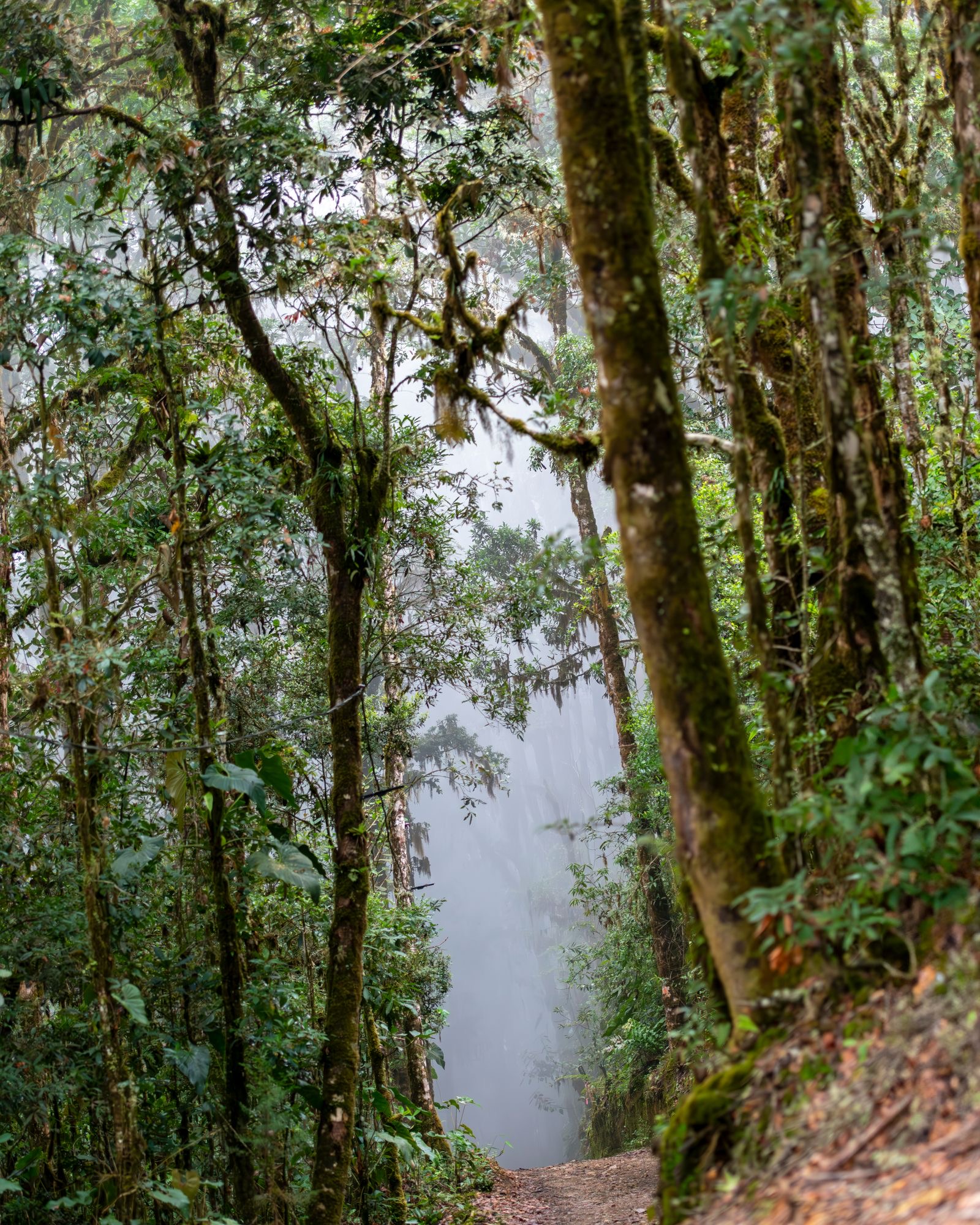
The cloud forest at Monteverde sits at an elevation where the clouds do not pass over — they pass through. We walked the hanging bridges in a mist that gathered on our eyelashes and turned the moss fluorescent. Quetzals are the reason most visitors come, and we did see one, a male, its tail feathers impossibly long, perched in an aguacatillo tree eating a fruit the size of a marble. Our guide, who had been leading these walks for twenty years, still stopped mid-sentence when it appeared. Twenty years of guiding and it still stopped him cold. The bird stayed for two minutes, then dropped from the branch and vanished into the cloud layer as if it had been recalled.
Costa Rica has built an economy on not cutting its forests down, which sounds obvious until you consider how recently it was doing exactly that. The country lost half its tree cover between 1940 and 1983, then reversed course with a system of payments for ecosystem services that made standing forest worth more than pasture. It is an imperfect model — the eco-lodge industry sometimes trades one form of extraction for another, and the howler monkeys along the highway between La Fortuna and Monteverde have learned to cross on electrical cables because the canopy bridges come too infrequently. But walking out of Corcovado at dusk, our boots heavy with mud, a scarlet macaw pair crossing overhead in the direction of their roost tree, the math briefly felt simple. What the forest keeps is worth more than what it yields.
We drank Imperial beers on the porch of our cabin that night and listened to the forest shift into its nocturnal register — a different orchestra, lower, more percussive. A kinkajou appeared on the railing, regarded us with eyes that reflected our headlamp, and left. The Pacific broke somewhere below in the dark. We did not talk for a long time, which in a marriage is sometimes the highest form of agreement.