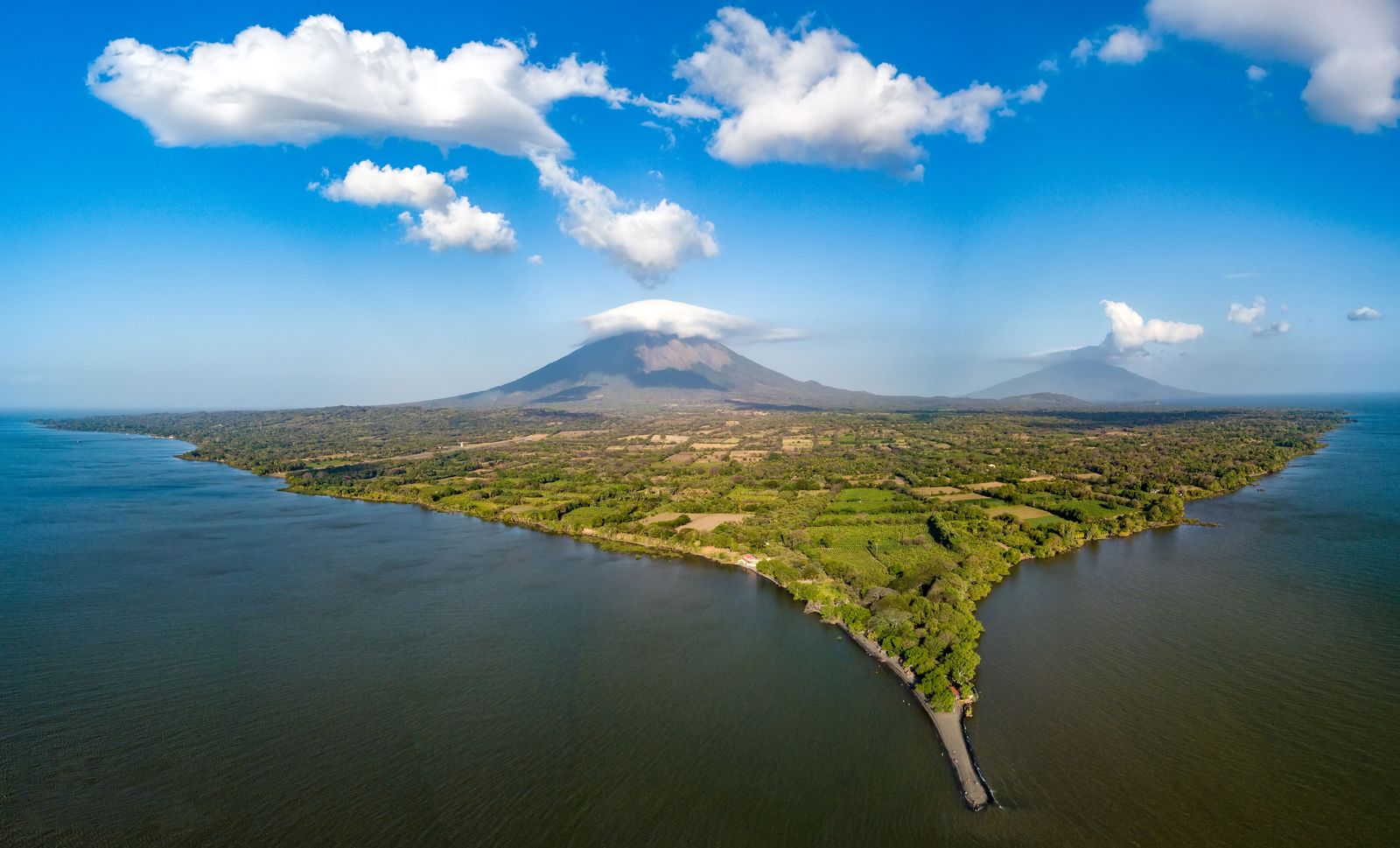
Dear friends — We are writing this from a hammock on Ometepe, which sounds invented, but the hammock is the only furniture on the porch and the chair inside has a broken leg, so here we are. The island sits in Lake Nicaragua like a figure eight drawn by someone with a steady hand — two volcanoes joined by a narrow isthmus, Concepción with its clean cone and Maderas with its crown of cloud forest. The ferry from San Jorge took an hour and the lake was rough enough that a woman near the bow crossed herself twice. We arrived damp and grateful.
Granada is the city Nicaragua puts forward first, and it does the job well. The cathedral faces a plaza where horse-drawn carriages wait beside motorcycle taxis, and the facades along Calle La Calzada run in a sequence of colonial colours — terracotta, indigo, a particular dusty yellow that shows up across Latin America wherever the Spanish built churches and then left. We walked to the old railway station, which no longer serves trains but houses a cultural center where a woman was teaching a ceramics class to six teenagers, the wheel turning slowly, her hands guiding theirs on the clay. The building smelled of wet earth and turpentine. Outside, a man sold vigóron from a basket — yuca and chicharrón wrapped in a banana leaf — and we ate it on a bench overlooking Lake Nicaragua while the light turned the water the colour of pewter.
Nicaragua will change — it is already changing — and the next version of this country will have better roads and worse secrets.
What strikes you about Nicaragua is its uncomposed quality. The tourism infrastructure that smooths a country into itinerary — the reliable airport transfer, the bilingual menu, the curated walking tour — exists here in patches but has not yet formed a continuous surface. On Ometepe, we rented a motorcycle from a man who wrote the rental agreement on the back of a school notebook page, and the road around the island alternated between pavement and something that a generous person might call gravel. We stopped at a waterfall called San Ramón that required a forty-minute hike down a trail marked by a hand-painted sign and the sound of water getting louder. The pool at the base was cold enough to make us gasp, green with mineral sediment, entirely empty of other people.
At Café de las Sonrisas in Granada, a restaurant staffed entirely by deaf employees, we ordered by pointing at a chalkboard menu and received the best gallo pinto we had eaten in Central America — the rice and beans cooked with enough garlic to constitute a philosophical position. The waiter communicated our bill through a series of gestures so efficient and good-humored that we felt our spoken language was the clumsier system. A cat slept on the chair beside us. The courtyard was planted with banana trees whose leaves filtered the noon light into something bearable. We stayed for two hours and ordered a second coffee because leaving felt like a small rudeness.
We took the ferry back in the late afternoon, Concepción silhouetted against a sky that was doing something complicated with pinks and greys. A boy on the upper deck flew a kite made from a plastic bag and string, the wind doing most of the work. Nicaragua will change — it is already changing — and the next version of this country will have better roads and worse secrets. But we are writing to you from the version that exists now, where the hammock is the only seat and the volcano is the only clock, and the woman on the ferry still crosses herself because the lake demands it. We wish you were here, though we are not sure the hammock would hold three. — M & L