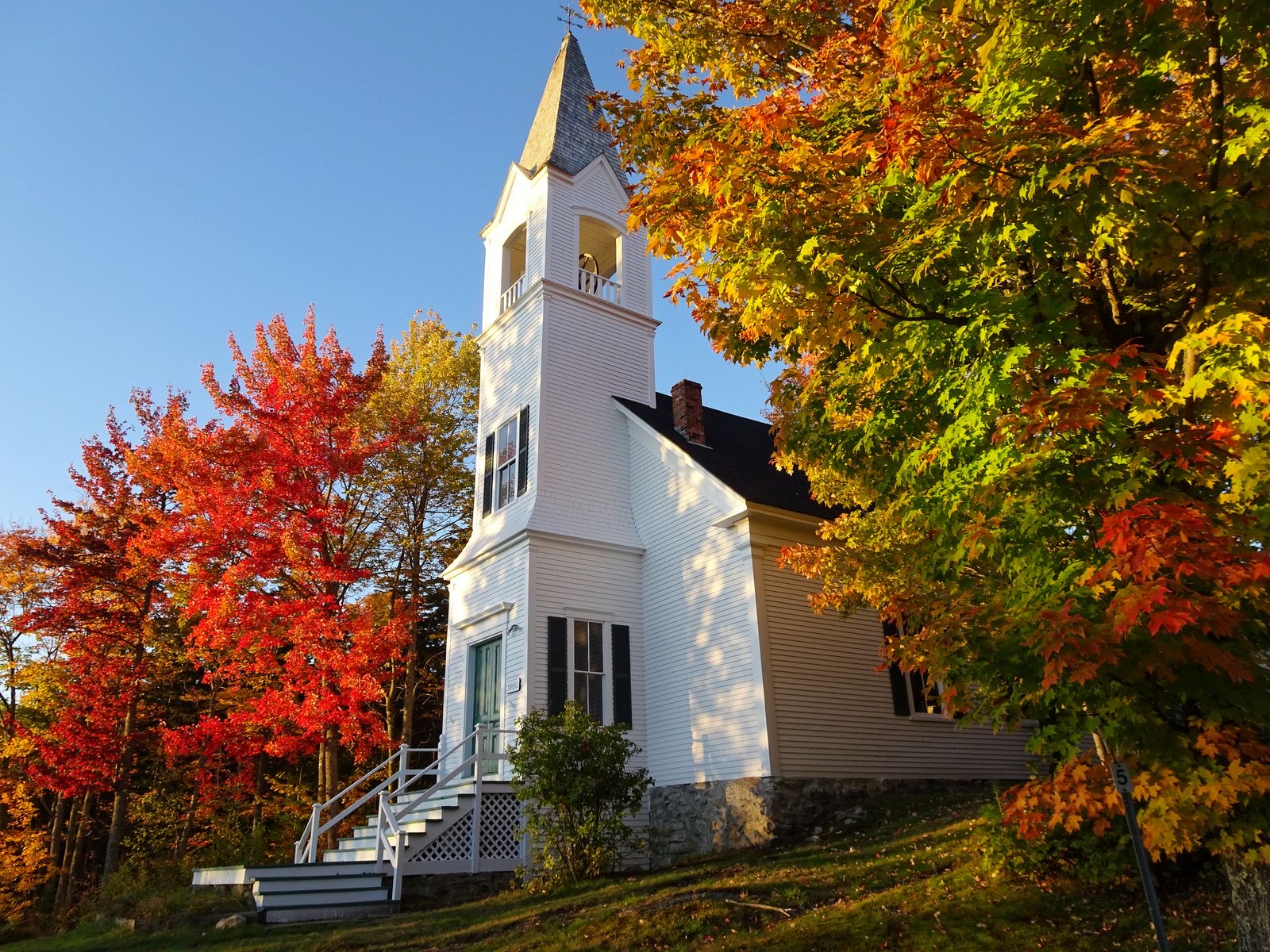
Autumn in New England is an event that has been photographed so many times it risks becoming its own reproduction. But the thing about clichés is that some of them are simply true — the sugar maples do turn that colour, the light does arrive at that angle, and the air does carry that particular smell of cold and decomposition that is not unpleasant but final. We drove north from Boston on Route 2 in early October, past Concord where Thoreau did his experiment and Lexington where the militia did theirs, and the canopy above the road shifted from green to gold to a red so saturated it looked painted. It looks exactly like the postcards, and we stopped caring about the cliché within the first ten miles.
The town of Woodstock, Vermont, arranges itself around a covered bridge and a green with the self-awareness of a place that knows it will appear on calendars. We parked near the general store and walked. The clapboard houses along Elm Street were white, as clapboard houses in Vermont are required by some unwritten statute to be, with black shutters and front porches where pumpkins sat in arrangements that suggested care but not professional staging. A woman raked leaves into a pile that her retriever immediately scattered, and she began again patiently, because the retriever had not once brought it back and she seemed fine with that. The Billings Farm down the road still keeps Jersey cows and demonstrates butter-churning to school groups — a museum of the agricultural life that these towns were built on before the tourists arrived to admire the architecture that agriculture paid for.
The public library is New England's quiet masterpiece — built on the premise that a democracy requires readers and readers require a room.
We ate lobster rolls at a shack on the coast near Rockport, Massachusetts — a counter window, a paper menu, and a view of the harbor where lobster boats rocked gently on their moorings. The roll was split-top, buttered, griddled, and the lobster was dressed with nothing but a thin coat of mayonnaise and a squeeze of lemon, which is the only acceptable preparation and we will not be debating this. A gull landed on our table, helped itself to a fry, and left. The harbor water was that particular New England grey-green that Turner would have understood — not dramatic, just deeply attentive to the sky above it.
The public library is New England's quiet masterpiece. In every town we passed through — Bennington, Brattleboro, Northampton, each one smaller than the last — the library occupied a building of disproportionate ambition. Stone facades, arched windows, reading rooms with oak tables and brass lamps that still worked. These were Carnegie gifts, many of them, built on the premise that a democracy requires readers and readers require a room. We stopped at the Athenaeum in St. Johnsbury, Vermont, where the art gallery on the second floor holds a collection of Hudson River School paintings hung salon-style on walls the colour of old cream. A docent told us the building had been open continuously since 1871. The rain started while we were inside, and we stayed to read the local newspaper in a leather chair by the window, which felt like the precise use the founders had intended.
On our last evening, we pulled over on a ridge road in the Berkshires and watched the sun go down behind a valley so filled with color it looked geological — strata of orange, red, bronze, the dark green punctuation of the pines. A stone wall ran along the road, the kind built by farmers clearing fields two centuries ago, each stone fitted without mortar by hands that understood weight and patience. New England wears its history on its surface. The white churches, the town greens, the war memorials with their lists of names — these are not decorations but arguments, made in wood and granite, about what a community owes itself. The leaves will fall in two weeks. The argument continues.
We drove back to Boston in the dark, the highway quiet, the radio tuned to a college station playing Coltrane. The city appeared as a low glow on the horizon, and we thought about how New England is a place where people built covered bridges to last two hundred years and libraries that are free and meetinghouses that face a common, and most of them are still standing, still free, still facing the common.