Oaxaca City smells of smoke. Mezcal smoke, copal smoke, tortilla smoke, candle smoke. Smoke here works as an ingredient, threaded through every street and courtyard, clinging to your shirt long after you've left the zócalo. The city was built by the Zapotecs, rebuilt by the Spanish, and is now being reclaimed by a generation of Oaxaqueños who understand that the best version of this place is the one that never left. The central square is ringed by portales where old men play chess at noon and vendors sell tlayudas folded around black bean paste and Oaxacan string cheese. We sat under the laurel trees on our first evening with a glass of mezcal and watched the light turn the cathedral's green cantera stone the colour of sage.
The Mercado de Abastos makes no concessions to tourism. It's a warehouse the size of a football pitch where the produce is piled in pyramids of colour that Caravaggio would have taken seriously. Chiles in twelve shades of red. Herbs in bundles that smell of rain. Chocolate ground to order on a stone metate, the cacao beans pounded with sugar and cinnamon until the paste is warm to the touch. A woman selling chapulines — toasted grasshoppers seasoned with lime and chili — offered us a handful and watched our reaction grinning, because she had seen a thousand foreigners perform the same hesitation. They tasted like the landscape: dry, smoky, sharp.
We asked if he'd ever consider scaling up. He looked at us the way you'd look at someone who'd asked if the ocean planned to get bigger.
We visited a mezcal palenque thirty minutes outside the city, where a man named Don Fortino distilled espadin agave over a wood fire in a copper still that his grandfather built. The palenque was a dirt-floor courtyard shaded by corrugated tin, with a horse tethered to a stone wheel that crushed the roasted agave hearts. The process takes eight years from planting to pouring. He produced four hundred litres a year. A fraction of what an industrial distillery produces in a day. We tasted three expressions — espadin, tobalá, and a wild cuishe from the hillside above his plot — each carrying the specific geology of the soil it grew in like a thumbprint. We asked him if he'd ever consider scaling up. He looked at us the way you'd look at someone who'd asked if the ocean planned to get bigger.
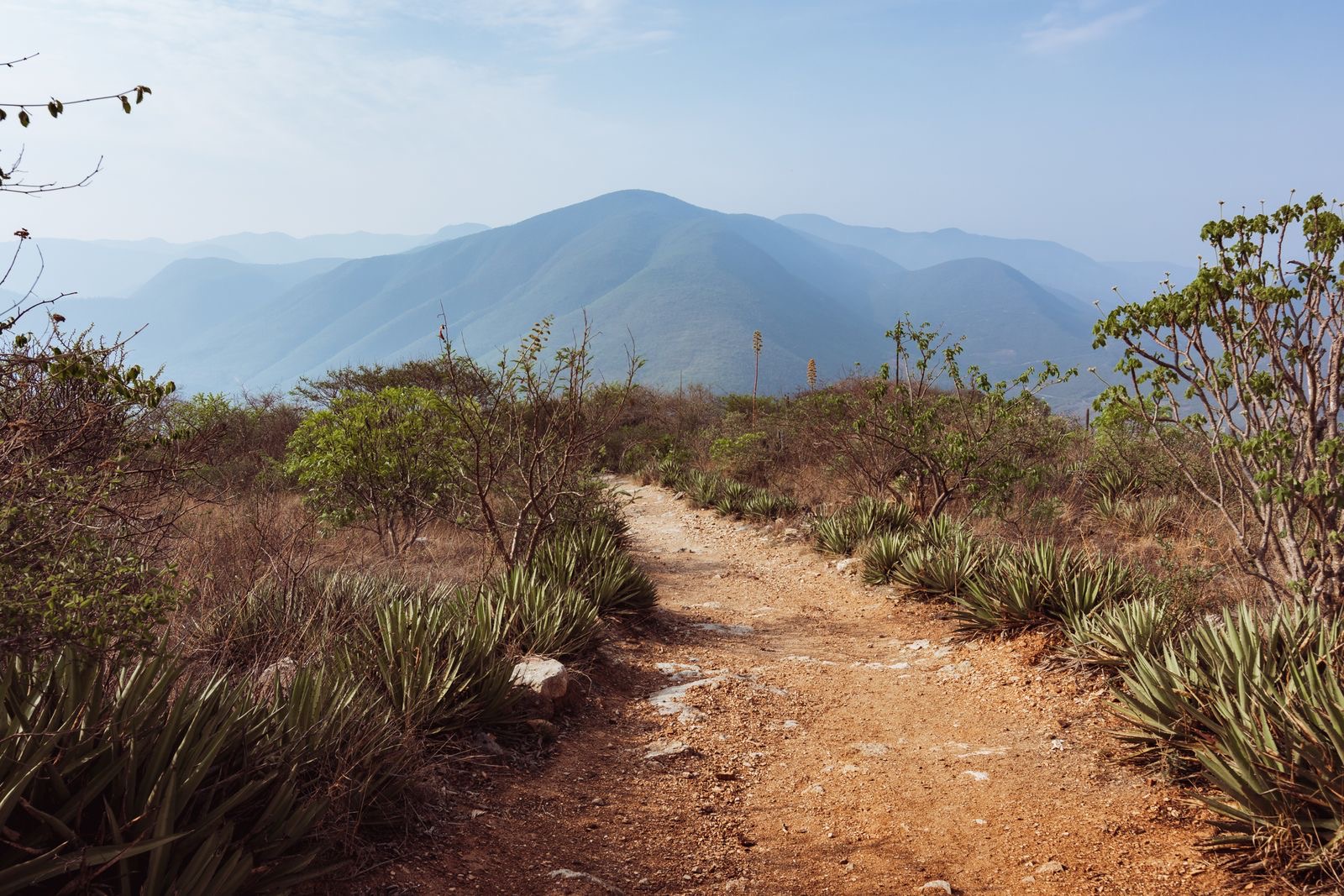
Monte Albán, the Zapotec capital above the valley, is Angkor's temperamental cousin — equally old, equally monumental, less visited, more exposed to the sky. We arrived at opening time and had the Grand Plaza to ourselves for twenty minutes. Twenty minutes of standing on a flattened mountaintop where a civilisation conducted its politics, its astronomy, and its rituals for fifteen hundred years. The Danzantes — stone carvings of contorted human figures set into the walls of one structure — are among the oldest writing in Mesoamerica, and nobody is entirely certain what they say. The theories range from captive records to medical diagrams. We prefer not knowing. The mystery suits the altitude.
In the villages outside the city, the artisan traditions operate on a logic that predates commerce. In Teotitlán del Valle, we watched a family dye wool with cochineal — insects crushed to produce a red so deep the Spanish once classified it as a state secret. The father worked the loom while his daughter carded the raw fleece, and neither looked up when we entered, not from rudeness but from the specific concentration of people whose hands are doing something their great-grandparents' hands did in the same room.
Oaxaca doesn't try to sell you anything. It makes things in front of you — textiles, pottery, food, spirits — and lets the making be the persuasion. The seven moles of the state, each from a different region, each a different colour and philosophy of spice, are the real argument for the place: complexity that insists on being tasted rather than described. This is, it turns out, the most effective sales technique ever invented.