A disclaimer first. Mali is not a country we recommend without serious caveats. Large parts of the north and centre are under active security warnings from most Western governments. Armed groups operate in several regions. The situation has worsened since our visit in December 2022, and what was possible then may not be possible now. If you consider going, start with your government's travel advisory, not with this article. We went to the Pays Dogon with a local guide we trusted, a driver vetted through two contacts, and three months of advance planning. We would not have gone otherwise.
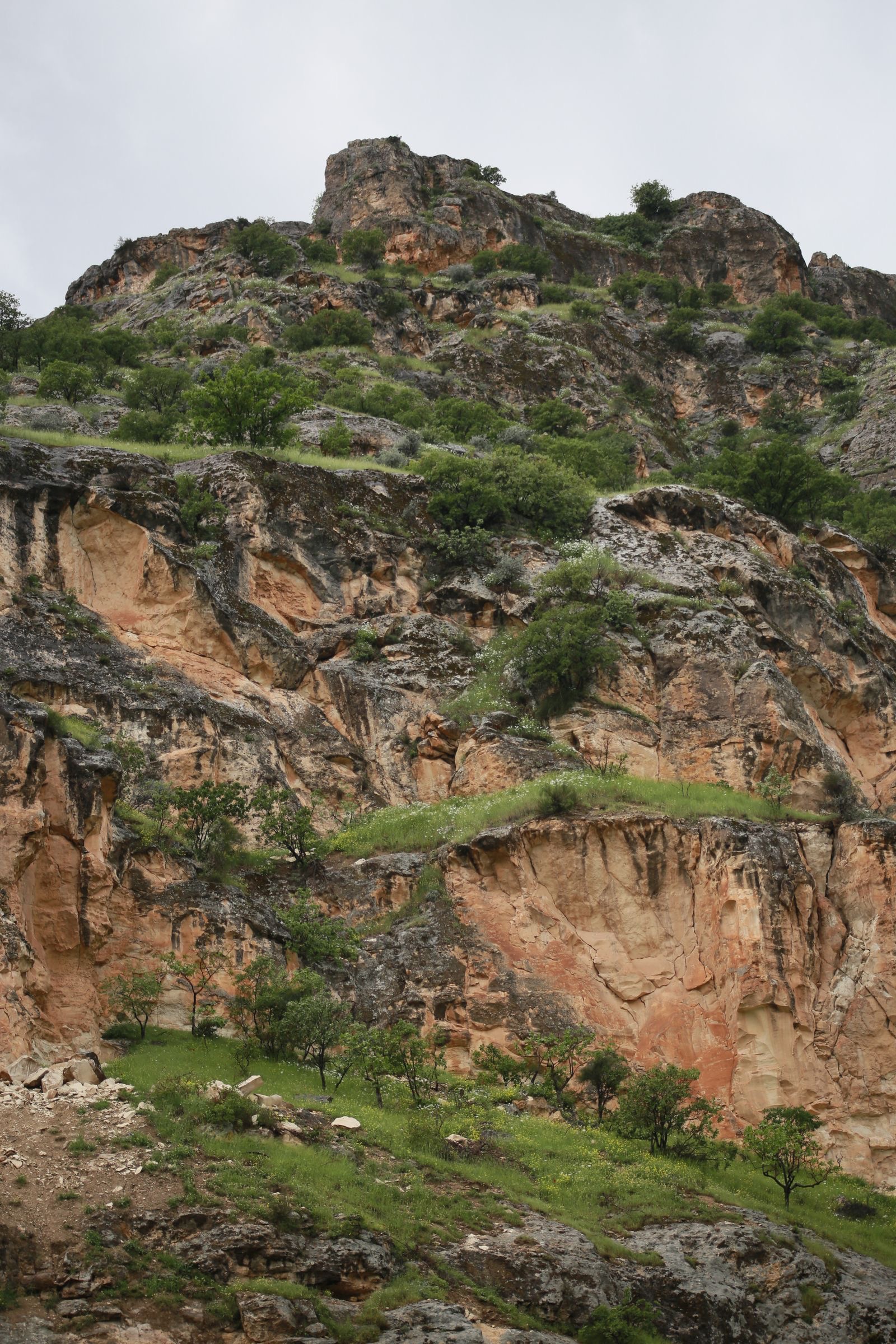
That said — the Pays Dogon is the most extraordinary place we have been. The drive from Mopti takes four hours on a road that alternates between tarmac, laterite, and guesswork. Thin acacias, red dust, motorbikes carrying three people and a sack of grain. Then the Bandiagara escarpment appears — a wall of sandstone stretching 150 kilometres, dropping 500 metres straight down. The Dogon built their villages into that wall. Granaries wedged into crevices. Houses stacked on ledges. The dead buried in caves above the living. From a distance, the villages look like they grew out of the rock rather than being built on it.
The ceiling is deliberately too low to stand. If you want to argue, you have to do it sitting down. We studied geopolitics for years. The Dogon solved it with a roof.
Our guide, Amadou, spoke four languages and had a patience that made us feel slow. He explained the toguna — the low-ceilinged meeting house where elders gather — with one detail that has stayed with us ever since: the ceiling is deliberately too low to stand. If you want to argue, you have to do it sitting down. In Ireli, we watched elders resolve a land dispute under one of these roofs. Forty minutes, no raised voices. The resolution involved a shared well and a boundary marked by a baobab tree that both families accepted without any survey. We studied geopolitics for years. The Dogon solved it with a roof.
Between villages, children walked with us — not asking for anything, just curious. One boy, maybe ten, led us two kilometres off the path to show us a cave painting. He had clearly done this before, many times, but he presented it with the same wide-eyed seriousness as if he had just found it that morning. The doors of the houses are carved with crocodiles, tortoises, figures with raised arms. Amadou explained some of the symbols. Others, he said, were not his to explain — they belonged to families or to initiations he had not undergone.
We slept on a rooftop in Ireli. No electricity for fifty kilometres in any direction. The Milky Way was not a band across the sky — it had depth, layers, a thickness we had never seen before. Lucas brought up the Dogon oral tradition about Sirius — descriptions of a companion star invisible to the naked eye, documented by ethnographers decades before Western astronomy confirmed it. Whether that knowledge is truly ancient or picked up through contact remains debated. But lying on a thin mattress in that heat, watching a sky that dense, the debate felt less important than the fact that people here have been looking up and paying attention for a very long time.
The Pays Dogon is not comfortable. The heat is brutal, the logistics are fragile, and the road you drove in on may not be the same road when you leave. But it is the only place where we have genuinely felt like guests of a civilisation that has nothing to prove to ours.