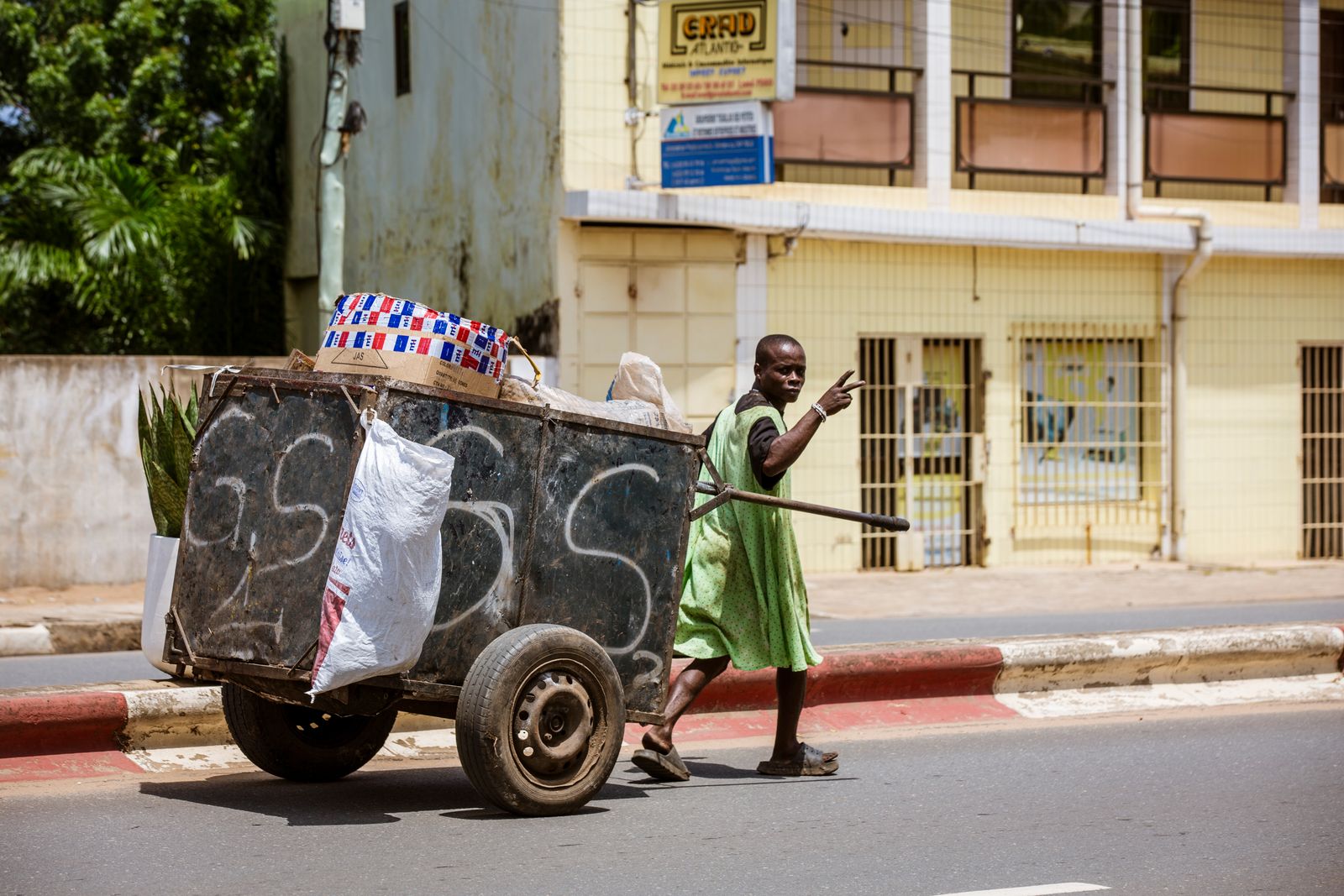
We had not planned to stop in Lomé. The city entered our itinerary the way most interesting things do — through a cancelled connection and a shrug. Thirty-six hours, we told ourselves. Enough to sleep, eat, walk, and leave. We were wrong about the leaving part, at least emotionally. Lomé is a city that operates at a frequency you have to tune into deliberately — it does not announce itself. The airport road passes through a corridor of low concrete buildings and hand-painted signs for mobile phone credit, and then the ocean appears on the right, grey-green and muscular, the waves landing on the sand every seven seconds.
The Grand Marche is a three-storey building in the centre of town where Nana Benz — the market women who built fortunes on the wax-print textile trade — once ran an economy from behind stacked bolts of fabric. The textiles are still there, floor to ceiling, in patterns named after proverbs and social situations: "My husband's eye is on me," "The back of my rival." We bought a length of indigo cotton from a woman who quoted us a price, received our counteroffer with theatrical despair, and settled at a figure that satisfied both parties and entertained the neighbouring stalls. Commerce in West Africa is a performing art, and the Grand Marche is its conservatory.
Commerce in West Africa is a performing art, and the Grand Marche is its conservatory.
The Akodessewa Fetish Market, on the northern edge of the city, is something else entirely. Here, the ingredients of traditional medicine and voodoo practice are laid out on wooden tables in the open air — dried chameleons, monkey skulls, porcupine skins, the desiccated heads of various animals arranged with the taxonomic precision of a natural history museum's back room. A fetish priest offered to consult the oracle on our behalf, grinding a powder while explaining the spiritual properties of each ingredient in four languages, switching between them mid-sentence. We declined the consultation but bought a small carved figure as a gesture of respect. The market smells of dried hide and woodsmoke and something older, something older that we had no word for.
That evening, we ate at a maquis — the open-air bar-restaurants that constitute Lomé's social infrastructure — on a street where every third building seemed to serve the same combination of grilled chicken, pâte de maïs, and Togolese beer. Plastic chairs on packed earth beneath neem trees strung with Christmas lights that stayed up year-round, their glow giving the street the atmosphere of a permanent, low-key celebration. A television propped on a stack of crates showed a Ghanaian soap opera that the patrons watched with commentary louder and more entertaining than the programme itself. The chicken had been marinated in ginger and scotch bonnet and grilled over charcoal until the skin crackled, and it arrived with a pepper sauce that required a decision about how much suffering you were willing to exchange for flavour. We chose bravery. We chose correctly.
In the late afternoon, we walked along the beach east of the port, where fishing pirogues were drawn up on the sand and nets hung drying from wooden frames. Boys played football in the space between the boats, using stacked flip-flops as goalposts. The Atlantic here is not for swimming — the undertow is severe, and the locals treat the ocean as a workplace, not a leisure facility. We sat on an overturned hull and drank a bottle of Eku beer and watched the light flatten across the water. Lomé, in thirty-six hours, had offered us a textile education, a confrontation with belief systems we could not assimilate, a coastline that laboured rather than lounged, and the feeling that thirty-six hours was not nearly enough. When our connection finally materialised, we boarded the plane slowly. We hadn't expected to care about leaving.