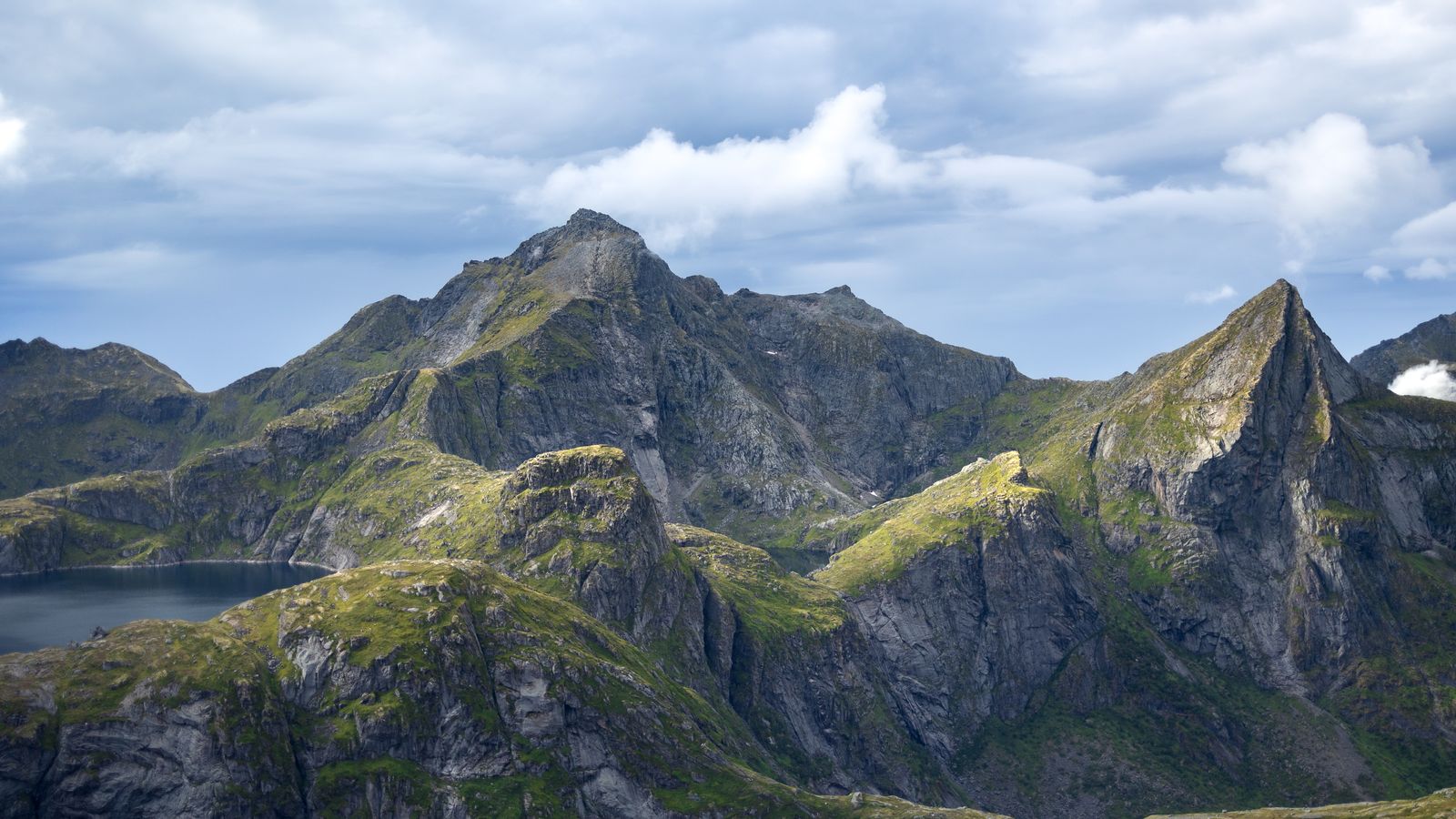
Lofoten doesn't offer one long-distance trail — it offers a dozen short, brutal, spectacular ones, granite peaks rising almost directly from the Norwegian Sea with barely a foothill to ease the introduction. We based ourselves in Reine, a fishing village of five hundred people voted, with some justification, one of the most beautiful in the world, and spent five days stringing peaks together on day hikes that each felt disproportionately hard for their modest length. The rorbuer we stayed in — a restored fisherman's cabin on stilts over the fjord — had a window that framed the harbour and the granite wall behind it in a composition no photograph quite captures, because a photograph can't include the smell of salt and tar that came through the cracks in the timber.
Reinebringen is the archipelago's signature climb: more than 1,500 hand-laid stone steps, built by Sherpa work crews using techniques imported from Nepal, gaining 448 metres in under a kilometre of horizontal distance. It is, without exaggeration, one of the steepest maintained trails we've climbed anywhere, and the view from the top — Reine's red rorbuer fishing cabins scattered across turquoise water, ringed by peaks that look freshly thrust from the seabed — justified every one of the thirty-minute breaks we took to admit we were struggling. The steps themselves are a feat worth noting: hand-fitted stone, mortared into a mountainside that used to be an eroded mud trench, in a project that took years and was carried out at the latitude of northern Siberia. We passed a work crew repairing a section halfway up and nodded in the universal language of people who respect what they're standing on.
Lofoten in summer barely sleeps. We didn't either, and didn't especially want to.
Kvalvika Beach, reached by a different trail entirely over the Ryten ridge, is the payoff for a longer, gentler walk: a horseshoe of white sand between two mountains, accessible only on foot, with waves that surfers travel here specifically to ride despite water temperatures that hover around eight degrees year-round. We watched three of them in wetsuits thick enough to survive an Arctic swim, and admired their commitment from the dry side of the sand. A couple had pitched a tent at the far end of the beach and were cooking on a camp stove, their laundry drying on a line strung between two rocks. They'd been there four days, they said, and saw no reason to leave. The beach has that effect.
The stockfish racks — wooden A-frames strung with drying cod — are Lofoten's oldest industry, unchanged in method since Vikings began exporting dried fish to southern Europe over a thousand years ago. The smell, sharp and briny, follows you through every village from January to April when the racks are full, and the dried cod itself, rehydrated into bacalao, remains one of Norway's most significant exports to Portugal and Italy both, an irony neither country seems to mind. At Gammelbua, a converted boathouse in Reine, we ate stockfish cooked with cream and potatoes alongside slices of reindeer that tasted of juniper and cold air, and drank a local craft beer that seemed designed specifically to accompany fish in all its forms.
The Midnight Sun runs here from late May to mid-July, and we climbed Ryten at 9 PM under full daylight, sharing the summit with photographers who'd timed the ascent specifically for the low-angle light that never quite becomes sunset. The sky turned through shades of amber and pewter without ever reaching dark, and the sea below held the colour like a mirror too large to frame. Lofoten in summer barely sleeps. We didn't either, and didn't especially want to.