Lesotho begins where the road gives up. Past Sani Pass, where the switchbacks turn to loose stone and the air thins enough to notice, the landscape opens into something austere and immense — a plateau kingdom where the lowest point sits higher than any summit in its surrounding neighbour. We crossed the border at the top in a four-wheel-drive that had earned its scratches, and the first thing we saw on the other side was a herd boy on horseback, wrapped in a Basotho blanket the colour of burnt ochre, watching us from a ridge without moving. We waved. They did not wave back.
The Basotho blanket doubles as weather system, identity card, and social text — all rolled into a single piece of wool. Different patterns carry different meanings — the corn cob for fertility, the cabbage leaf for prosperity, the popcorn design that young men wear. We rode out from a village near Mokhotlong on Basotho ponies, small and sure-footed animals bred for terrain that would snap the legs of a thoroughbred. Our guide, Thabo, sat his horse the way people sit who learned to ride before they learned to read. He pointed out San rock paintings under a sandstone overhang — faded figures of eland and hunters that had been there for two thousand years, unbothered by the centuries.
The light at this altitude has a clarity that makes everything — stone, grass, the flank of a horse — appear to vibrate faintly, as if seen through a magnifying lens.
The Maluti range is not dramatic in the way of the Alps or the Andes. It does not spike or tower. It rolls, enormously, in shades of brown and grey and pale green, the grass cropped short by livestock and altitude. In winter, snow covers the peaks and the herd boys wrap their blankets tighter and the rivers freeze into glass. We were there in the shoulder season, when the mornings were cold enough to see our breath but the afternoons warmed into something almost gentle. The light at this altitude has a clarity that makes everything — stone, grass, the flank of a horse — appear to vibrate faintly, as if seen through a magnifying lens.
At Semonkong, we walked to the Maletsunyane Falls, where the Maletsunyane River drops two hundred metres into a gorge lined with basalt columns. The sound reached us before the sight — a low, continuous roar that seemed to come from the rock itself. We stood at the edge and watched the water shatter against the pool below, the mist rising back up from the impact. A local operator was running abseils down the cliff face. We watched from the edge, which was enough.
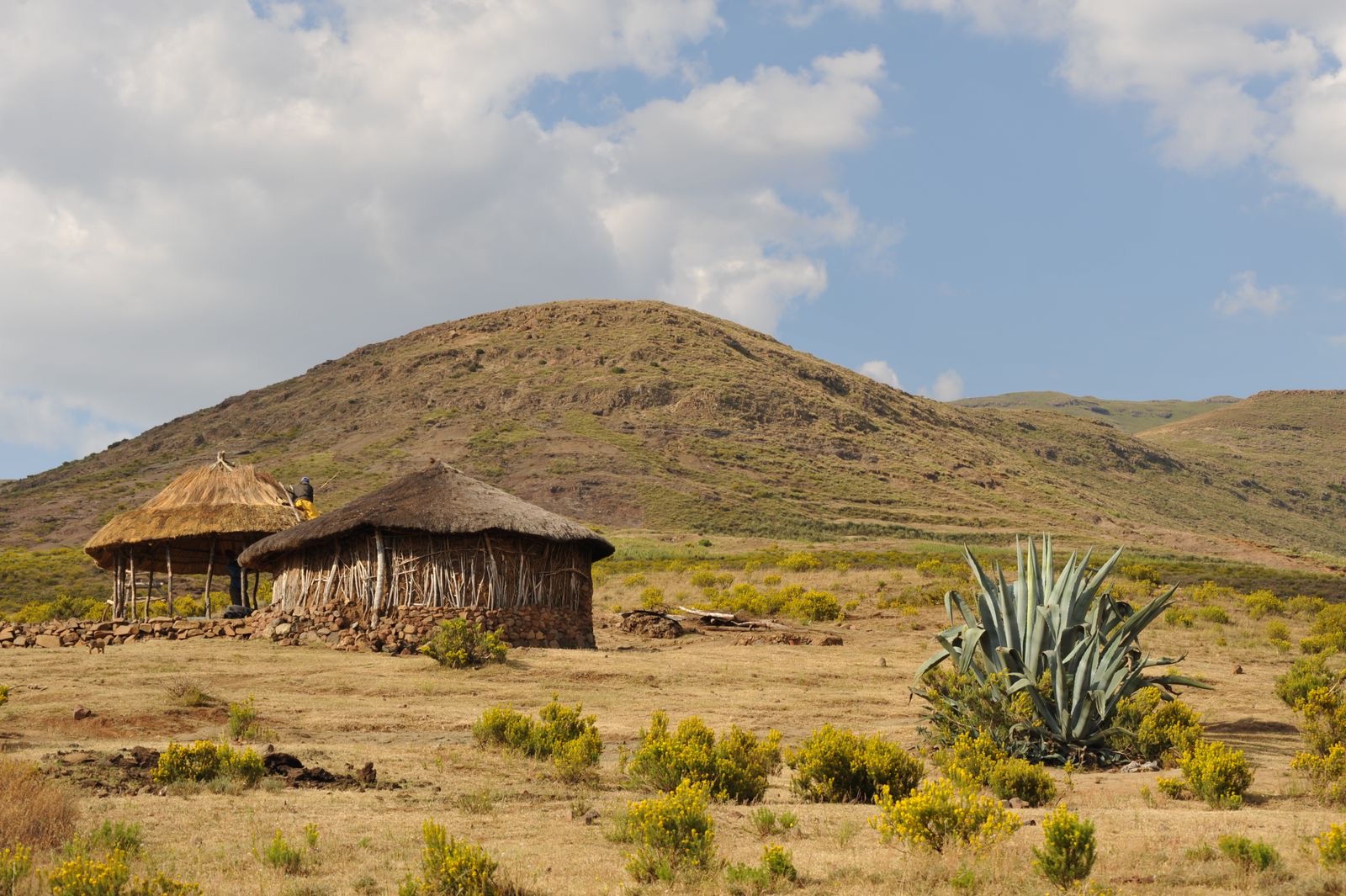
The villages we passed through were small — a cluster of rondavels, a school built from donated cinderblocks, a shop that sold paraffin and sugar and airtime. Women washed clothes in the river while children drove cattle with sticks they wielded like conductors' batons. The economy here runs on livestock and remittances from the mines across the border in South Africa, and the landscape bears the evidence of both: overgrazed hillsides where the topsoil has retreated to reveal ribs of sandstone, and new tin roofs paid for by men who spend eleven months underground in Gauteng. Lesotho's workforce largely lives elsewhere, and the weight of that absence shapes the demographics — the very old, the very young, and the women who hold everything between those poles.
On our last night, we slept in a rondavel — the traditional round stone hut with a thatched roof — and the temperature dropped to near freezing. The stars above Lesotho were obscene in their clarity, the Milky Way a wide brushstroke across the sky with no light pollution to dilute it. In the morning, Thabo made us moroho — wild greens cooked with maize meal — over a fire, and we ate sitting on the ground while the ponies grazed nearby. Lesotho, he told us, means the place of the people who speak Sesotho. It is a country defined entirely by language, altitude, and the stubbornness required to live at both.