Madagascar split from the African continent roughly 160 million years ago and has spent the intervening time becoming something else entirely. The result is a place where ninety percent of the wildlife exists nowhere else on earth, where the trees look like they were planted upside down, and where isolation has become a form of identity so deep it saturates the soil. We flew into Antananarivo on a Tuesday evening, the city stacked across its hills in tiers of terracotta and crumbling colonial plaster, the traffic below operating on a logic that owed nothing to lane markings. Our driver navigated with his horn and his intuition, both finely calibrated.
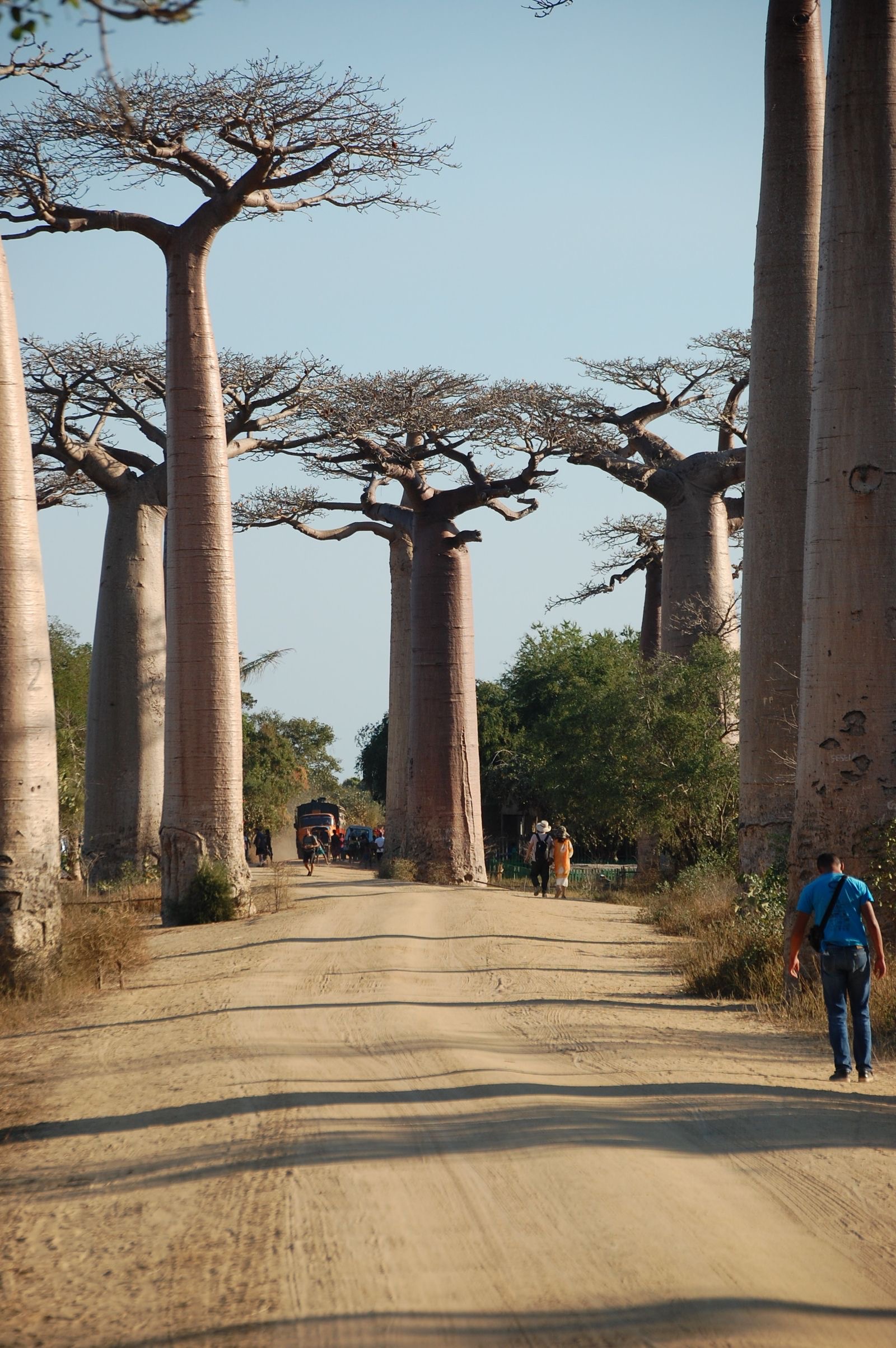
The Avenue of the Baobabs near Morondava is one of those places where the photograph never captures the scale. The trees — Adansonia grandidieri, some over eight hundred years old — stand along a dirt road like columns in a roofless cathedral, their trunks swollen and silver-grey, their branches splayed against the sky in gestures that suggest supplication or indifference, depending on the light. We arrived at dusk, when the sun dropped behind the trees and turned them into silhouettes, and the few rice farmers on the road cast shadows longer than the baobabs themselves. There was no sound except the creak of an oxcart and the evening call of a Madagascar bee-eater. We stayed until the colour drained entirely, and the trees became shapes against the dark, patient and improbable.
Eighty million years of isolation, and the island has used every one of them.
On the east coast, near Mananara, the vanilla orchid grows in plantations shaded by litchi trees and ylang-ylang. The curing process takes months — the green pods are blanched, then sweated in wool blankets, then dried on racks in the sun until they blacken and wrinkle and release a fragrance so concentrated it makes you slightly dizzy. A farmer named Hery showed us his drying racks and let us hold a cured pod to our noses, and the smell was nothing like the extract in a bottle — it was deeper, almost fermented, with notes of tobacco and dark chocolate. Madagascar produces most of the world's vanilla, and the price fluctuations have turned it into a commodity more volatile than some metals. Hery spoke about this with the measured fatalism of someone who grows a luxury crop in a poor country.
The tsingy formations at Ankarana are limestone karst eroded into razor-sharp pinnacles by millions of years of rain. Walking among them requires harnesses and via ferrata cables, and the grey stone is so sharp it will cut through a leather glove. Below the tsingy, dry deciduous forest grows in the canyons, and ring-tailed lemurs move through the canopy with a fluidity that makes the human effort of climbing seem graceless by comparison. We watched a family of crowned lemurs leap between the pinnacles at a height that would have been fatal for us, their orange-capped heads catching the late light. The tsingy is not a landscape that accommodates visitors. It exists on its own terms, like most things in Madagascar.
In the central highlands around Ambositra, the Zafimaniry people carve geometric patterns into everything — window shutters, house beams, furniture, the handles of spoons. The patterns carry meaning: the spider web for family ties, the honeycomb for community, the cross-hatching for ancestors. UNESCO has listed the craft as intangible heritage, which is a way of saying it matters beyond its materiality. A woodcarver named Rabe worked on a window frame while we watched, his chisel moving with a rhythm that suggested the pattern was already in the wood and he was just bringing it out. That seemed to be Madagascar's general approach to most things: wait long enough, and what is there becomes what it was always going to be.