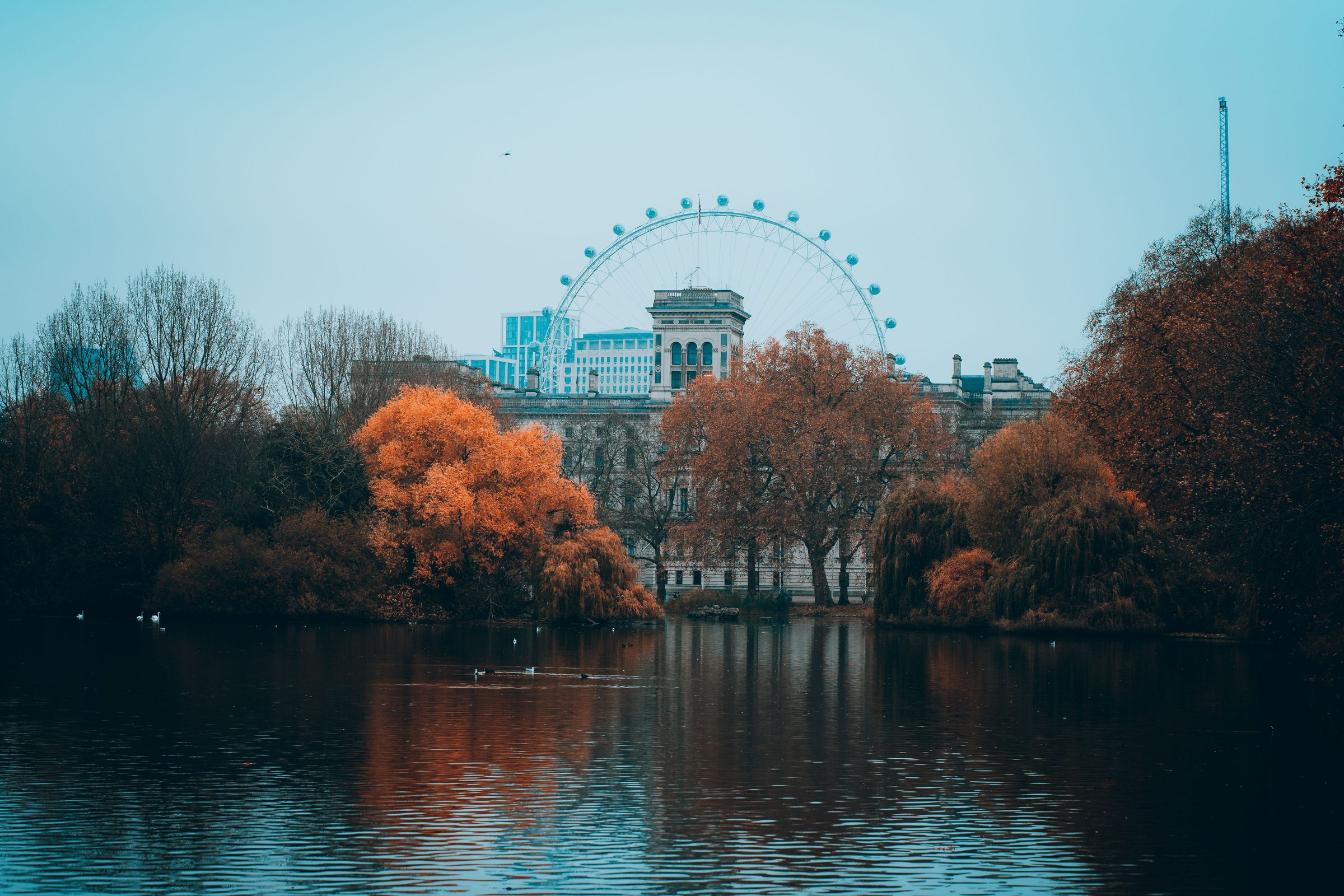
London runs on thirty villages sharing a Tube map. Each one has its own accent, its own pub, and its own theory about which park is the best park. The correct answer, as with most things here, depends on who is asking. We arrived on a Thursday in October, when the plane trees along the South Bank were turning the colour of old gold and the light on the Thames had the specific quality of London autumn — low, grey-gold, and flattering to every building it touches.
We stayed in Marylebone, a neighbourhood where the butcher knows your name and Oxford Circus is ten minutes away. The high street has a butcher, a cheesemonger, and a bookshop with a cat. The back streets have Georgian terraces painted in colours that Farrow & Ball would describe with words like ‘Elephant’s Breath’ and the rest of the world would describe as grey. On Sunday morning, the Marylebone Farmers’ Market was the quietest, most civilised negotiation for sourdough we have ever witnessed.
Thirty villages sharing a Tube map. Each one has its own accent, its own pub, and its own theory about which park is the best park.
The parks are the reason London works. Without them, the city would be a hundred square miles of brick and ambition. With them, it is something else entirely. Regent’s Park at seven in the morning, before the runners and the tourists, is as quiet as any countryside we have walked through. A heron stood in the lake, motionless, as if it had been there since Tuesday and had no plans to move before Friday. The rose garden was still wet. The city, beyond the trees, was invisible.
The Cotswolds, ninety minutes west by car, are what happens when a landscape decides to be pretty and never stops. The villages are built from honey-coloured limestone that the light turns to gold in the afternoon, and the hedgerows are so meticulously maintained they look like topiary. In Burford, the main street drops steeply to a medieval bridge over the Windrush, and the tea rooms outnumber the residents. In Bibury, Arlington Row — a line of weavers’ cottages from the fourteenth century — is the most photographed street in England, and it earns it, not because it tries but because it has been this beautiful for so long that trying would be redundant.
We had dinner at a pub in Stow-on-the-Wold where the beams were older than the menu and the roast explained everything about the English and Sunday lunch. The publican, asked about the building’s age, said it was sixteenth century, possibly fifteenth, and that the fireplace was original. He said this while lighting the fire, which he does every morning and finds nothing in it worth remarking on.
Back in London, on the last morning, we walked through Hampstead Heath at dawn. The city spread below us in a haze of chimney pots and cranes, and the trees on Parliament Hill were so still they looked painted. A man walked a greyhound that moved like something built for a speed that this morning walk would never require. The heath is eight hundred acres of what London would look like if London had never happened, and standing on it, at the highest point, with the skyline in one direction and the ancient woodland in the other, you understand the English talent: not for building cities, but for leaving enough green inside them that the city can breathe.
On the Eurostar back, the Cotswolds gave way to suburbs, the suburbs to London, and London to the tunnel. We fell asleep somewhere past Ebbsfleet. The last thing through the window was English fields — flat, green, divided by hedges into squares that looked, from the speed of the train, like a game nobody had explained the rules to.