In Utsjoki, the northernmost municipality in Finland, the sun sets in late November and doesn't return until late January. They call this kaamos. It is not darkness — it is blue. A deep, underwater blue that lasts all day and makes the snow glow as if it's generating its own light. We arrived in mid-December expecting a kind of sensory deprivation. What we found was the opposite — a saturation of blue so complete that every other colour we'd ever seen started to feel like a distraction.
We drove north from Rovaniemi in a rented car that had studded tyres and a block heater and an instrument panel that read minus thirty-one degrees. The road narrowed to a single lane. The trees shrank — first the birches disappeared, then the spruces thinned to isolated silhouettes bent sideways by wind. By Inari, the landscape was so flat and white that the horizon disappeared and the sky and the ground became the same surface. Driving felt like floating. Lucas kept checking the GPS because the road, snow-packed and unmarked, was indistinguishable from the frozen lake beside it. We passed a single car in ninety minutes.
By the third day, we stopped missing the things we had left behind, and by the fifth, we had stopped counting days altogether.
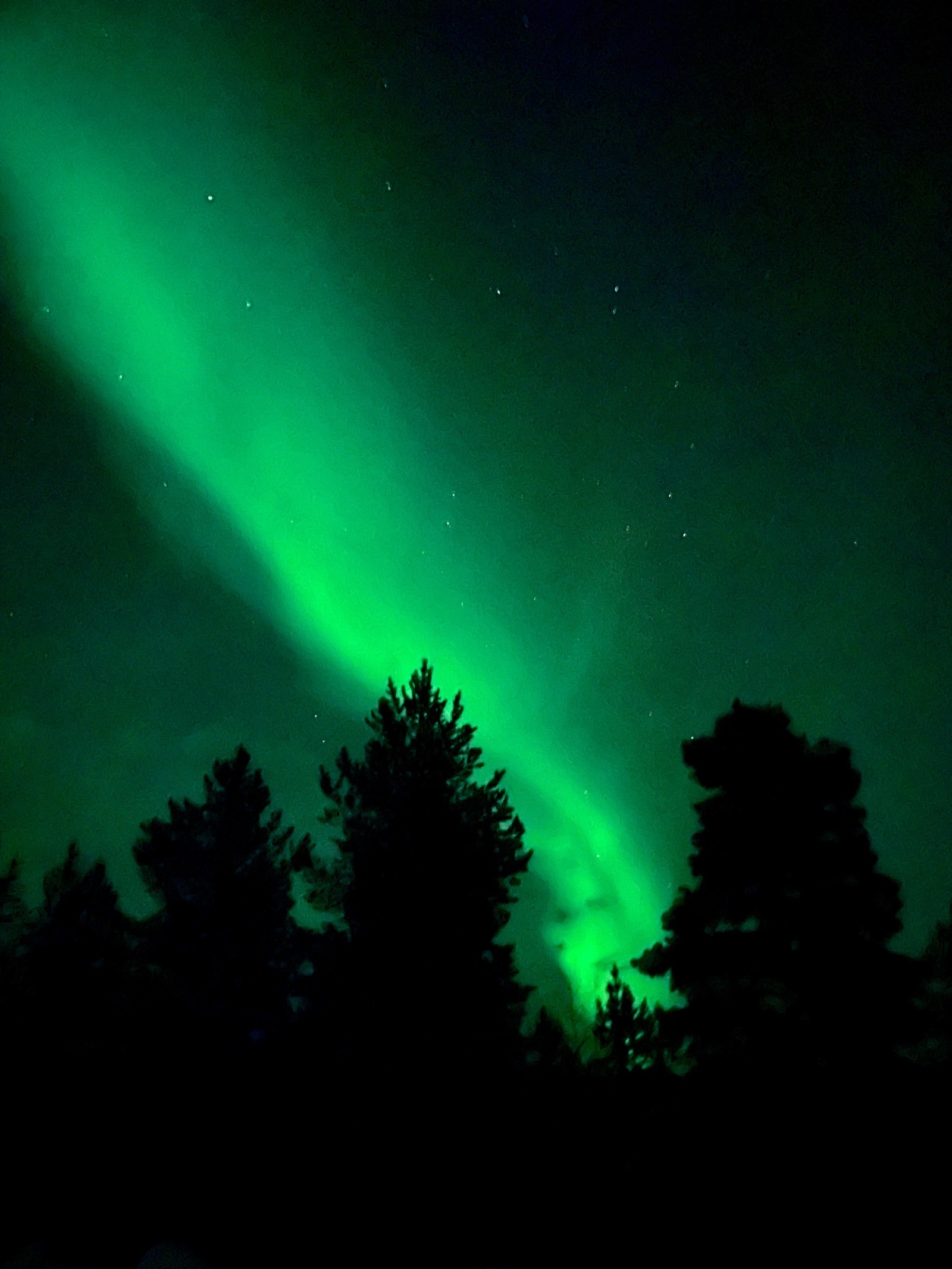
The cabin had a sauna and a window facing north and a wood-burning stove that took twenty minutes to bring the room from freezing to bearable. The routine established itself immediately: wake in the blue half-light, boil coffee on the stove, sit by the window and watch the colour shift from navy to cobalt to a pale steel that was the closest kaamos comes to noon. The first night, the aurora appeared at 10 PM — a green curtain that moved like something alive. Lucas, who reads atmospheric phenomena the way some people read weather forecasts, said the solar wind that night was unusually strong. The curtain turned violet. Then pink. Then it dissolved and the stars reasserted themselves with a sharpness that felt aggressive.
A reindeer herder named Nils-Matti invited us to his lavvu, a Sami tent heated by a birch fire, and served us dried reindeer meat and coffee boiled in a pot that looked older than the tent. He spoke Finnish, Sami, and Swedish, and he explained the seasons not as four but as eight — because the tundra insists on more precise language than the rest of Europe uses. There's a word for the season when the reindeer calves are born and a different word for when the lakes freeze and another for the two weeks when the snow is hard enough to travel on but not yet so deep that the reindeer can't dig through it. His herd numbered around four hundred, and he knew most of them by sight the way a teacher knows a classroom.
The food in Lapland follows the landscape: sparse, direct, surprisingly rich. Reindeer stew with lingonberries and mashed potatoes at a roadside inn that seated twelve and was the only restaurant within forty kilometres. Smoked Arctic char from Lake Inari, the flesh so orange it looked dyed but wasn't. Cloudberries picked in autumn and preserved in sugar, served on flatbread with a cheese that squeaked when you bit it. Every meal tasted like the specific place it came from, in a way that restaurant food almost never does. The cook at Aanaar in Inari was doing something with fermentation and foraged herbs that Michelin had recently noticed, but the dining room still felt like someone's front room, which is probably why it worked.
We skied into Lemmenjoki National Park on a trail marked only by orange ribbons tied to birch trunks, the snow untouched except for a single line of reindeer tracks. The silence was so complete that the sound of our skis was an intrusion. We stopped at a wilderness hut after twelve kilometres, lit the fire, melted snow for water, and sat in a quiet so total that when a branch cracked under the weight of ice outside, we both startled.
Lapland in winter runs at minus thirty, and the sun never fully rises. But by the third day, we stopped missing the things we had left behind, and by the fifth, we had stopped counting days altogether.