Kungsleden — the King's Trail — runs 440 kilometres through Swedish Lapland from Abisko to Hemavan, and most walkers, sensibly, choose a section rather than the whole. We chose the northernmost stretch, Abisko to Nikkaluokta, a five-day, 105-kilometre route through Sápmi, the traditional land of the Sámi, past Sweden's highest peak and reindeer herds that outnumbered the hikers by a wide margin. The train from Stockholm to Abisko takes eighteen hours. You board in a capital of glass and steel and step off into a silence so total it has weight. The platform at Abisko Östra is a concrete slab beside the track. The train leaves. You are in the Arctic.
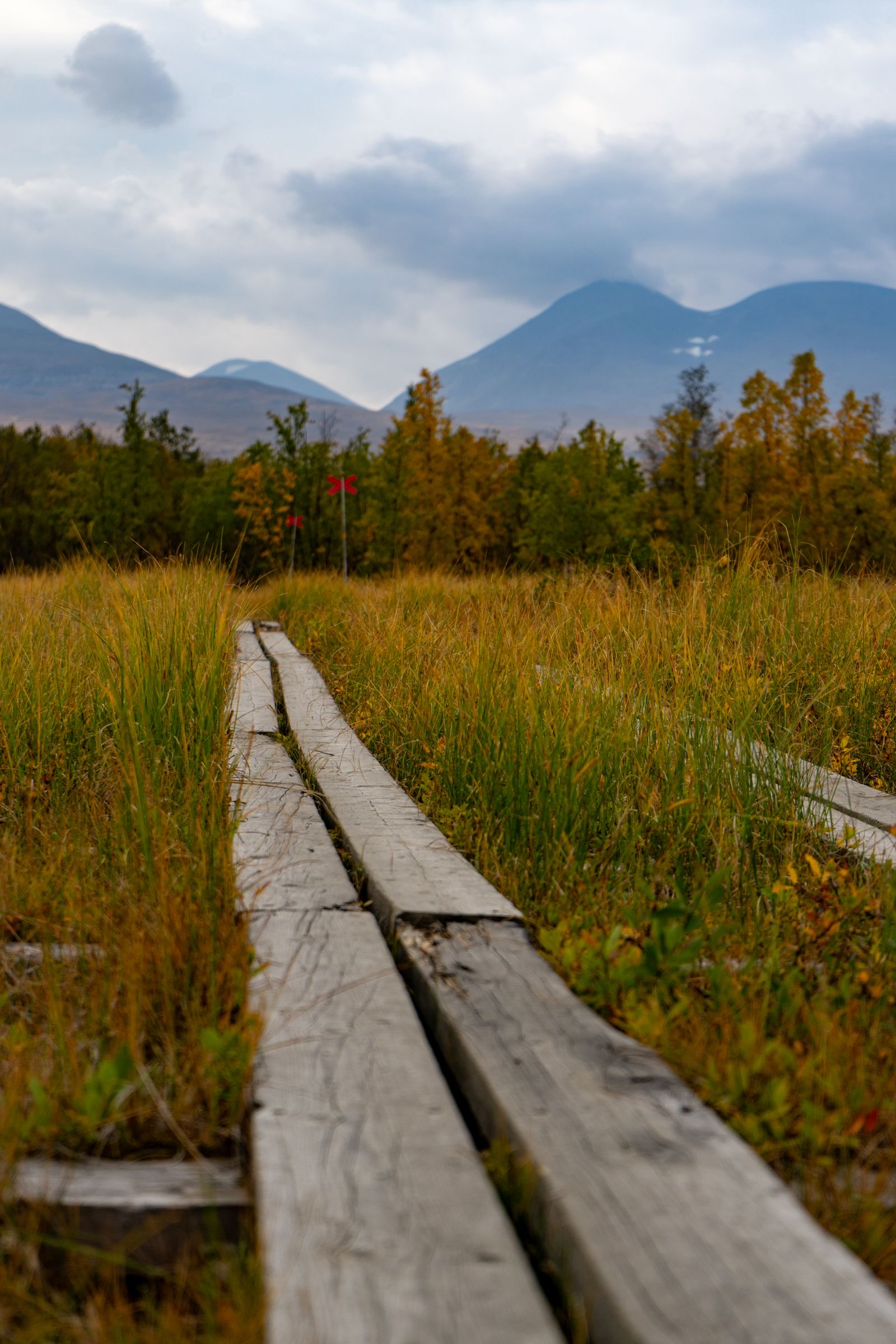
The trail begins in Abisko National Park, and within an hour the boardwalk crosses into a landscape so open it makes the concept of a 'trail' feel almost redundant — birch forest giving way to true tundra, the Torneträsk lake stretching silver to the horizon, and reindeer moving across the valley floor in loose formation, unbothered by our presence in a way that suggested we were the visitors and they very much were not. The birch trees are the last trees you will see for days. They grow low, bent by wind into shapes that look rehearsed. Beyond them, the land flattens into a treeless expanse where distance becomes unreliable — a cairn that looks ten minutes away takes an hour to reach, and mountains that seem close enough to touch are a full day's walk.
We slept in eye masks against a brightness that never dimmed.
The STF mountain huts along the route — Abiskojaure, Alesjaure, Tjäktja, Sälka — are a Swedish institution: wood-fired saunas, a communal kitchen stocked with a small shop selling chocolate at prices that reflect the difficulty of restocking a hut this far from a road, and wardens who track weather on the Tjäktja pass, at 1,150 metres the trail's highest point, with the seriousness of people who've had to turn hikers back before. At Alesjaure, two Sámi women ran a small turf-roofed shelter where they sold coffee and dried reindeer meat. The meat was dark and salty, cut into strips no thicker than a bootlace. We ate it standing by the lake, watching a pair of long-tailed skuas patrol the shoreline, and the combination of strong coffee and smoked game at sixty-eight degrees north felt like the most honest meal we'd had in months.
We crossed Tjäktja in a wind that made walking upright a genuine negotiation, past a red emergency shelter that exists for exactly this — horizontal rain and two-degree wind chill, and descended into the Tjäktjavagge valley as the cloud lifted to reveal Kebnekaise, Sweden's highest peak at 2,096 metres, its glacier catching a low sun that, in July, doesn't fully set at this latitude. The descent was steep and loose, the scree shifting underfoot with every step, and the valley below opened up in stages — first a river, then a meadow of cotton grass, then the Singi hut appearing like a red full stop at the end of a very long sentence.
The river crossings on the northern Kungsleden are not symbolic. The bridges are narrow, sometimes a single plank wide, and the glacial meltwater beneath them is the colour of milk and cold enough to numb a hand in seconds. At one crossing near Sälka, the bridge had been replaced by a rowing boat chained to both banks, which you pulled yourself across hand over hand while the current tried to argue you downstream. Lucas called it the most Swedish thing we'd encountered: practical, silent, and slightly more dangerous than it appeared.
The Midnight Sun changes a trek's rhythm entirely. We ate dinner at 11 PM in full daylight, slept in eye masks against a brightness that never dimmed, and understood, walking a ridge at 1 AM simply because the light allowed it, why Sámi reindeer herders have historically timed migrations to a clock that has nothing to do with sunrise or sunset. On our last night, in the hut at Singi, we sat outside on a bench while the sun dipped to the horizon, paused, and rose again without ever disappearing. The sky turned gold, then copper, then gold again.