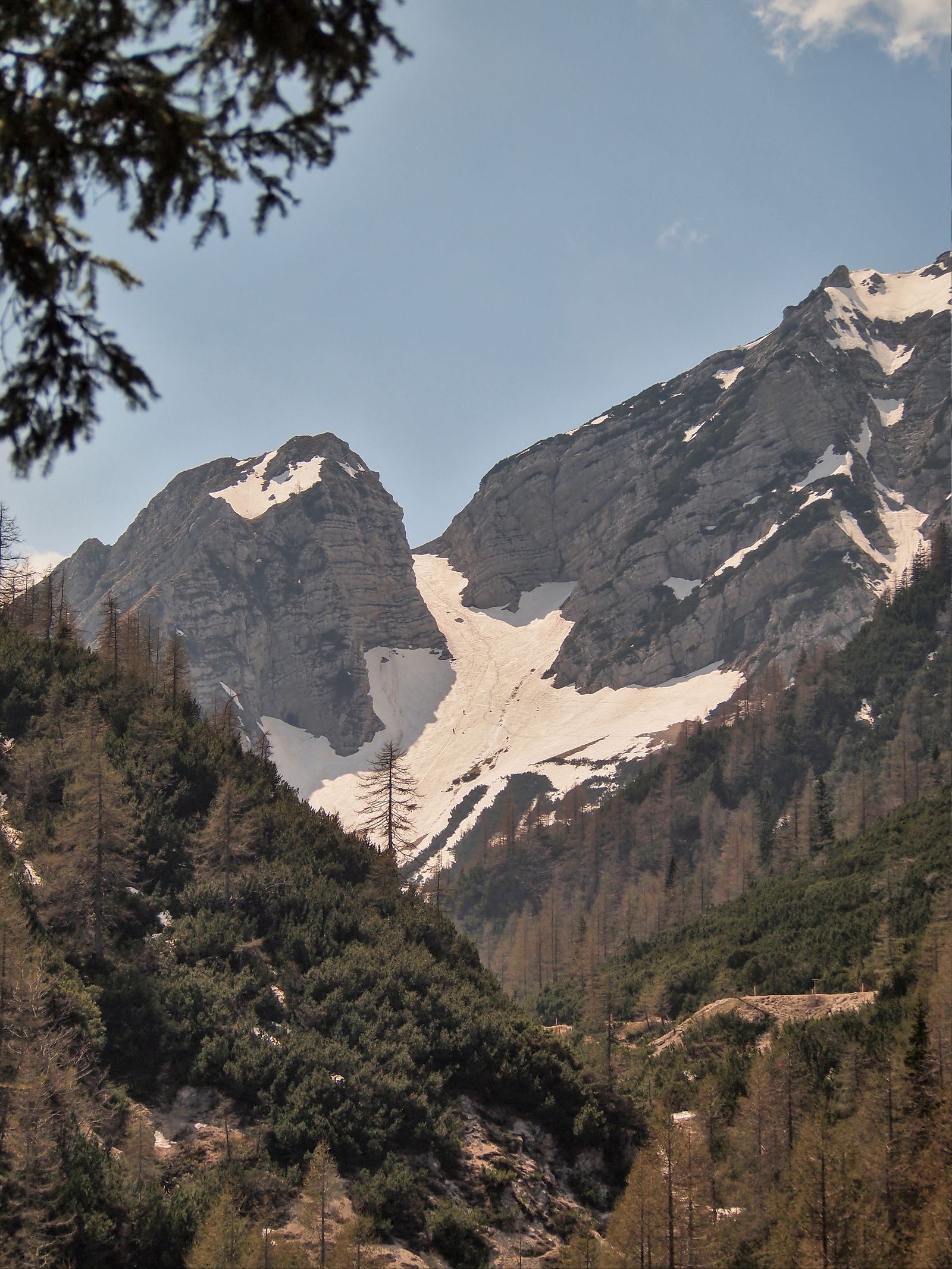
There's a Slovenian saying that you're not a true Slovenian until you've stood on Triglav's summit. At 2,864 metres, the country's highest peak and the central image on its flag, the mountain is less a hike than a rite of passage with cable-assisted sections, and we climbed it over two days from Pokljuka, via Vodnikov dom and the Kredarica hut, the way most visiting walkers do. The mountain appears on the national coat of arms, on the two-euro coin, and in the first conversation any Slovenian starts when you mention you're heading to the Julian Alps. Whether they've climbed it or not, they have an opinion about which route, which season, and how many times is respectable.
The approach through Triglav National Park is deceptively gentle — pine forest, karst sinkholes, a valley floor scattered with the region's distinctive haystacks — before the trail steepens sharply above the treeline and the final push to Kredarica requires hands as much as feet on the scree. Kredarica hut, at 2,515 metres, is Slovenia's second-highest, and we arrived to a dining room full of climbers comparing forecasts with the specific anxiety of people whose summit day depends entirely on wind speed. Dinner was jota, a sour cabbage and bean stew that tasted better than anything with that description has a right to, served in tin bowls at communal tables. A father and his teenage daughter from Ljubljana studied a topo map with the intensity of generals planning a campaign. She rolled her eyes at his caution. He pretended not to notice.
At that altitude, everyone's entitled to a little geography.
The summit push begins before dawn, and the final six hundred vertical metres involve exposed ridgelines with fixed cables — via ferrata sections that require a harness, though we saw plenty of confident locals scrambling past unclipped, treating the cables as suggestion rather than requirement. We did not follow their example. The exposure on the northeast side is real, and the guidebook's warning about 'a head for heights' undersold the situation by a comfortable margin. At one point the trail narrows to a ledge barely wider than a boot, the cable bolted into rock that drops away sharply on both sides, and the only reasonable strategy is to look at your hands, not your feet, and certainly not down.
The summit itself holds a small iron tower, Aljažev stolp, built in 1895 by a priest who wanted a shelter and ended up creating Slovenia's most photographed piece of high-altitude architecture. We reached it at 7 AM with four other climbers, the Julian Alps spread out in every direction under a sky so clear we could pick out Italy's Dolomites to the west and, someone claimed, Austria to the north. We didn't argue the claim. At that altitude, everyone's entitled to a little geography. A father and daughter from the hut the night before arrived ten minutes after us, and the daughter — the eye-roller — stood on the summit with her hand on the tower and wept in a way that made everyone else suddenly very interested in the view. She had earned it. So, for that matter, had her father.
The descent via the Seven Lakes Valley, a longer but gentler route down through a chain of glacial tarns, gave us two full days to decompress from the summit's exposure. The tarns sit in limestone bowls at progressively lower elevations, each a slightly different shade — slate green, pale turquoise, one almost black under the shadow of a cliff face. We swam, briefly and regrettably, in water cold enough to reset every joint we'd used getting up there, then lay on warm rock and watched clouds build over ridges we'd crossed that morning. By the time we reached the Bohinj valley floor, the mountain had receded into a silhouette that looked, from that angle, almost gentle. Triglav asks more of a hiker than its modest altitude suggests. Slovenians seem to consider that the entire point.