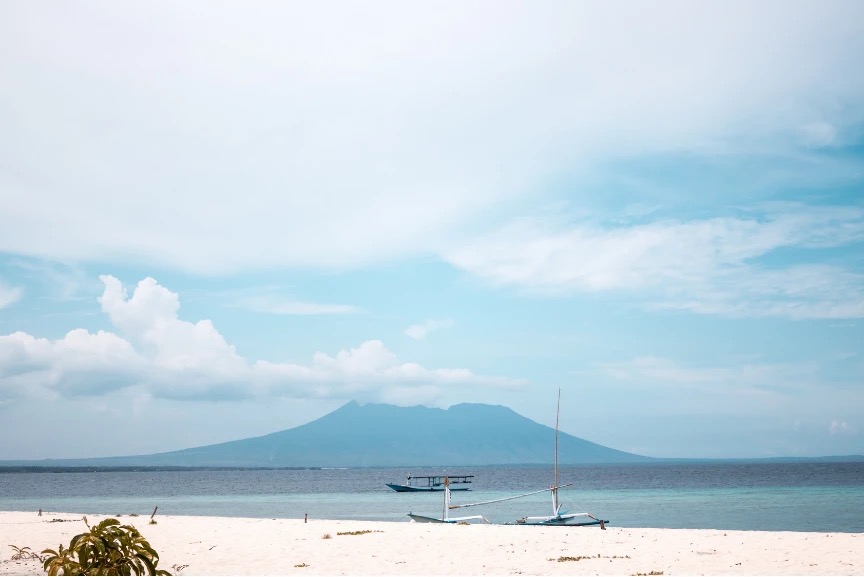
Java earns its reputation at 4 AM, when we stood on the rim of Mount Bromo and watched the sun rise over a caldera that looked like the surface of another planet. The sand sea below — a flat expanse of volcanic ash — caught the first light in bands of grey and gold, and the crater itself exhaled a column of sulphur that climbed straight up in the windless air. A horseman led his animal across the sand floor, a silhouette that belonged to a century we could not identify.
We had driven through the night from Surabaya, past sugar plantations and sleeping villages where the only light came from the mosque and the petrol station. The jeep rattled up the mountain on a road that our driver navigated by memory rather than headlights. At the viewpoint, a hundred people stood in silence. Nobody spoke. The spectacle was large enough to require it.
A star you can't see from Europe. It cost nothing but the walk up.
Bromo is the accessible volcano, the one the tour buses reach. Ijen, on the eastern tip of Java, is the one you earn. The trail begins at midnight and climbs for two hours through forest and then rock, and at the summit you look down into a crater lake the colour of antifreeze — an electric turquoise caused by dissolved sulphuric acid. By torchlight, miners carry baskets of solid sulphur up from the crater floor, eighty kilos per load, twice a day, for a wage that would not cover lunch in Jakarta. We watched and said nothing, because there was nothing to say that would not have been insufficient.
Between the two volcanoes, Java lives at a different pace. Malang, a university town in the highlands, had wide colonial avenues, a flower market that opened at dawn, and a warung where a woman served nasi rawon — a black beef soup stained with keluak nut — with a speed that said she could do this blindfolded and had chosen not to only because it would alarm the customers. We ate two bowls each and she nodded and refilled the sambal without asking.
Yogyakarta, seven hours west, is where Java keeps its cultural argument. The Sultan's palace, the Kraton, is still occupied by a sultan — the ninth in a line that predates the Dutch — and the court gamelan orchestra rehearses every morning in an open pavilion where anyone can sit and listen. The music is built on bronze and patience: each note placed a half-beat behind the one before, the ensemble following a structure that Western ears hear as improvisation but is actually a conversation between bronze instruments that we could follow without understanding a note.
Borobudur at sunrise rivals Bromo for the title of Java's greatest spectacle. The ninth-century Buddhist temple rises from a plain of palm trees like a stone mandala, 72 bell-shaped stupas containing seated Buddhas who have been meditating on the same view for twelve hundred years. We climbed to the top terrace and sat with one of them, watching the mist lift from the Kedu Plain, and for a moment the twelve hundred years between us and the stonemasons felt like nothing. Then a tour group arrived and we walked down into the day.
The crossing to the Gili islands was a corrective. After Java's density — its crowds, its sulphur, its layered history — Gili Trawangan offered subtraction. No cars, no motorbikes, no engines apart from the boat that dropped us at a wooden pier. The island is small enough to walk around in two hours, and we did, along a sandy path where the only traffic was horse carts and the occasional cyclist weaving between coconut palms. At night, the southern sky held constellations we had never learned to name — Centaurus, the Southern Cross — and the sea was so calm that the bioluminescence followed our ankles when we waded in. We slept in a bamboo room with no air conditioning and no door lock, and the sound of the reef breaking offshore was the only clock the island acknowledged.