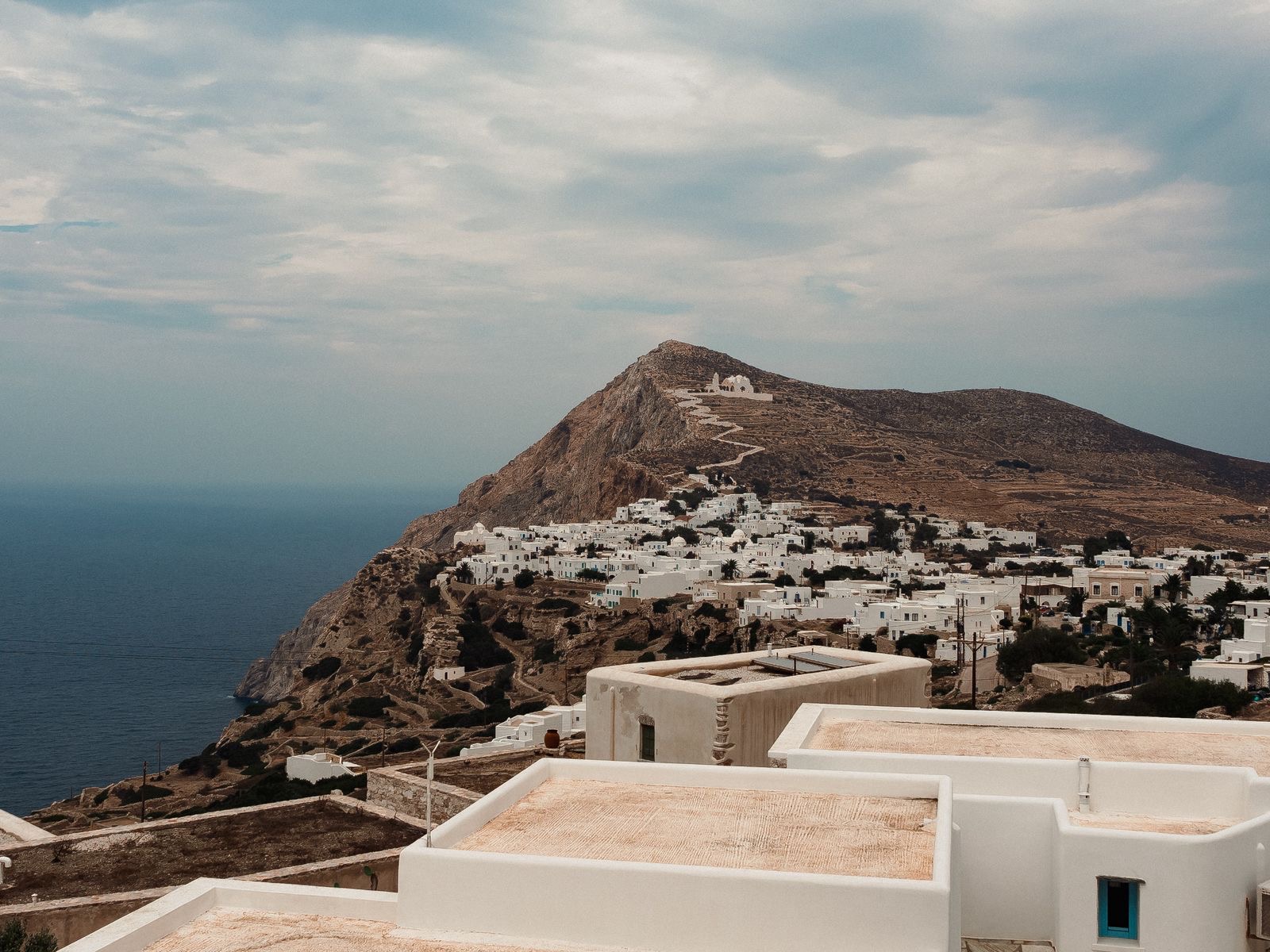
Folegandros has no airport, no chain hotel, no international brand. The ferry from Piraeus takes seven hours, sometimes eight if the meltemi is doing what the meltemi does, which is blow hard enough to rearrange your plans. This is the island's security system. Anyone who arrives has committed to arriving, and that commitment means the people on the dock actually want to be there.
The Chora sits on a cliff edge, white against blue in the way that Greece is always white against blue, but here without the crowd that usually stands between you and the cliche. The streets are barely wide enough for two people to pass, paved in slate and shaded by bougainvillea that spills over walls with a disregard for property lines. The church of Panagia is reached by a zigzag path that the donkeys know better than the tourists. At sunset, the entire village moves to the edge of the cliff and watches the Aegean turn from blue to copper to black. No one takes a photograph. Everyone takes a photograph. It doesn't matter. The sunset doesn't care. What struck us was the quiet — no music from a bar, no commentary, just the wind and the sound of ice in someone's glass.
The Cyclades beyond the famous ones ask for patience more than secrecy.
Tinos is the island the Greeks know. Marble villages — Pyrgos, Volax, Panormos — where the carving tradition is so embedded that even the bus stops are sculpted. The dovecotes in the fields are geometric abstractions that Mondrian would have studied, hundreds of them dotting the hillsides in patterns that are both decorative and functional. In Pyrgos, we visited a marble workshop where a sculptor named Dimitris was carving a lintel for a church in Athens, his hands white with dust, his radio playing rebetiko. He'd learned from his father, who'd learned from his father, and the tools on the wall looked old enough to prove it. The food is what Greek food is before it becomes Greek restaurant food: wild greens, raw artichoke, cheese aged in a cave so humid the wheels grew a second skin of mould that you peeled away to find something extraordinary underneath.
Amorgos is the furthest east, the most dramatic, the hardest to leave. The ferry arrives at Katapola, a harbour so small it feels like the island is holding its breath to let the boat in. The monastery of Hozoviotissa clings to a cliff 300 metres above the sea, white paint on brown rock, built in the 11th century by people whose ambition exceeded their engineering — and whose engineering held anyway. A monk offered us a spoonful of loukoumi and a glass of raki at the entrance, and the view from the monastery's narrow balcony — straight down to an Aegean so blue it looked synthetic — was enough to end any argument about where to go next. The path down to Agia Anna beach is steep, hot, and worth every step. The water at the bottom was cold enough to make us gasp and clear enough to see the seabed six metres down.
We ate most of our meals at tables placed directly on the edge of something — a cliff, a harbour wall, a terrace with no railing. Greek island restaurants trust their diners not to fall, and in return the diners get to eat grilled octopus with their feet dangling over the sea. On Folegandros, we had a dinner of goat slow-cooked in a wine whose name we never caught, with potatoes roasted in the same pan, and a salad that was mostly tomato and mostly perfect. The waiter brought us a carafe of house wine without being asked and charged us nothing for it. This happened more than once across the three islands.
The Cyclades beyond the famous ones ask for patience more than secrecy. You either take the slow ferry or you don't get there. The schedules are approximate, the connections are weather-dependent, and the reward for tolerating this is an island that still functions as a place where people live rather than a set designed for visitors. The inconvenience is the filter. It works.