A layover in Rome is a dare the city has been issuing for two thousand years: come see everything, we don't care that you only have a day. We landed at seven, dropped bags at a hotel in Monti, and let the Eternal City do what it does to anyone with limited time — compress two millennia into a walk that never quite lets you sit down. The streets were already warm at half past eight, and the espresso at the corner bar cost one euro twenty and was, without exaggeration, better than any coffee we'd had in the previous six countries.
The Pantheon at 8 AM, before the tour groups, is close to a religious experience even for the non-religious. The oculus throws a single disc of light across the coffered dome, moving through the day like the slowest sundial ever built, and the building has been doing this, uninterrupted, since 128 AD. We stood under it in silence with four elderly Italians attending the morning Mass, and nobody looked up at us for arriving underdressed. The scale of the interior only registers when you stand directly below the opening and look up — the dome is wider than St. Peter's, a fact that most people learn and immediately forget because St. Peter's has better marketing.
The stone goes the colour of the Aperol you'll be drinking twenty minutes later on a rooftop in Monti.
From the Pantheon we walked without a route, which in Rome means you end up somewhere extraordinary by accident. Through Piazza Navona, still being hosed down from the previous night, its fountains running clean and its vendors not yet arrived. Down a side street where a woman was hanging laundry between two buildings four storeys up, the sheets white against terracotta, a composition that no photographer could have improved. Past the Largo di Torre Argentina, the sunken ruins where Caesar was assassinated, now a cat sanctuary — dozens of feral cats sleeping on the stones where a republic ended, cared for by volunteers who have clearly decided this is a reasonable use of ancient history.
Lunch was cacio e pepe at a trattoria two streets from the Pantheon with no English menu and a waiter who corrected our pronunciation without being asked, kindly, the way a good teacher corrects a student they believe in. The pasta had three ingredients — pecorino, black pepper, and water starch — and the result was better than most meals we ate all year. We asked how he made it. He said practice. Forty years of it. The Trevi Fountain came after, crowded exactly as advertised, and we threw the coin anyway, because refusing the cliche felt more effortful than simply enjoying it.
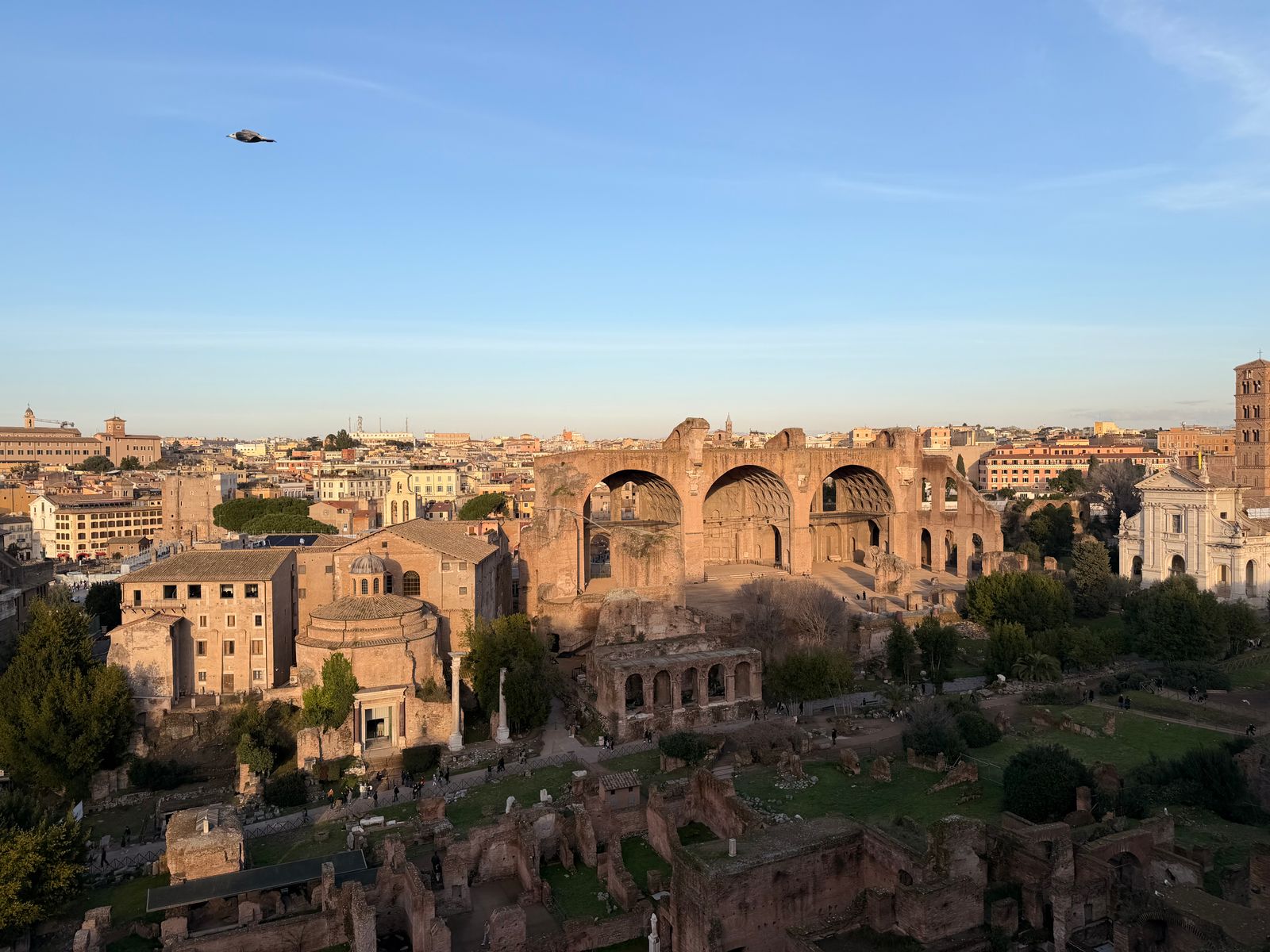
The real trick to a Rome layover is the golden hour walk from the Capitoline Hill down through the Roman Forum's edge to the Colosseum, timed for 6 PM, when the stone goes the colour of the Aperol you'll be drinking twenty minutes later on a rooftop in Monti. The Forum at that hour is closed to entry but entirely visible from above, and the columns cast shadows that lengthen in real time across a floor that Cicero's sandals actually touched. The Colosseum at sunset is the rare landmark that exceeds its photograph — larger, more violent in its beauty, more obviously a machine built for spectacle than any image can convey.
We caught our flight the next morning having seen, by rough count, four empires' worth of architecture in under eighteen waking hours. Rome, more than any city we've visited, rewards the compressed trip — not because a day is enough, but because the city's density means that even the walk between monuments is a monument. Every corner turned is a church, a fountain, a ruin repurposed as a wall. A layover, with its hard deadline, removes the luxury of selection: you take what the city offers, in the order it offers it, and Rome's order has been good enough for twenty centuries.