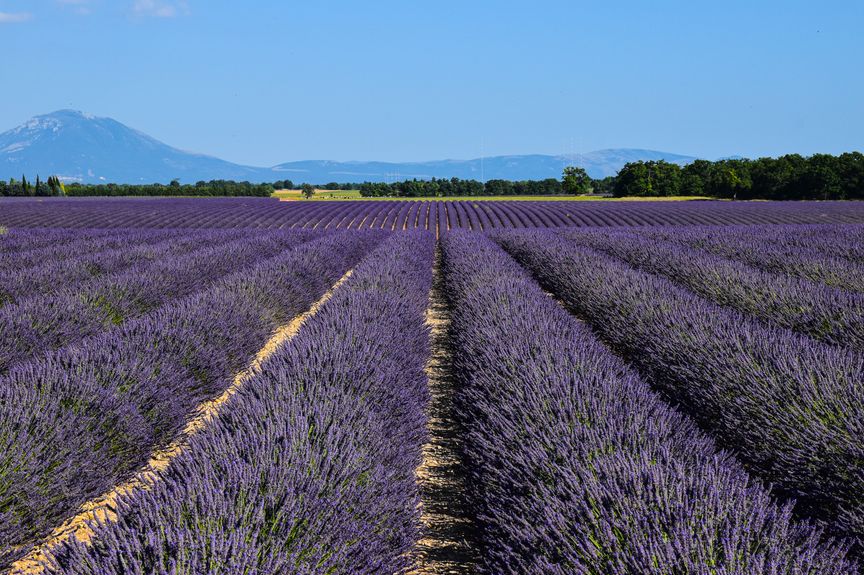
Provence is not a destination. It is an argument about light. Cézanne made it about the mountain. Van Gogh made it about the colour. Peter Mayle made it about the house. The light does not care. It arrives at six, turns the stone from grey to gold, and leaves at nine, having proved its point. We drove down from Lyon in June, when the lavender was a week from full bloom and the air already smelled of thyme and warm stone and the particular dry heat that makes you understand why the Romans came and never left.
The Luberon is the part of Provence that Instagram has not yet ruined, though not for lack of trying. The villages — Gordes, Bonnieux, Ménerbes, Lacoste — sit on hilltops the way Provençal villages have always sat on hilltops: as though they arrived first and the landscape arranged itself around them. The stone is pale. The shutters are blue or green or the colour of dried lavender. The fountains work. The cafés serve rosé at a temperature that suggests the bottle was in the shade five minutes ago and the shade was five degrees cooler than the street.
The light arrives at six, turns the stone from grey to gold, and leaves at nine, having proved its point.
In Gordes, the market fills the square on Tuesday mornings with stalls selling everything from chèvre so fresh it trembles to soap cut from blocks the colour of olive oil. An old man in a flat cap sold us honey from hives he kept on the plateau de Vaucluse, and when we asked what kind, he said: all kinds, because the bees go where they want and he had given up arguing with them years ago. The honey tasted of lavender and rosemary and the heated scrubland that the Provençaux call garrigue and that has no English translation because English does not have the right sun.
We stayed in a mas outside Bonnieux — a stone farmhouse that had been in the same family since before the Revolution and that the current owners had restored with the specific restraint of people who understand that old stone does not need help, only maintenance. The bedroom had lime-washed walls, a view of Mont Ventoux, and no air conditioning, because the walls were a metre thick and the mistral, when it blew, arrived through the windows and cooled the whole room in five minutes.
Aix-en-Provence, thirty minutes south, is a city that makes everywhere else look like it is trying too hard. The Cours Mirabeau — the main boulevard, lined with plane trees so old their branches have fused into a canopy — is where the city sits and watches itself. The cafés are not remarkable. The fountain in the centre is not remarkable. What is remarkable is the light, which arrives through the trees in a pattern that dapples the limestone and makes the whole boulevard look like a film set that nobody bothered to strike.
At Rustrel, the Provençal Colorado, the ochre cliffs turn the landscape into a colour chart that no paint manufacturer would dare produce. The paths wind through formations of red, orange, and yellow earth that look like the desert of the American Southwest transplanted into a pine forest. We walked for an hour and saw three people. The silence was the kind that makes noise feel like an intrusion.
We left on a morning when the mistral was blowing hard enough to rattle the shutters of the mas. The lavender was in full bloom by then, the fields striped purple and green across the plateau. At the last petrol station before the motorway, the attendant asked where we had been. The Luberon, we said. He nodded. He was from Apt. He said the honey was better this year.