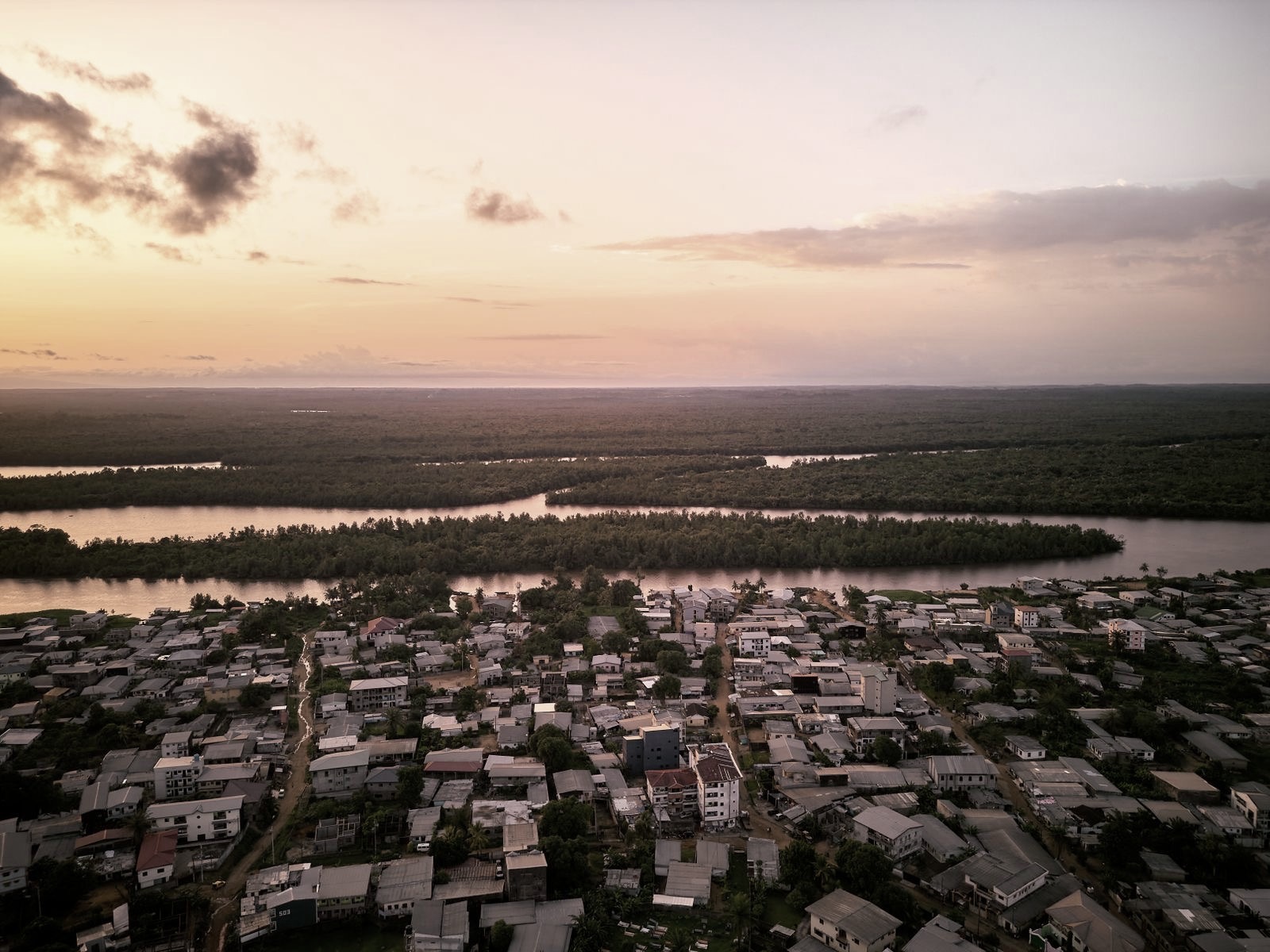
Douala does not announce itself so much as arrive — a density of sound and diesel and wet heat that meets you the moment you step outside the terminal. The city sits where the Wouri River widens into an estuary, and everything here carries the memory of water. The air is thick enough to lean against. We took a taxi through Akwa, past buildings where the colonial facades are slowly being replaced by concrete and glass, and past others where the concrete is being reclaimed by mould and bougainvillea in equal measure. Douala works like a port: things arrive, mix, and move on. Two colonial languages — French and English — coexist in a friction that shapes everything from politics to the way a market vendor switches mid-sentence.
The art scene operates from spaces that refuse the white-cube formula. At Doual'art, a contemporary art centre in Bonanjo, the exhibitions spill into the street and the street spills back. We saw an installation made from reclaimed motorcycle parts — helmets, handlebars, exhaust pipes — arranged into a form that suggested both a crowd and a machine. The artist, a woman from Bamenda, explained that the piece was about movement and about the impossibility of standing still in a city built on trade routes. Later, at the SUD Salon Urbain de Douala, we walked through a neighbourhood where public art had been commissioned not for galleries but for intersections, walls, and the concrete pillars of an overpass. The work was not decorative. It argued.
Cameroon is a country of crossroads — linguistic, geographic, culinary — and it carries all of it at once without making a fuss.
From Douala, the road to Buea climbs through palm plantations and into cloud. Mount Cameroon — Fako, in the local Bakweri language — is an active volcano that rises 4,040 metres from the coast and generates its own weather systems with a confidence that makes meteorology feel like suggestion. We hiked the lower slopes with a guide named Emmanuel, through montane forest where the canopy closed above us and the light came through green and broken. He pointed out plants used in local medicine, and birds whose calls we could hear but not see. The mountain had been in cloud since morning, and the rain arrived not as a decision but as a gradual increase in the weight of the air until everything was simply wet.
In Buea, the old German colonial capital, we ate ndolé — bitter leaf stew with shrimp and groundnuts — at a roadside restaurant where the plastic tables were set beneath a mango tree. The dish was complex in the way that Cameroonian cooking often is: layered, slow, built from ingredients that each required their own preparation before they could meet. A woman at the next table was speaking Pidgin English into her phone with a cadence so musical we mistook it for song. Cameroon is a country of crossroads — linguistic, geographic, culinary — and it carries all of it at once without making a fuss.
We returned to Douala in the evening, when the city's energy shifts from commercial to social and the waterfront fills with families, vendors selling grilled fish and plantain, and the sound of Makossa drifting from somewhere we could not locate. The Wouri was the colour of iron in the fading light. A pirogue crossed slowly, its outline sharp against the water, carrying something we could not see to a destination we could not name. Cameroon is complicated, and it does not apologise for that. We liked it for exactly this reason.