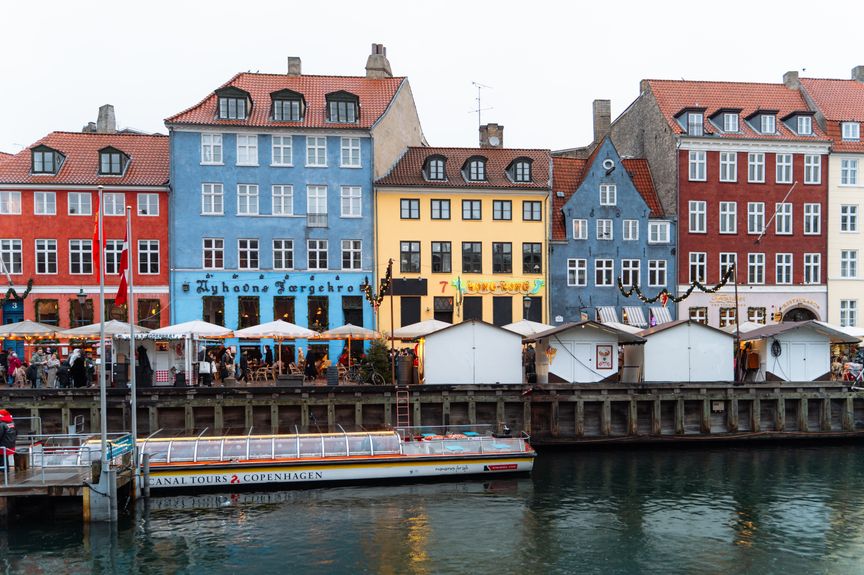
Copenhagen in autumn operates on a principle that the Danes call hygge and the rest of the world has spent a decade trying to translate — something closer to the decision to make the indoors as beautiful as the outdoors is brief. The candle, the wool, the coffee, the chair that costs more than a sofa and is worth it because you will sit in it for the next forty years. We arrived in late October, when the light lasted until four and the city had turned inward, which is to say it had turned into itself, which is where Copenhagen does its best work.
Nyhavn — the coloured houses along the canal — is the postcard, and it earns it, but the real Copenhagen is two streets back, where the design shops sell lamps by Poul Henningsen and ceramics by Kähler and the staff speak about light distribution the way French waiters speak about terroir. In a furniture showroom on Bredgade, a salesman explained the engineering of an Arne Jacobsen Egg chair with a reverence usually reserved for religious texts. The chair was, we conceded, extremely comfortable. The price was, we noted, more than our return flights. This appeared to be the correct ratio.
A country that spends five months in the dark has a very good reason to make its interiors extraordinary.
The food in Copenhagen has, since Noma, been discussed to the point of exhaustion. What is less discussed is the bread. The rugbrød — dense, dark rye bread, sliced thin and topped with whatever the smørrebrød tradition considers appropriate — is the foundation on which Danish lunch is built. At Aamanns, a smørrebrød restaurant in the city centre, the herring was cured in-house, the remoulade was made that morning, and the rye bread tasted the way February sounds — slow, dark, deliberate produce.
We cycled to the Assistens Cemetery in Nørrebro, where Kierkegaard and Hans Christian Andersen are buried and where the living come to run, picnic, and sit on benches among the headstones with a casualness that suggests the Danes have a different relationship with death than most people, or possibly the same relationship but better furniture. The trees were golden. The graves were mossy. A woman read a novel beside a stone that had been there since 1847 and neither of them seemed to mind the other’s company.
Louisiana, the modern art museum thirty kilometres north of the city, is the argument for putting a museum beside the sea instead of in a city centre. The building wraps around a sculpture garden that drops to the Øresund, and the view across the water to Sweden is visible from the gallery where a Giacometti stands in front of a window that frames the strait and the curator and the architect clearly coordinated the angle. This is Denmark: the detail is always intentional.
We left on a Sunday morning when the city was still asleep and the light was the flat, silver kind that makes Copenhagen look like a photograph of itself. The Egg chair was still in the showroom on Bredgade. We had not bought it. We had sat in it for eleven minutes. The salesman said this was above average.