Prague earned its nickname — the City of a Hundred Spires — honestly, and the actual count, depending on who's counting, runs closer to five hundred. We climbed the Old Town Hall Tower at dusk rather than joining the crowd waiting for the Astronomical Clock's hourly show below, and the view repaid the substitution: a skyline of Gothic and Baroque spires catching the last light in a way the clock, for all its 15th-century mechanical genius, couldn't compete with. From up there, the city looks like a forest of stone — each spire a different height, a different century, a different idea about what a building should reach for.
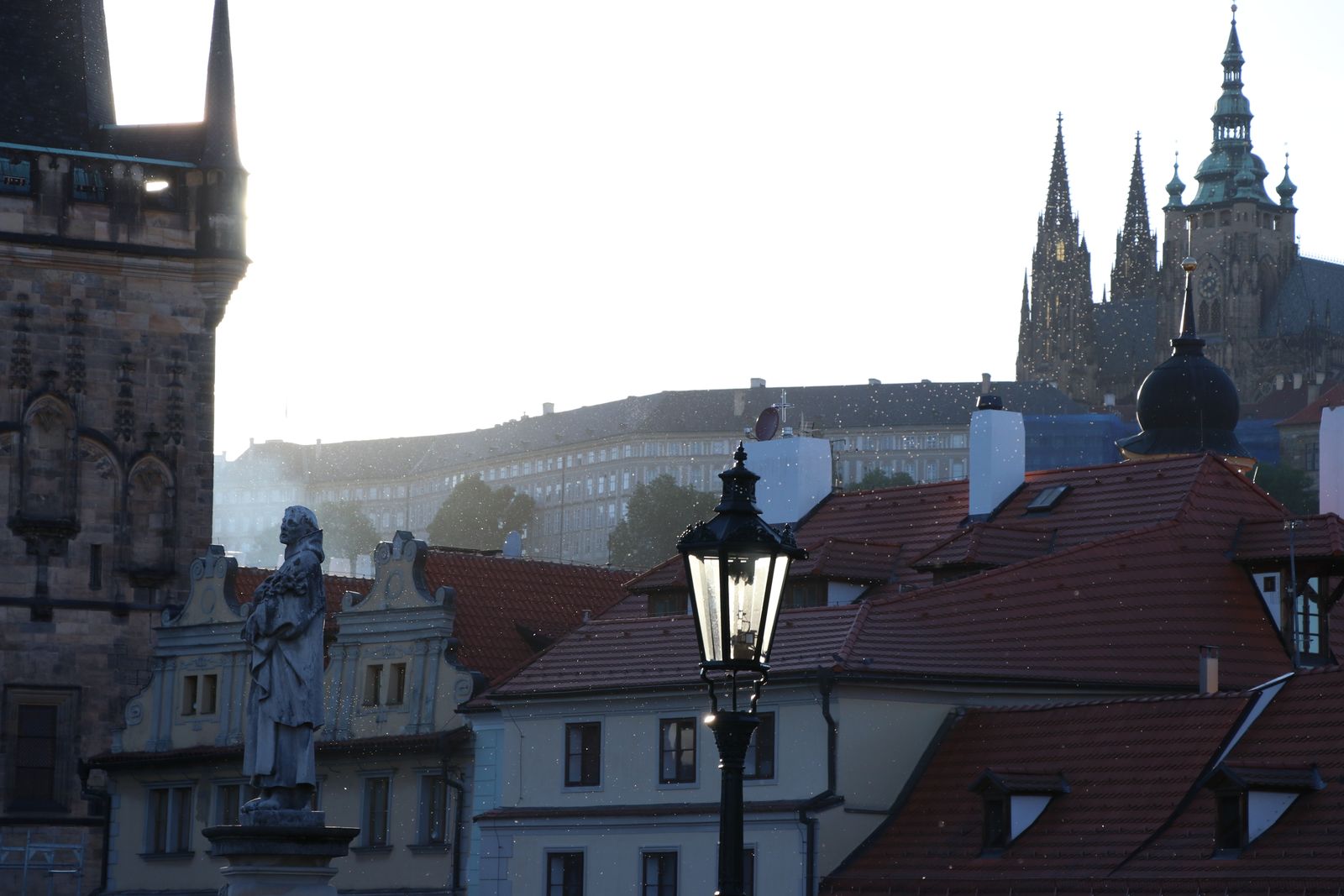
The Charles Bridge at 6 AM belongs briefly to joggers and a handful of vendors setting up easels, before the statues of saints along its length disappear behind a wall of tour groups by nine. We crossed it early, deliberately, and stood at the centre watching the Vltava move under thirty arches that have carried foot traffic since 1357. The fog hadn't fully lifted, and the bridge towers on both ends dissolved into grey at their tops, which made the statues — blackened Baroque figures frozen in expressions of devotion or agony — seem to float. A fisherman below us was casting from a small boat, apparently unconcerned with the six centuries of architecture above him.
Prague's beauty and its recent history sit close together, geographically and otherwise.
Czech beer culture functions as national infrastructure, with per capita consumption higher than anywhere else on Earth and a price point that makes the local Pilsner Urquell cheaper, reliably, than bottled water. We drank ours at a hospoda in Mala Strana with wooden benches worn smooth by generations of elbows, alongside a table of retired men who'd clearly been having the same argument at the same table for decades. The waiter replaced empty glasses without being asked and marked each round with a pencil stroke on a paper slip. The system has survived centuries of political change, and we suspect it will survive whatever comes next.
We walked through the Jewish Quarter in the afternoon, where the Old Jewish Cemetery holds twelve thousand tombstones in a space the size of a small garden, the graves stacked twelve layers deep because the living weren't permitted to expand the burial ground. The headstones lean against each other like tired commuters. Rabbi Loew's grave, marked by pebbles left by visitors, sits in the corner, and the legend of the Golem he supposedly created — a clay figure brought to life to protect the community — felt less like folklore and more like a reasonable response to the neighbourhood's history. The Pinkas Synagogue next door has the names of 77,297 Czech Jewish victims of the Holocaust written on its walls. Every name by hand. The silence in that room is a different kind of silence than the one on the Charles Bridge at dawn.
The Museum of Communism, a short walk from Wenceslas Square, is a necessary corrective to the city's postcard prettiness — this skyline survived four decades under a regime that considered its own citizens' movement a security risk. We spent an hour reading transcripts of interrogations and looking at photographs of informants who'd been recruited from ordinary life — teachers, doctors, neighbours. Prague's beauty and its recent history sit close together, geographically and otherwise, and a good layover holds room for both rather than choosing only the one that photographs well.
We ended the day on a bench in Letna Park, above the Vltava, with a beer from the pavilion and a view that held the castle, the bridge, and the old town in a single frame. A skateboard park sat behind us — teenagers doing kickflips against a sunset that was turning the river gold. Prague layers its ages without apology: medieval stone next to Soviet concrete next to a 22-year-old's graffiti tag on a railway bridge. Prague hands you everything at once and expects you to sort it out yourself.