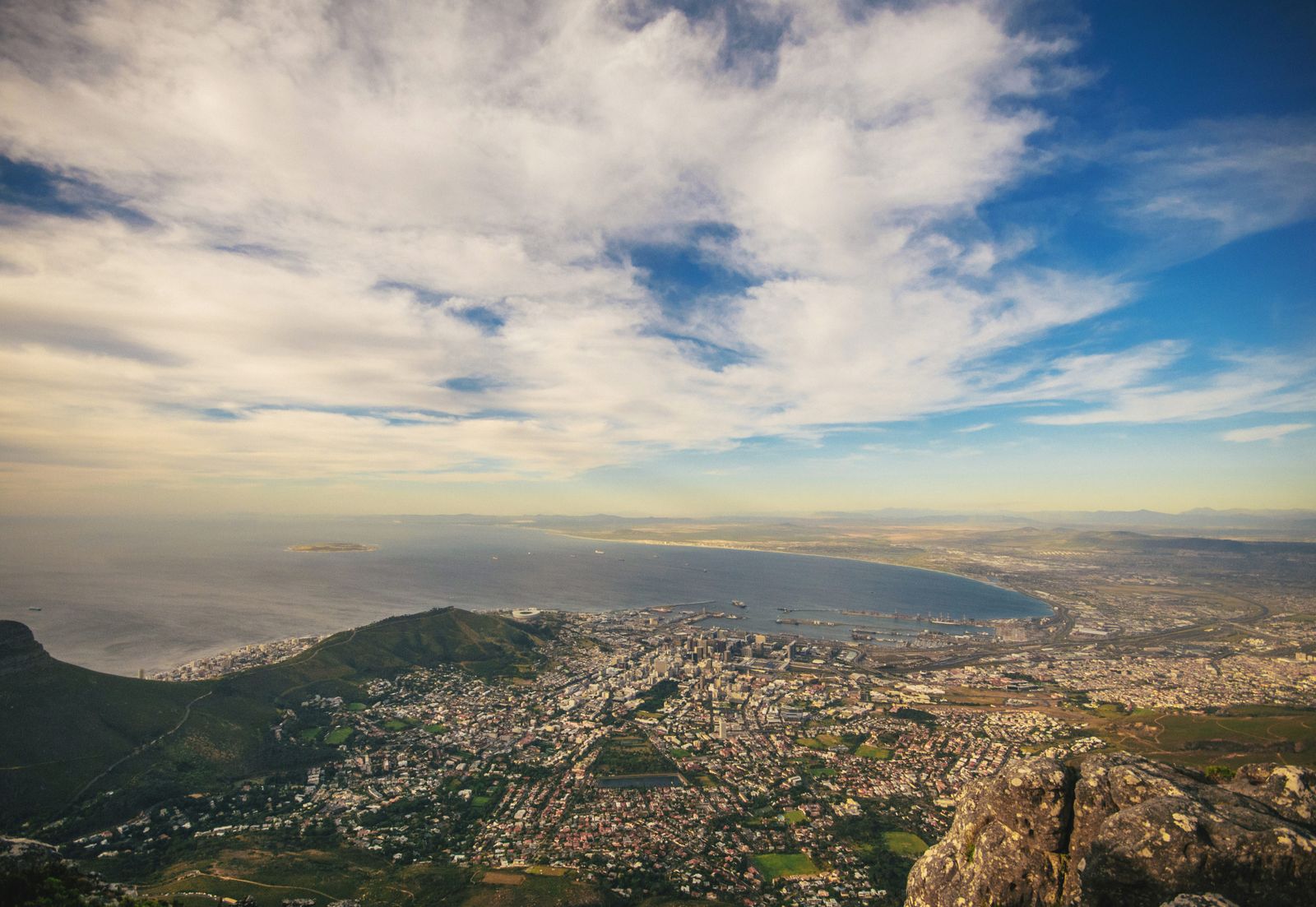
Cape Town changes colour every two hours. Morning haze off the Atlantic, the hard noon shadow Table Mountain throws across the Bo-Kaap, then that late amber that makes the winelands look like a painting you would not believe if someone showed it to you. We arrived on a January afternoon when the southeaster was up, and the tablecloth of cloud rolled over the mountain's flat summit, slow and theatrical, the edge curling down toward the city. The city beneath carried on, indifferent to the theatre above it.
In Woodstock, the old biscuit mills have become studios and coffee bars — ceramicists share walls with natural wine bars and nobody finds that unusual. We ate bobotie at a counter overlooking a courtyard where a woman was screen-printing protea motifs onto raw canvas. The food here carries history in its spice — Cape Malay turmeric, Dutch cinnamon, Indonesian sambal — layers of arrival compressed into a single dish. At Neighbourgoods Market on a Saturday, the queues moved slowly and nobody minded. Nobody here seems to be in a rush, and after two days we weren't either.
The wine was pale, mineral, faintly honeyed — it tasted like the afternoon looked.
The Bo-Kaap climbs the slope above Waal Street in a grid of houses painted lime green, cobalt blue, marigold, and the pink of watermelon flesh. The colours date from emancipation — freed slaves marking their homes in shades the Company had forbidden — and they have become both tourist backdrop and neighbourhood assertion. We walked the cobbled streets early, when the call to prayer from the Auwal Mosque drifted down over wet pavement and the spice merchants on Upper Wale Street were opening their shutters. A woman was making koesisters — syrup-soaked dough scented with cardamom and anise — at a table beside her front door, and she sold us two in a brown paper bag without interrupting her conversation with a neighbour. The sweetness had depth — cardamom, anise, a syrup that had been boiled to the exact right point — and it tasted like something that had been made this way for a very long time.
We drove out through Constantia toward Stellenbosch on a road lined with oak trees old enough to remember the Dutch East India Company. The wine estates sit in valleys so precisely beautiful they feel deliberate, the mountains and the vineyards lined up and the white-gabled Cape Dutch homesteads according to a Renaissance sense of proportion. At one estate, we drank a chenin blanc on a terrace facing the Helderberg range while swallows cut low arcs over the dam. The wine was pale, mineral, faintly honeyed — it tasted like the afternoon looked.
But Cape Town is also a city that holds its contradictions close to the surface. The cable car up Table Mountain costs more than many residents earn in a day. The townships stretch east from the airport in a geometry of corrugated iron and satellite dishes that the tourist bus routes carefully avoid. We walked through Langa with a guide who had grown up there, and he spoke without sentimentality about a neighbourhood that was making its own economy from braai smoke and gospel music and micro-enterprise. The mountain was visible from every corner, impassive.
On our last evening, we sat at a restaurant in Camps Bay where the plate glass framed the Twelve Apostles range turning rose and violet as the sun dropped behind Lion's Head. The Atlantic was steel-coloured and cold — always cold here, even in summer, the Benguela current arriving from Antarctic waters. A couple at the next table were arguing softly in Afrikaans. The waiter brought us kingklip and a Swartland syrah, and we watched the mountain darken from the top down, the city lights filling in what the daylight left, and neither of us said anything for a while. Cape Town does that to you at dusk.