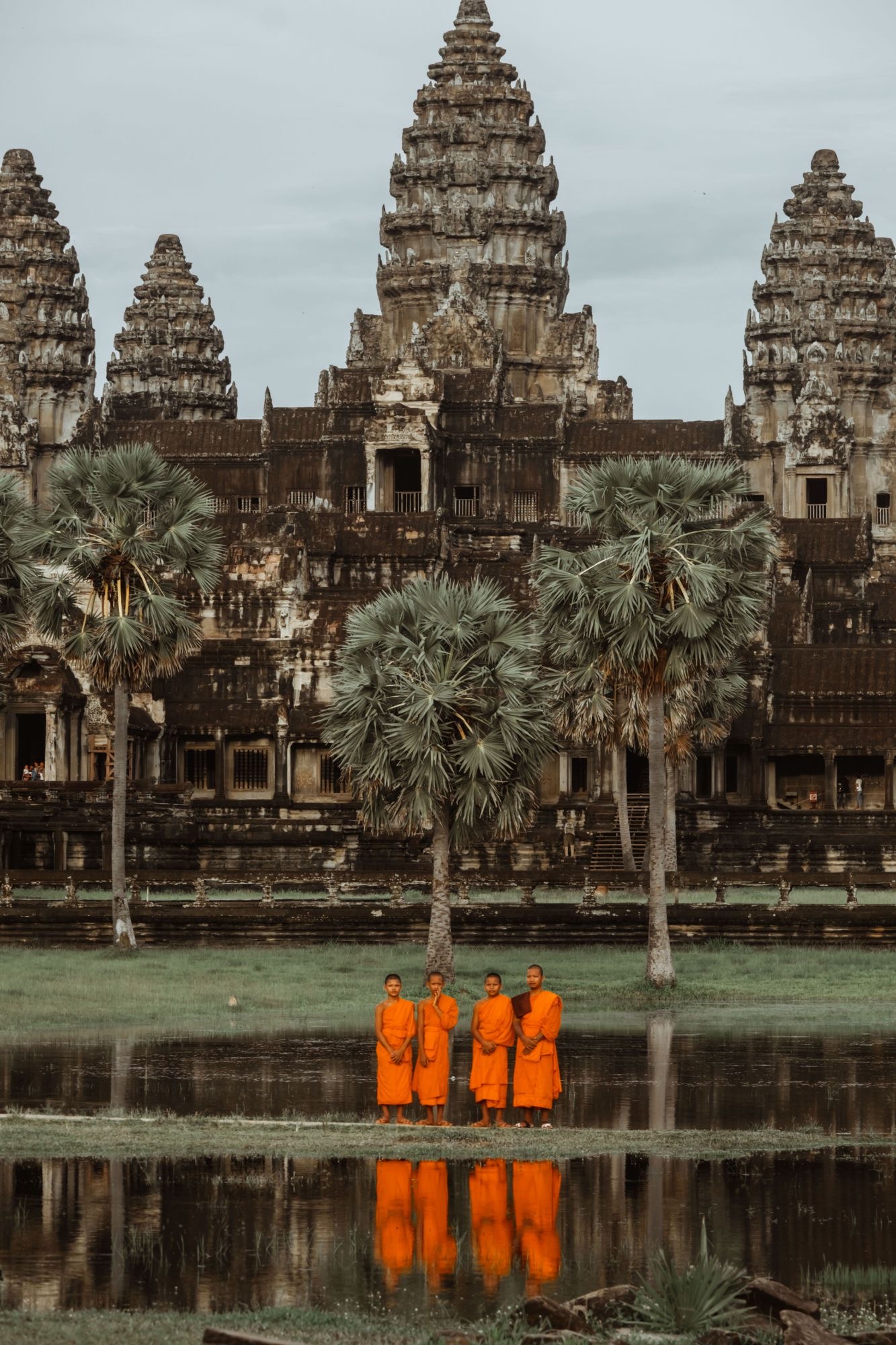
The alarm went off at four. The tuk-tuk driver was already waiting, smoking a cigarette that smelled of clove, his vehicle decorated with fairy lights that seemed optimistic for the hour. We drove in darkness through Siem Reap, past shuttered restaurants and sleeping dogs, and through the checkpoint at the Angkor Archaeological Park where a guard examined our three-day passes with a flashlight and waved us into a forest that contained the largest religious monument ever built.
Angkor Wat at sunrise is, before anything else, a logistical experience. Hundreds of people position themselves around the reflecting pool for the money shot — the five towers silhouetted against a sky that transitions from violet to orange over fifteen minutes. We joined them, because the shot works. The towers are real, the reflection is real, and the light does exactly what a million photographs have promised it will do. But the photograph is the prologue. What follows, after the crowd disperses and you walk through the west gate, is a corridor where the morning light enters through stone windows and falls on bas-reliefs that have been telling the same stories for nine hundred years.
The bas-reliefs at Bayon are the most sophisticated portraiture we've seen outside of a museum. And they're open to the rain.
The bas-reliefs at Angkor Wat run for nearly a kilometre around the outer gallery. They depict the Churning of the Ocean of Milk, the Battle of Lanka, and a Heaven and Hell so detailed that you can identify individual sinners being punished for specific crimes. We spent three hours with them and a guidebook and still missed entire panels. A stone apsara — a celestial dancer — smiled from a pillar with an expression that has survived the Khmer Rouge, the jungle, and nine centuries of monsoons, and still managed to look amused.
Angkor Thom, the walled city a kilometre north, is where the complex becomes something else entirely. The Bayon temple is a forest of towers, each carved with four enormous faces that smile in every direction with an expression that scholars have been arguing about since the French rediscovered the site in the 1860s. Are they the Buddha? The king? Both? We climbed to the upper terrace and stood face to face with one, its stone lips level with ours, and the smile was neither serene nor mocking. It was the expression of someone who knows something you do not and has decided not to tell you.
Ta Prohm is the temple the jungle is eating. The decision to leave it partially unrestored, silk-cotton trees growing through the walls, their roots draped over doorways like the fingers of a hand that has been reaching for eight hundred years, was made by the French conservators and it was the right decision. The result is more beautiful than either the builders or the jungle could have managed alone. We walked through a gallery where a tree root had lifted an entire stone lintel two metres off the ground and held it there, suspended, in a balance that looked temporary but had lasted a century.
Siem Reap in the evening is the antidote to the temples: a town that exists because the temples exist, and that has developed accordingly. Pub Street is everything the name implies and we avoided it. The night market was better — grilled meats, fried insects presented as a dare rather than a cuisine, and a woman selling paintings on rice paper with the matter-of-fact salesmanship of someone who has heard every tourist compliment and remains unmoved by all of them.
On our last day we visited Banteay Srei, thirty kilometres northeast, a tenth-century temple carved from pink sandstone with a detail so fine it looks like lacework. It is smaller than Angkor Wat by an order of magnitude and more beautiful by the same margin. The carvings depict scenes from Hindu mythology with a precision that makes you wonder about the artists — who they were, how long each panel took, and whether they knew that a thousand years later people would fly across the world to stand where they stood and see what they made. They probably did not. They were making something for the gods, not for us. We just got lucky.