Berlin at six in the morning belongs to the bakers. We found the city through its bread — Schrippen still warm from the oven at a Neukölln Bäckerei, the crust crackling as we tore it open on a bench by the Landwehr Canal. The water was black and still. A heron stood on the opposite bank like a piece of civic sculpture nobody had bothered to label. This is the Berlin that interests us: not the monuments but the intervals, the long residential streets in Schöneberg where the Altbau facades are the colour of cold butter and the courtyards behind them hold bicycles, ivy, and an unexpected silence. A city of four million that somehow, on its side streets at dawn, feels like a town where the baker knows your name even if she doesn't.
We spent the afternoon at Hamburger Bahnhof, where the former railway station holds art in an industrial volume that makes even modest work feel consequential. Anselm Kiefer's lead books filled one hall with a weight you could almost feel in your shoulders. Afterwards, we crossed to a Turkish grocery on Turmstrasse and bought olives, bread, and a block of white cheese, and ate on the Spree embankment. The river smelled of iron and rain. Two barges passed, low in the water, heading east toward nothing we could name.
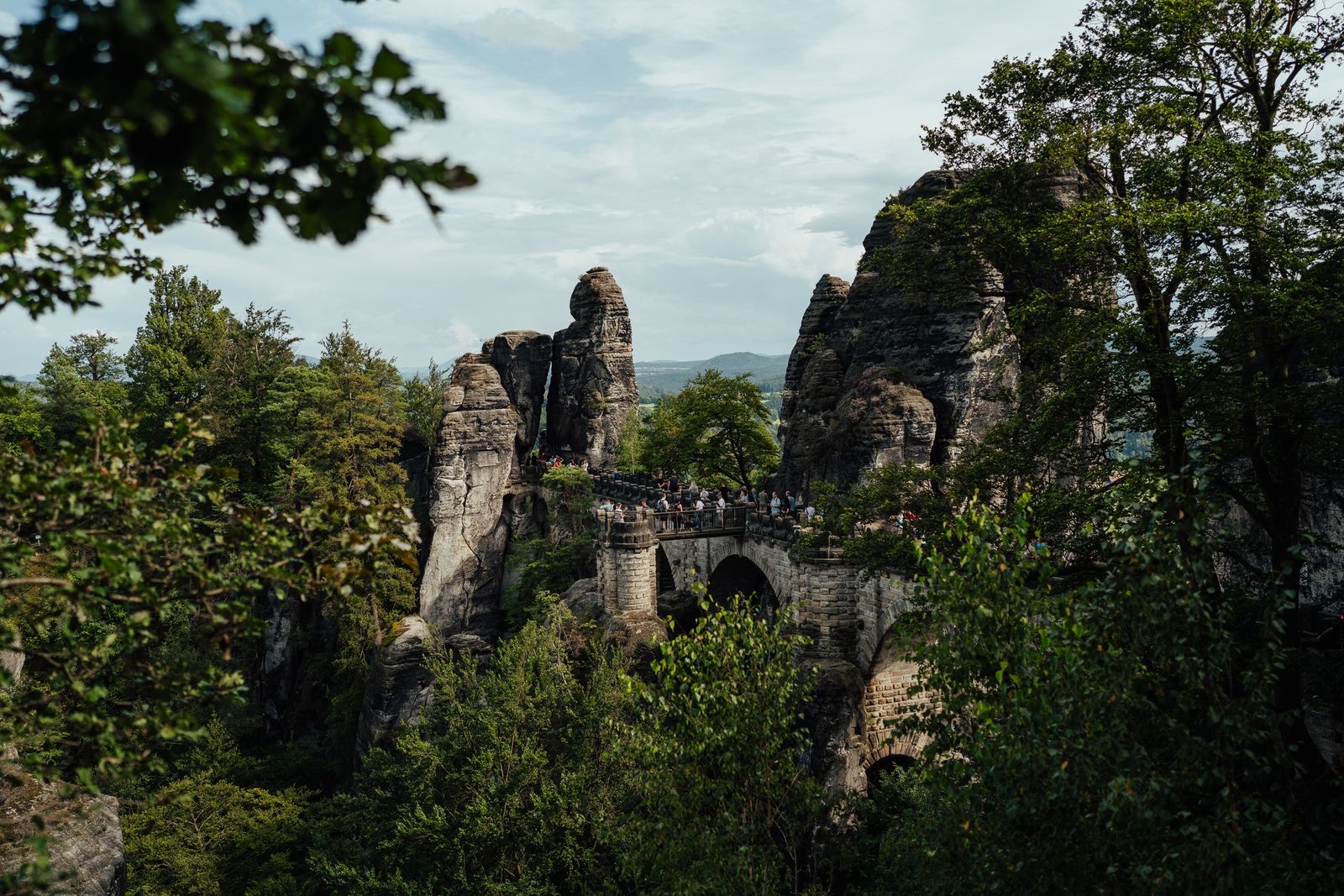
The formations rise from the forest floor like the ruins of a civilisation that built only in columns.
That evening we walked Kreuzberg as the light dropped. The canal path filled with people who seemed to have nowhere particular to be and no urgency about getting there — a woman reading on a blanket, two men playing backgammon on an upturned crate, a group sharing Spätis beer on the bridge railing. A Döner from a stand on Oranienstrasse that had been operating, according to the faded awning, since 1983. We ate it standing up, tahini dripping onto the pavement, and watched the U-Bahn rattle across the overhead bridge every seven seconds. Berlin has a Döner stand from 1983 and a canal full of people with nowhere to be.
The next morning we took the regional train south to Saxon Switzerland, where the Elbe has spent a few million years carving a gorge through Cretaceous sandstone. The formations rise from the forest floor like the ruins of a civilisation that built only in columns. We hiked the Malerweg — the painters' path — through morning fog so dense the bridges appeared only when we were already on them. The trail passes through forest that smells of pine resin and wet earth, up stone staircases carved into the rock by hands we couldn't date, and along ridgelines where the sandstone has eroded into shapes that look deliberate but aren't. The Bastei lookout, when we reached it, offered a view that explained a century of German Romantic painting without requiring a single caption. Below, the Elbe moved slowly, the way it has been moving for a few million years, in no particular hurry to get to Dresden.
Thirty-six hours is not enough for either place. But there is something clarifying about the compression — Berlin's bakery at dawn, a gallery at noon, then the deep quiet of sandstone at dusk. Germany does this well: the distance between its cities and its wilderness is short enough to cross in a morning, and the contrast between them is sharp enough to make the crossing feel like a proper journey. The train back passed through towns whose names we did not catch, past fields where the last light turned the stubble gold, past a river so flat it held the sky like a second copy. We arrived at Hauptbahnhof with flour on our jacket and red dust on our boots, which felt like the right passport stamps for this particular crossing.