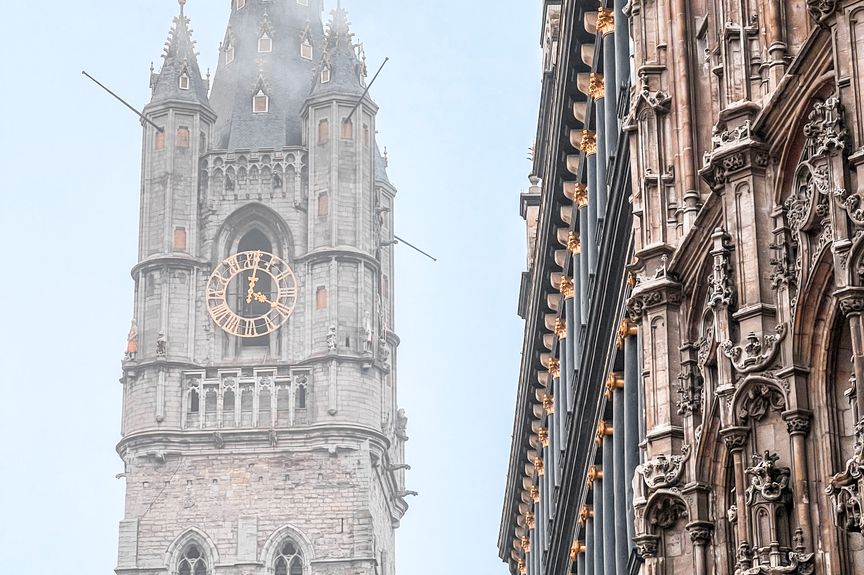
Ghent arrived by surprise. We had come for the altarpiece — the Van Eyck brothers’ Mystic Lamb, which every art-history class mentions and few students actually see — and found a city that was still working: students on the canals, a market in the square, a vegetarian day on Thursdays. The train from Brussels took twenty-eight minutes, barely enough to finish a waffle but long enough to feel as though you had changed countries.
The Ghent Altarpiece — the Adoration of the Mystic Lamb, by the Van Eyck brothers — is the reason the city exists on the art-history map, and it earns its place the way great paintings earn their place: by being impossible to look away from. The colours are six hundred years old and still wet-looking. The lamb’s expression is beatific and slightly unsettling. The donor portraits are so real they seem to breathe. We stood in front of it for thirty minutes and left with the sense that painting, as a medium, peaked in 1432 and has been politely declining ever since.
In Belgium, beer is not a drink but a position.
The Graslei, the row of guild houses along the Leie river, is best seen at dusk, when the facades light up and the reflections in the water double the effect. A boat passed slowly, a flat-bottomed vessel that has probably carried beer and grain along these canals for five centuries, and the driver waved without looking up from his phone. We ate waterzooi at a restaurant on the quay — a Flemish stew of chicken and cream and root vegetables that is exactly as comforting as it sounds and more complex than it looks.
Brussels, an hour south and a linguistic border away, is a city that operates on a frequency only Brussels understands. The Grand-Place is, without discussion, the most beautiful square in Europe, and the guildhalls that surround it — Baroque, gilded, rebuilt after the French bombardment of 1695 — are so ornate they make Versailles look restrained. A chocolate shop on the corner sold pralines that cost more per gram than the building they were sold in, and they were worth it, which is something we do not say about chocolate lightly.
In the Marolles, the working-class quarter below the Palais de Justice, the flea market at Place du Jeu de Balle is a daily exercise in organised chaos. Vintage Tintin posters next to brass doorknobs next to a taxidermied fox wearing spectacles. A man sold us two Art Nouveau handles for a door we do not own, and the logic of the purchase seemed, at the time, entirely sound. The bar across the street served guèze — the sour, spontaneously fermented beer that Brussels claims as its own — in glasses that looked like champagne flutes, because in Belgium, beer is not a drink but a position.
On the Thalys back to Paris, the Belgian fields slid past the window — flat, damp, and divided into plots that looked too small to farm and too green to leave alone. The pralines from the Grand-Place were in my bag. The Art Nouveau door handles from the flea market were in Marie’s. Neither purchase made any practical sense, which felt, by then, entirely Belgian.