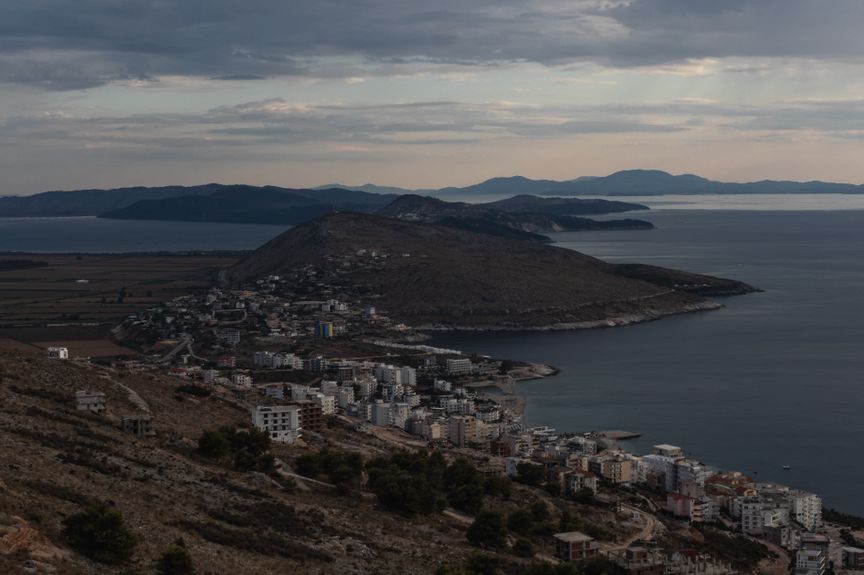
The Albanian Riviera starts where the road from Vlorë climbs into the cliffs and the Ionian opens up below — the same blue as the Greek islands forty nautical miles south, but emptier, wilder, and markedly cheaper. The concrete bunkers from the Hoxha era sit on the headlands, pockmarked and weedy, while the bays beneath them hold some of the cleanest water we have swum in anywhere in Europe. We drove south along a road carved into the rock with more ambition than engineering, and every turn revealed another cove that looked like someone had forgotten to put it on the map.
Himara is a town that has not yet decided whether it is a beach resort or a mountain village, and the result is both. The old town sits on a hill above the harbour, the houses crumbling with the specific beauty of things that are falling apart because no one has yet arrived with enough money or bad taste to save them. The beach below is a long crescent of pebble and sand, and the water is so clear that the fish are visible from the taverna terrace, which suggests either remarkable water quality or remarkably foolish fish.
The water is the same Ionian blue as the Greek islands, but emptier, wilder, and markedly cheaper.
Gjirokatër, an hour inland and a thousand years uphill, is a UNESCO city built of stone and slate where the Ottoman mansions rise from the hillside in tiers, each one a small fortress with a tower and a view. The castle above the town held, at various points, a garrison, a prison, and a collection of captured American spy equipment, which the guide described with the deadpan delivery of someone who has told this story many times and still finds it amusing. The city’s most famous son is Enver Hoxha, a fact the residents handle with the pragmatism of people who did not choose their history but are not going to pretend it did not happen.
Berat — the City of a Thousand Windows — is Gjirokatër’s rival for the title of Albania’s most beautiful town, and the rivalry is genuine. The Ottoman houses stacked on the hillside above the Osum River do, in fact, have a thousand windows, all of them facing the same way, and at sunset the reflection turns the river to copper and the town to something that belongs in a painting it has not yet sat for.
Albanian food is the cuisine of a country that was isolated for fifty years and emerged with its grandmother’s recipes intact. The byrek — a phyllo pie filled with cheese, spinach, or meat — is eaten for breakfast, lunch, and what appears to be every hour in between. The tavë kosi — lamb baked in yoghurt until the surface sets like a soufflé — is the national dish and deserves to be. In Berat, at a restaurant by the river, the owner brought a carafe of raki that he had distilled himself and warned us it was strong. The first glass proved the point. The second made us stop counting.
We swam at Gjipe Beach, reached by a thirty-minute walk down a canyon that drops to a cove where the cliffs meet the water and the sand is private not by design but by difficulty of access. There was no bar. There was no sunbed. There was the Ionian Sea at the temperature of a bath and the cliff walls rising on either side like a theatre designed by geology for an audience of four.
On the last morning, in Sarandë, we watched a fisherman pull his boat onto the beach and lay out his catch on a plastic sheet. Bream, bass, a couple of octopus. A woman from the apartment block behind the beach walked down in her slippers and bought the octopus without negotiating. The fisherman folded the sheet, carried the boat up the sand, and went home. The whole exchange took three minutes and nobody involved seemed to think it was worth photographing.